
Getting a research paper published takes a sequence of steps and is more than uploading a file and paying. You begin by selecting a fitting journal and shaping the manuscript to its requirements, then submit it accurately, go through editorial screening and peer review, and finish the post-acceptance and production tasks before the article is actually online. Planning for each stage early saves effort and avoids delays that could have been prevented.
What Does Publishing a Research Paper Involve?
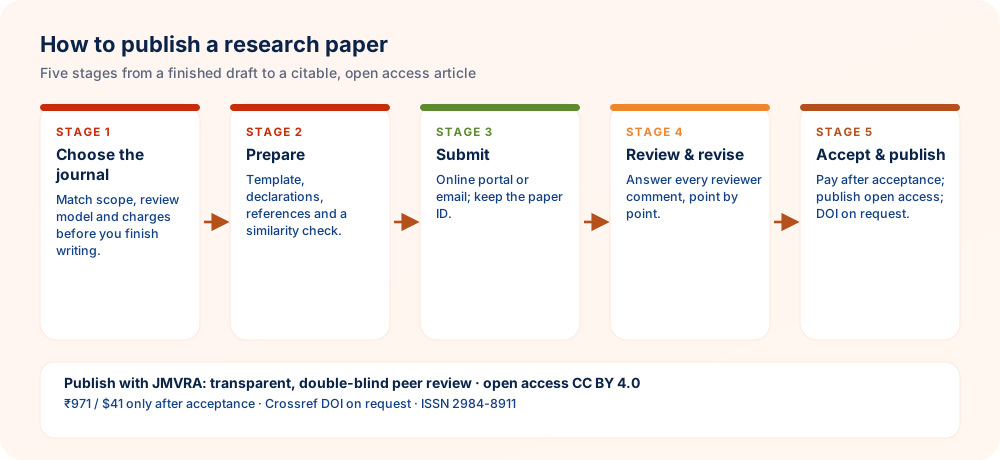
To publish is to release your research via a journal's editorial process, in which the manuscript is judged under that journal's own review procedures before turning into a lasting, citable record. Most credible journals follow broadly the same outline, even though specific steps, terminology and timelines vary:
Start by reading the instructions of the journal you are targeting, as general advice, this guide included, can never replace that journal's current requirements.
Step 1: Select a Suitable Journal
Few choices in the whole process matter more than which journal you pick. Authors often complete the manuscript first and only then choose a journal, going purely by a cheap fee or a quick advertised turnaround. Matching the paper to a journal early shapes its structure, tone and length.
Check the fit
- Is research from your field, in your article type, really published by the journal?
- Do recent issues contain papers like yours?
- Does the journal's target readership fit your work?
Look at the model and the cost
- Whether publishing is open access, subscription, hybrid or institutional
- The article processing charge, and whether taxes, a DOI, a certificate or printed copies come included or cost extra
- The point at which payment is taken in relation to the review result
A modest fee does not in itself signal a problem, and an expensive one does not prove quality; the Low-Cost Journal Publication section below covers what really counts.
Check transparency
- A named publisher and editorial board whose affiliations can be verified
- A peer-review policy that is described clearly
- Policies on publication ethics, copyright or licensing, and archiving
- A real archive of earlier issues that you can browse
Step 2: Get Your Manuscript Ready
Go through the journal's present author instructions prior to formatting, because one paper frequently has to be laid out differently for different journals. As a minimum, verify word or page limits, abstract length, citation style, figure and table rules, reference style and permitted file types.
- Title: name the real subject in words that researchers in your area would recognise, and steer clear of a dramatic title that claims more than the paper delivers.
- Abstract: sum up what was actually done, covering the problem, method, main result and conclusion, instead of repeating the introduction.
- Keywords: select words that lead readers to the paper and avoid popular but unrelated search terms.
- Authorship: agree the final list of authors, their order and affiliations with all co-authors ahead of submission.
- Ethics: review similarity or plagiarism, rules on duplicate submission, conflicts of interest and any ethics or funding declarations that are needed.
Step 3: Send In the Paper
Prior to opening the submission form, put together a compact "submission pack" holding the final manuscript, title, abstract, keywords, author details, affiliations, the corresponding author's email and phone, address and any necessary declarations. Then check it against the manuscript to find metadata mismatches before they get to the editorial office.
JMVRA's present online form is divided into four stages, Paper Authors Address Final Review, and once a submission succeeds it provides a Registration ID and Private Key. The complete walkthrough is in How to Submit a Research Paper to JMVRA.
Step 4: Peer Review and Screening
A status of "Submitted" does not mean reviewers already have the manuscript. Usually the journal first carries out editorial screening of scope, formatting, similarity or plagiarism and completeness, and it may send a paper back at that point before external review begins.
Peer review generally looks at originality, methodology, technical soundness, clarity and relevance, under a model the journal ought to explain openly: single-blind, double-blind, open or transparent. Journals really do differ in the model they use, so do not assume they match. JMVRA operates double-blind, transparent peer review backed by a panel of 3,000+ reviewers, and passes on anonymised reviewer comments with the decision.
Step 5: Answer the Revision Requests
Being asked to revise is different from being rejected. Read all the comments and build a simple response table pairing each comment with the change you made:
| Reviewer Comment | Your Response | Change Made |
|---|---|---|
| Clarify methodology | Added explanation | Section 3 |
| Update reference | Added current source | Reference 18 |
| Explain result | Expanded discussion | Section 5 |
Should you disagree with a particular comment, give your scholarly reasons clearly and politely instead of passing over it.
Step 6: Make Sense of the Editorial Decision
The journal's decision can be to accept the manuscript, ask for minor or major revision, or reject it. A rejection does not necessarily show that the research has no value; typical causes are mismatched scope, too little novelty, methodological worries, poor presentation or high similarity. Use the feedback to strengthen the paper before sending it elsewhere, and where it is prohibited, never submit one manuscript to several journals simultaneously.
Step 7: Tasks After Acceptance
Being accepted marks a milestone rather than the end. Before production starts, most journals still ask for a publishing agreement, the final manuscript, identity verification, payment and last corrections. At JMVRA this at present means sending the signed undertaking form, the final formatted manuscript, the corresponding author's identity proof and proof of payment together, with the Registration ID in the subject line; see What to Do After Payment, Before Publication.
Step 8: Publication and Record-Keeping
Once the article is live, compare its title, authors, affiliation, abstract, keywords and DOI (if there is one) with your records. Report any error to the editorial office and never edit an official certificate or record on your own. Keep an orderly folder containing the published PDF, certificate, confirmation letter, DOI, Paper ID and issue information. See How to Download Your Certificate and Published Paper and How to Find Your Published Paper.
Step 9: Make the Paper Easier to Find
- Keep the permanent article URL and the DOI if one was assigned
- Put the paper on your ORCID profile and write your author name the same way in every paper
- Circulate it using genuine academic channels and suitable repositories
- Look at Google Scholar and other discovery systems from time to time, and keep an eye on citations
Do not purchase citations or take part in artificial citation schemes; a DOI and complete metadata make a paper easier to find, yet nothing can ensure a given citation count.
Low-Cost Journal Publication: Points to Verify
"Low cost journal" is a search phrase typed by people ready to act, especially Indian authors, but price should never be the sole selection criterion. A journal with a modest fee may be fully legitimate when it keeps costs low through digital-first publishing, efficient workflows or institutional infrastructure; the real question is not "is it cheap?" but "is it transparent, suitable and credible for my requirement?"
A complete 10-point verification checklist is kept in UGC CARE and Low-Cost Journals in India: What Authors Should Check Before Submitting; it covers editorial ownership, peer-review disclosure, ethics policy, DOI verification, a complete fee breakdown, copyright or licensing and institutional acceptance. Apply it to any journal you are assessing, JMVRA included.
Steering Clear of Predatory or Misleading Claims
Treat with caution any journal promising guaranteed acceptance, guaranteed Scopus or Web of Science indexing, immediate publication whatever the review, guaranteed citations, or an unexplained "impact factor." Check indexing and identifier claims at the original source and do not trust a logo: the official ISSN record, the Scopus/Elsevier or Web of Science/Clarivate coverage lists, the DOAJ record and DOI resolution. Cloned & Fake Journal Alert lists the particular patterns to look out for.
How JMVRA Currently Handles Publication
The workflow at JMVRA has the same overall outline: Submit Screening Peer Review Decision Post-Acceptance Production & Publication Certificate. A detailed walkthrough for each page is found in our documentation and help-center pages:
- How to Submit a Research Paper to JMVRA
- What to Do After Paper Submission
- What to Do After Payment, Before Publication
- What Happens After Your Paper Is Published
- Full Documentation & Manuscript Guidelines
- Step-by-Step Tutorials
Mistakes to Avoid
- Choosing only by fee — a cheap fee on its own is not enough reason to pick a journal.
- Ignoring scope — even a technically strong paper may not suit the journal you chose.
- Entering author names incorrectly — fixing publication metadata later can be difficult.
- Uploading the wrong manuscript version — open the uploaded file again to be sure before you submit.
- Treating peer review as a formality — it is a real evaluation and no automatic pass.
- Paying before checking the current policy — first confirm the official fee as it stands and what it includes.
- Assuming a DOI means indexing — having a DOI is nothing like being in a selective index.
- Forgetting post-publication records — store the PDF, certificate, article URL and DOI the moment they become available.
Final Checklist
- Scope of the journal, type of article and present author guidelines reviewed
- Fee and its inclusions confirmed on the journal's up-to-date official page
- Peer-review policy and editorial board reviewed
- Title, abstract, keywords and references compared with the manuscript
- Names, order and affiliations of authors, plus the corresponding email, verified
- Right final file uploaded and previewed once submitted
- Registration or reference ID and any private tracking credential stored safely
- Each reviewer comment read in full and answered one by one
- Documents and payment after acceptance completed according to the current policy
- Published PDF, certificate, DOI and article URL downloaded and kept
At-a-Glance Checklist
- Journal verifiedISSN, review policy and charges checked at the source
- Manuscript completeTemplate, abstract, keywords, references and declarations
- Similarity checkedBelow 15% for JMVRA
- Authors agreedNames and order final — up to 5 covered by JMVRA’s fee
- Paper ID savedQuote it in every message
- Plan to shareShare the DOI link once published
Errors Made by First-Time Authors
| Mistake | Better approach |
|---|---|
| Selecting a journal once the writing is done | Decide early and write with it in mind |
| Ignoring the template | Apply the formatting from day one |
| Sending to multiple journals | One at a time |
| Using an agent | Go straight to the journal when submitting |
| Skimming over reviewer comments | Answer each point in turn |
Once Your Paper Is Published
- Review the published version — and flag errors promptly
- Ask for a DOI if you need one — Crossref DOI available at JMVRA on request
- Refresh ORCID and Google Scholar — adding the new paper
- Prepare the next paper — use the lessons you learned
Planning a Research Paper Publication from Draft to Print
Publishing goes more smoothly when you treat it as a project with stages. These planning habits help first-time and experienced authors reduce rework and stay calm during review.
- Shortlist journals before writing. Read recent issues of several candidate journals and compare their scope with your topic. Writing for a known audience is easier than reshaping a finished draft later.
- Follow the guidelines literally. Apply the stated word limits, reference style and file formats from the beginning. Formatting rejections are frustrating and almost entirely preventable.
- Seek a friendly pre-review. Ask a colleague outside your project to read the manuscript and summarise its message back to you. Any mismatch shows where the writing is unclear.
- Treat revision as a conversation. Thank reviewers, respond to every comment and explain politely where you disagree, using evidence. Constructive replies often lead to acceptance.
- Check publisher claims independently. Be careful with offers that promise certain acceptance or unusually low charges. Verify editors, policies and contact details before you pay or upload anything.
Choose the venue first, follow its rules exactly, welcome feedback and verify every claim a publisher makes before committing your manuscript.
Questions Researchers Often Ask
Your Paper's Journey at JMVRA, From Submission to Publication
- SubmissionPaper ID is issued
- ScreenScope & similarity
- ReviewDouble-blind
- DecideEmail & SMS
- ReworkEach point answered
- AcceptCopyright & fee
- ProduceYou can request a DOI
- PublishMonthly issue
How long review takes depends on the reviewers and on any revision required, so no set turnaround is promised; you are told of acceptance or rejection by email and WhatsApp.
Ready to Publish? Submit to JMVRA
JMVRA is aligned with UGC's Suggested Parameters for Choosing Peer-Reviewed Journals.
JMVRA is a Transparent, Peer-Reviewed, Open Access Journal (Refereed Journal). Following the discontinuation of the UGC and UGC-CARE journal listing, and in alignment with the latest UGC-CARE recommendations and guidelines, JMVRA is aligned with UGC’s Suggested Parameters for Choosing Peer-Reviewed Journals.
Where to go next on jmvra.org
Key Terms
Subjects and search phrases this article addresses.
Related Reading
Further reading on the same theme from the JMVRA blog.
After You Submit to JMVRA: Status, Review & Next Steps
Read the guide RelatedFixing Common JMVRA Submission Problems
Read the guide RelatedJATS XML: Why Article Markup Matters
Read the guide RelatedResponding to a Special Issue Call for Papers
Read the guide RelatedSelecting Keywords: A Guide
Read the guide RelatedFormatting a Manuscript for Submission
Read the guide From the blogResearch Paper Publication in India — A Complete Guide for Scholars & Faculty
Read the article From the blogFrom Manuscript to DOI: How Long Publishing Takes
Read the article From the blogChoosing a Journal: A 7-Step Scoring Framework
Read the articleKeep Reading on the JMVRA Blog
Find this guide on the JMVRA journal blog, a collection of practical guidance on publishing, indexing, metrics and research integrity that favours verifiable content over promotion.