
Authors rarely come across JATS XML directly, and that is intentional: it is infrastructure that operates in the background, not something you are meant to handle. Still, knowing what it is helps explain why articles from some journals are indexed, archived and discovered more dependably than others.
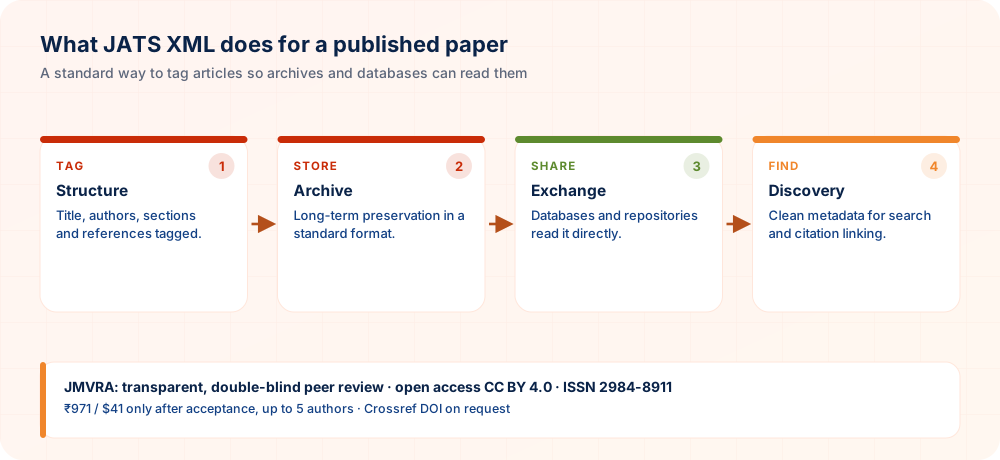
JATS Explained Simply
The Journal Article Tag Suite (JATS) is an XML format that describes scientific and scholarly articles in a structured form that machines can read. An article need not exist only as a PDF or Word file, formats made for human readers; JATS encodes the title, authors, abstract, references, figures, tables and full text in a standardised structure that software can parse, index and archive dependably.
Who Looks After the Standard
The National Information Standards Organization (NISO) maintains JATS, which is approved as an American National Standard. It has been in active use since 2003 and has become the de facto standard that many publishers, archives and indexing bodies depend on to exchange article content and metadata consistently between systems.
The Three JATS Article Models
| Model | Purpose |
|---|---|
| Journal Archiving and Interchange | The most permissive model, built for long-term archives that take in content from many different sources |
| Journal Publishing | Moderately prescriptive, and the model most publishers really use for their production XML |
| Article Authoring | The most prescriptive model, intended for tools used while a manuscript is being written |
Why It Affects How Easily Your Paper Is Found
Indexing databases, archives and aggregators rely on structured, consistent metadata to catalogue an article properly: who wrote it, when, in which journal and with which references. A well-formed JATS record makes this far more dependable than extracting the same details from a plain PDF, where inconsistent formatting can lead to a paper being miscatalogued, overlooked by crawlers or wrongly linked to the works that cite it. Complete, clean metadata at submission gives the process the best start.
What This Means for You as an Author
Authors do not write JATS XML themselves. You submit an ordinary manuscript, usually in Word or PDF, and after acceptance the journal turns the formatted article into structured XML as part of production. For you the practical point is that a journal with a well-implemented JATS production pipeline is more likely to have your paper indexed correctly and completely on the platforms that count — CrossRef, archives and search engines — than a journal that depends only on a static PDF with no structured metadata behind it.
At-a-Glance Checklist
- Clean manuscriptClear headings and references
- Metadata completeNames, affiliations, ORCID
- References formattedConsistently
- Figures captionedWith alt text
- Final proof checkedBefore publication
What JATS Looks Like in Practice
JATS marks each part of an article with descriptive tags so that machines know what each piece of text is. Here is a simplified fragment of the front matter:
<article-title>Title of the article</article-title>
<contrib contrib-type="author"><name><surname>Author</surname><given-names>A. A.</given-names></name></contrib>
<article-id pub-id-type="doi">10.xxxx/xxxxx</article-id>
Since the title, authors and DOI are explicitly labelled, archives, indexes and repositories can read them dependably and show them correctly.
Who Uses JATS
Archives
PubMed Central and other repositories take in content as JATS, or convert it to JATS, for long-term preservation.
Publishers
Many publishers create JATS XML next to their PDF and HTML versions.
Indexes and tools
Text-mining tools and discovery services depend on a consistent structure.
Authors (indirectly)
Accurate metadata in your submission turns into accurate tags in the published record.
Preparing a Manuscript That Converts Cleanly to JATS
Structured markup is produced by the publisher, but the quality of your source file decides how smoothly it happens. These habits help authors supply manuscripts that convert into clean, machine-readable article files.
- Use real heading styles. Apply your word processor's built-in heading styles rather than bold text of a larger size. Conversion tools read the styles to build the section structure of the article.
- Keep references in one format. Follow a single citation style throughout and avoid manual numbering. Consistent references convert into properly tagged entries, which helps links to cited works resolve correctly.
- Insert tables as tables. Build tables with the table tool and never paste them as pictures. Real tables can be tagged cell by cell, while images hide the data from readers and software.
- Give every figure a caption. Write a clear caption and a short text description for each figure and cite it in the body. Captions become structured elements that support accessibility and discovery.
- Spell out author details fully. Provide full names, affiliations and a corresponding email in a consistent order. Accurate metadata at the start prevents misattributed records that are hard to correct afterwards.
A tidy, consistently styled source document costs little effort and lets the publisher produce accurate structured files without guessing your intentions.
Questions Researchers Often Ask
The Parts of a Research Paper
Usual proportions for an empirical paper — guidance rather than a fixed rule.
- BackgroundDescribe the gap briefly, in 1–2 sentences.
- ObjectiveGive the question or hypothesis behind the work.
- MethodsApproach: design, data and tools employed.
- ResultsThe central findings, together with the numbers.
- In SummaryWhat it means.
- Key Terms4–6 searchable terms.
Leave the abstract for the end; roughly 150–250 words is enough to include all five parts. The full rules are set out in JMVRA Publication Guidelines.
Ready to Publish? Submit to JMVRA
JMVRA is aligned with UGC's Suggested Parameters for Choosing Peer-Reviewed Journals.
JMVRA is a Transparent, Peer-Reviewed, Open Access Journal (Refereed Journal). Following the discontinuation of the UGC and UGC-CARE journal listing, and in alignment with the latest UGC-CARE recommendations and guidelines, JMVRA is aligned with UGC’s Suggested Parameters for Choosing Peer-Reviewed Journals.
Further reading on jmvra.org
Key Terms
Subjects and search phrases this article addresses.
Related Reading
Further reading on the same theme from the JMVRA blog.
Keyword Selection Guide
Read the guide RelatedUsing JMVRA RMS Points Toward Publication
Read the guide RelatedJMVRA Call for Papers – ISSN 2984-8911
Read the guide RelatedYour Paper Is Published in JMVRA: What Comes Next
Read the guide RelatedJournal Fees Decoded: APC, Taxes & Add-Ons
Read the guide RelatedA Guide to Writing Your Research Paper
Read the guideKeep Reading on the JMVRA Blog
This article sits on the JMVRA journal blog, where practical guidance covering publishing, indexing, metrics and research integrity is written to be verifiable, not promotional.