
The phrase “research paper journal” spans everything from a society journal a century old to an open-access title launched last year. Before choosing where to publish, it pays to understand which kinds of journals exist, how they are funded, and which article types they take. That vocabulary makes every other decision — indexing, fees, speed — much easier to evaluate.
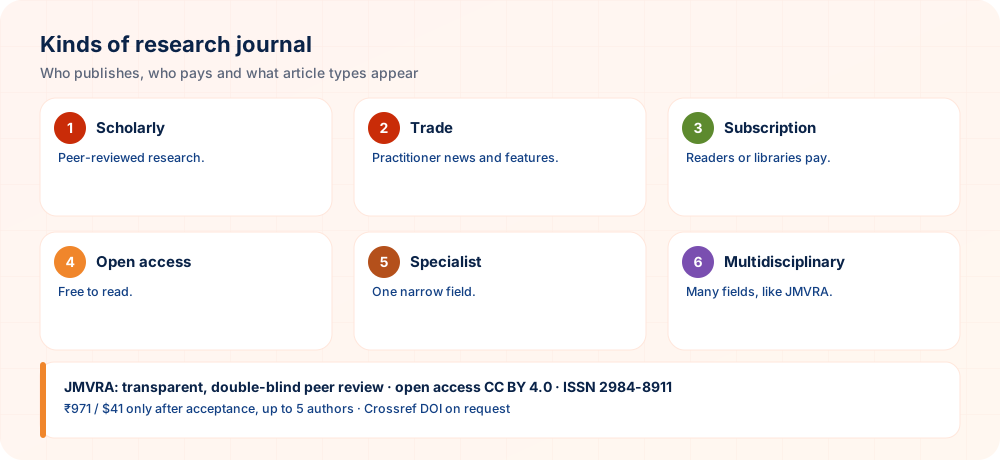
Kinds of Journals
Scholarly (peer-reviewed)
Presents original research that independent experts evaluate before it is accepted. This is the usual meaning of “journal publication” for academic credit.
Trade and professional
Industry news, practice pieces and opinion — helpful, but typically not peer reviewed.
Specialist
Concentrates on a narrow field, for example power electronics or clinical psychology, with specialist readers and reviewers.
Multidisciplinary
Takes work from many fields; well suited to applied and cross-disciplinary research.
How Journals Get Funded
| Model | Who pays | Who can read |
|---|---|---|
| Subscription | Libraries and readers | Subscribers only |
| Gold open access | Authors or funders (article processing charge) | Everyone, free |
| Diamond open access | A sponsor, society or institution | Everyone, free — no author fee |
| Hybrid | Subscription, plus optional author fee to open one article | Subscribers, or everyone for opened articles |
Types of Article Found in Journals
| Type | Purpose | Typical length |
|---|---|---|
| Original research article | New findings from your own study | 4,000–8,000 words |
| Review article | Synthesises published research on a topic | 6,000–10,000 words |
| Short communication | A brief, important result | 1,500–3,000 words |
| Case study | A detailed account of one case, site or project | 2,000–5,000 words |
| Technical note | A method, tool or design detail | 1,500–3,000 words |
Volumes, Issues and Publication Frequency
Journals appear in volumes (typically one a year) split into issues — monthly, bi-monthly, quarterly or continuous. Some journals put each article online as soon as it is ready (“continuous publication”) and compile issues afterwards. Frequency determines when your paper appears, not the quality of the journal.
Identifiers You Will Encounter
- ISSN — marks the journal itself, with separate ISSNs for print and online editions.
- DOI — a permanent identifier for every single article.
- ORCID — marks you as the author throughout all of your publications.
- Volume/issue/pages — where the article sits within the journal’s record.
Which Type Suits Your Paper?
- Begin with your requirement. A PhD, promotion or grant often calls for peer-reviewed or indexed journals.
- Fit the article type. Review articles belong in journals that accept reviews.
- Think about readers. Experts read specialist journals, whereas multidisciplinary ones attract a wider audience.
- Look at the funding model. Find out whether an APC is payable and at what stage.
Parts of a Journal Article Page
Professionally managed journals dedicate a separate page to each article. The following features signal quality, and they make your paper easier to discover and cite:
- Complete title, every author and their affiliations
- Abstract and keywords
- Journal title, volume, issue, page range or article number, and publication date
- DOI displayed as a https://doi.org/ link
- A licence statement, such as CC BY 4.0
- Dates of receipt, revision and acceptance
- A link to download the full text
- A “how to cite” statement
The 10 Most-Searched Questions on This Topic
Here are the ten questions researchers search for most on this subject, each with a direct answer.
research paper journals
Peer-reviewed research articles, reviews and similar article types are published in scholarly journals.
types of journals in research
Journals may be scholarly, trade, specialist or multidisciplinary, and may be funded through subscriptions, open access or hybrid arrangements.
what is a peer reviewed journal
Submissions are sent to independent experts for assessment before the journal decides whether to publish them.
open access vs subscription journal
Open access articles cost readers nothing, and the expense is typically met through an author fee; with subscription articles, readers or libraries pay.
diamond open access meaning
Open access that charges neither authors nor readers, with costs met by an institution or sponsor.
types of research articles
The most common types are original research, review articles, short communications, case studies and technical notes.
volume and issue meaning
A volume normally spans one year of a journal, while issues are its instalments, released monthly, quarterly or on another schedule.
multidisciplinary journal meaning
A journal covering research from numerous subject fields.
ISSN vs DOI
An ISSN identifies the journal as a whole, whereas a DOI identifies one individual article.
how to choose a research journal
Compare the journal with your needs, article type, target readers and budget, and then confirm its review and indexing claims.
How JMVRA Fits In
JMVRA is a Transparent, Peer-Reviewed, Open Access Journal (Refereed Journal). Following the discontinuation of the UGC and UGC-CARE journal listing, and in alignment with the latest UGC-CARE recommendations and guidelines, JMVRA is aligned with UGC’s Suggested Parameters for Choosing Peer-Reviewed Journals. UGC public notice (PDF)
Since June 2023, JMVRA has published monthly as a multidisciplinary, scholarly, peer-reviewed gold open-access journal that welcomes original research, reviews, short communications, case studies and technical notes.
- ISSN
- 2984-8911 (online) · publishing since June 2023
- Issues
- Monthly issues across many disciplines
- Review
- Two-way anonymous review by specialists
- Access
- Available as open access (CC BY 4.0)
- Fee
- ₹971 INR for Indian and $41 USD for foreign authors, due only after acceptance
- DOI
- Crossref — available as an optional extra
- Indexing
- Google Scholar only; not Scopus, Web of Science or DOAJ
- Impact factor
- 11.25, derived from Google Scholar data
Screening begins the moment a paper arrives and each decision is sent as soon as it is reached, yet JMVRA never promises a set number of days: actual review time depends on the reviewers and on how much revision the paper needs.
At-a-Glance Checklist
- Journal type identifiedScholarly or trade
- Access model identifiedSubscription or OA
- Article types reviewedResearch, review, short
- Identifiers locatedISSN and DOIs
- Suitability judgedFor your paper
A Quick Method for Reading Journal Articles
- Title and abstract — does it relate to your work?
- Figures and tables — what do the key results show?
- In Summary — what do the authors claim?
- Methods — are the claims believable?
- Introduction and discussion — background and limitations
Other Scholarly Outputs
Conference papers
Briefer papers, frequently with early findings.
Book chapters
In edited volumes.
Theses
Complete research projects, frequently held in repositories.
Datasets and software
Each can be cited through its own DOI.
Practical Tips for Understanding Different Journal Types
Journals differ in audience, funding model and the kinds of article they accept. Knowing these differences helps you place your work where readers who care about it will actually find it.
- Read the aims and scope carefully. Study the description of subjects and article types a journal welcomes, then compare it with your manuscript honestly. Mismatched scope is a common reason for quick rejection.
- Browse recent issues, not only the name. Skim the contents of several recent issues to see typical length, depth and tone. A journal's reputation in your memory may differ from what it publishes today.
- Match your article type to the venue. Decide whether your work is an original study, a review, a short communication or a case report, and confirm the journal accepts that format. Forcing a paper into the wrong type wastes everyone's time.
- Understand reuse and copyright terms. Read the licence and author rights before agreeing to publish, especially if you plan to share the paper in an institutional repository. Rules differ widely between journals.
- Beware of unsolicited invitations. Treat emails praising your work and promising rapid publication with caution. Verify the journal independently through trusted sources and speak to experienced colleagues before sending anything.
Choose a journal by reading what it truly publishes, confirming it accepts your article type, and verifying its credibility independently.
Questions Researchers Often Ask
Your Paper's Journey at JMVRA, From Submission to Publication
- UploadPaper ID issued
- ScreenScope & similarity
- ReviewDouble-blind
- DecideEmail & SMS
- ReviseRespond point by point
- AcceptCopyright & fee
- ProduceObtainable DOI, on request
- PublishMonthly issue
How long review takes depends on the reviewers and on any revision required, so no set turnaround is promised; you are told of acceptance or rejection by email and WhatsApp.
Ready to Publish? Submit to JMVRA
JMVRA is aligned with UGC's Suggested Parameters for Choosing Peer-Reviewed Journals.
JMVRA is a Transparent, Peer-Reviewed, Open Access Journal (Refereed Journal). Following the discontinuation of the UGC and UGC-CARE journal listing, and in alignment with the latest UGC-CARE recommendations and guidelines, JMVRA is aligned with UGC’s Suggested Parameters for Choosing Peer-Reviewed Journals.
Further reading on jmvra.org
Key Terms
Subjects and search phrases this article addresses.
Related Reading
Further reading on the same theme from the JMVRA blog.
Choosing a Journal: A 7-Step Scoring Framework
Read the guide RelatedBuild Your Own Reliable Journal Shortlist
Read the guide RelatedHow to Judge a Journal's Real Review Speed
Read the guide RelatedOpen Access, Peer Review, Impact Factor & UGC Parameters Norms — A Complete Guide
Read the guide RelatedDOI vs ISSN: Two Identifiers, Two Jobs
Read the guide RelatedORCID iD: The Researcher ID Everyone Needs
Read the guideKeep Reading on the JMVRA Blog
This article sits on the JMVRA journal blog, where practical guidance covering publishing, indexing, metrics and research integrity is written to be verifiable, not promotional.