
Perhaps you were recently asked for your "ORCID iD" next to your name and affiliation when you submitted to a journal — this explains what that field is for, and why it is turning into something close to a requirement across academic publishing. Setting it up once is quick and pays off every time you submit.
About the ORCID iD
The ORCID iD (Open Researcher and Contributor ID) costs nothing and is a unique 16-digit identifier; it links your name with everything you produce — papers, datasets, grants, peer reviews — across your entire career, whether you change your name or switch institutions.
Why a Name by Itself Cannot Identify You Reliably
Names make surprisingly poor unique identifiers in academic publishing: several researchers can share one name, an author's name can change over the years, and a single name may be written or transliterated in different ways across publications and databases. An ORCID iD clears up that ambiguity completely by attributing everything you produce to one unmistakable identity.
Who Really Asks for It
- Funders — many large grant funders now ask for ORCID iDs on applications
- Publishers and conferences — a growing number require, or strongly encourage, an ORCID iD when you submit or register a publication
- Your future self — a single identifier that stays with you for your whole career, sparing you repeated form-filling and linking your output correctly at every institution where you work
ORCID vs DOI: Person vs Publication
How to Set One Up
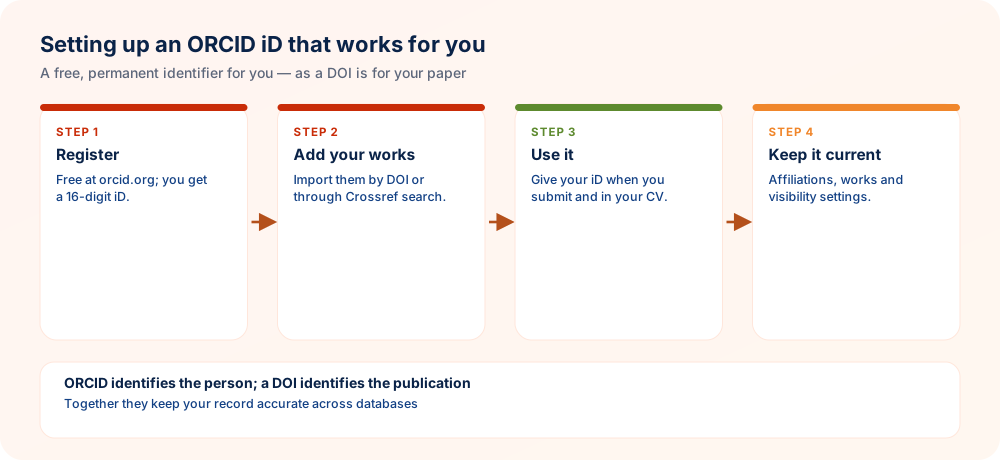
- Sign up free of charge at orcid.org using your name and email
- Enter your existing publications by hand, or link the record to Crossref so that new DOI-registered papers are added automatically
- Put your ORCID iD on each manuscript you submit from now on, next to your name and affiliation
- Treat it as your single lasting researcher identity, whatever institutional moves come later
At-a-Glance Checklist
- Just one iDAvoid creating duplicates
- Public worksChoose visibility so others can view them
- Add by DOIMetadata is cleaner than typed entries
- Use it everywhereSubmissions, CV, grant forms
Creating a Useful ORCID Profile
An ORCID iD is worth only as much as the record behind it. With a complete record, journals, funders and employers can check your work without retyping anything:
- Record your name variants — enter initials, transliterations and earlier names in the “Also known as” section
- Link your affiliations — present and previous institutions, with dates
- Pull in your works automatically — link Crossref and similar search-and-link tools so that DOIs appear in your profile on their own
- Choose visibility on purpose — public items let others confirm who you are; each item's visibility is under your control
- Quote the iD wherever you can — on manuscripts, grant forms, conference sign-ups and in your email signature
Common ORCID Mistakes
| Mistake | Fix |
|---|---|
| Making a second ORCID iD | Keep a single one; ORCID can help you deprecate a duplicate |
| An empty record | Add affiliations and works so that the iD truly identifies you |
| Entering works by hand, with errors | Import by DOI through Crossref search-and-link |
| Relying on a personal email alone | Register an institutional email and a personal one so you never lose access |
| Leaving the iD out when you contact the journal | Provide it at submission so it gets linked with your article metadata |
Continue with what to do after publication and DOI explained.
Keeping Your ORCID Record Complete and Trustworthy
Creating an identifier takes minutes, but its value depends on upkeep. These tips help researchers maintain a record that colleagues, funders and publishers can rely on.
- Use the same email everywhere. Add every institutional and personal address you have used, and verify them. This helps the system recognise you when a publisher or funder submits a record.
- Prefer imported over typed entries. Connect trusted sources so works are added automatically with their identifiers. Imported records contain fewer typing errors than entries made by hand.
- Set sensible visibility. Review who can see each item and make professional information public. A record that is hidden entirely cannot help readers or evaluators confirm your work.
- Remove duplicates promptly. Merge or delete repeated entries after changes of title or version. A tidy list presents a clearer picture of your contribution.
- Quote your identifier consistently. Include it in manuscripts, theses and slide decks in the same format. Consistent use makes it easy for others to link you with your outputs.
Review your profile whenever you publish or change institution, so your identifier always points to an accurate and current record.
Questions Researchers Often Ask
Your Paper's Journey at JMVRA, From Submission to Publication
- SubmitPaper ID given
- ScreenScope & similarity
- ReviewDouble-blind
- DecideEmail & SMS
- UpdateOne point at a time
- AcceptCopyright & fee
- ProduceRequest a DOI
- PublishMonthly issue
How long review takes depends on the reviewers and on any revision required, so no set turnaround is promised; you are told of acceptance or rejection by email and WhatsApp.
Ready to Publish? Submit to JMVRA
JMVRA is aligned with UGC's Suggested Parameters for Choosing Peer-Reviewed Journals.
JMVRA is a Transparent, Peer-Reviewed, Open Access Journal (Refereed Journal). Following the discontinuation of the UGC and UGC-CARE journal listing, and in alignment with the latest UGC-CARE recommendations and guidelines, JMVRA is aligned with UGC’s Suggested Parameters for Choosing Peer-Reviewed Journals.
Pages worth visiting on jmvra.org
Key Terms
Subjects and search phrases this article addresses.
Related Reading
Further reading on the same theme from the JMVRA blog.
Free Zenodo DOIs: Uses and Limits
Read the guide RelatedImproving Online Discovery of a Research Paper — DOI, Metadata, Google Scholar and OpenAlex
Read the guide RelatedChecklist: DOI Resolution and Metadata for Confirming a Journal DOI Works
Read the guide RelatedYour Published Paper and a Crossref DOI: Purpose, and How to Request One
Read the guide RelatedHow Journals Obtain Crossref DOIs
Read the guide RelatedPublishing an Academic Book: ISBN, DOIs & Process
Read the guide From the blogGoogle Scholar for Researchers: Profiles & Visibility
Read the article From the blogWhy a DOI Helps a Student's First Research Paper
Read the article From the blogStudent First Paper: Choosing a Visible, Safe Journal
Read the articleKeep Reading on the JMVRA Blog
As part of the JMVRA journal blog, this guide shares practical help on publishing, indexing, metrics and research integrity, and is written to be verifiable rather than promotional.