
Quick answer: Crossref DOIs reach a journal through Crossref membership: the member is given a DOI prefix and registers every article by depositing its metadata, which Crossref ties to a permanent landing page. No path to a Crossref DOI avoids membership, and that is how the system actually works, not a mere technicality.
What a DOI Is
A Digital Object Identifier (DOI) is a lasting, resolvable identifier given to one particular digital object, most often an individual journal article. Even years afterwards, clicking a DOI should still take you to the correct paper, however much the publisher's own website has changed. Keep the DOI link handy whenever you cite or share the work.
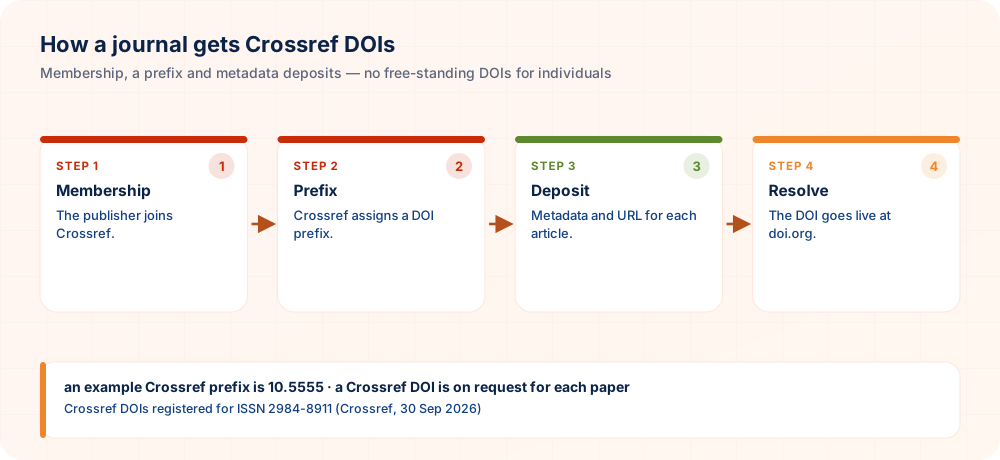
Membership & Prefix
Join Crossref
Membership leads to a DOI prefix; no individual Crossref DOI exists without it.
Receive a prefix
A distinct numeric prefix that marks your organisation as the registrant.
Register content
Each article's metadata is deposited, and Crossref then issues the suffix and activates the DOI.
Metadata & Landing Pages
Mistakes to Avoid
Zenodo registers its DOIs automatically via DataCite rather than Crossref. The DOI is genuine and functional; it simply comes from a different registration agency, backed by a different scholarly-citation ecosystem. Read our Crossref/Zenodo guide for details.
How JMVRA Handles Its Own DOI Process
Crossref DOI registration at JMVRA is an optional extra, charged on top of the base publication charge and apart from the article-publication fee itself. Check JMVRA's own DOI and hard copy charges page for the current process and fee, since prices may change and any figure quoted elsewhere should not be taken as up to date.
Submit Your Paper to JMVRA
Peer-reviewed and open access, with ISSN 2984-8911. A Crossref DOI can be added as a clearly disclosed extra.
Submit Paper Online Call for PapersCommon Search Terms
What Authors Should Ask About a Journal's Crossref DOIs
Authors cannot register a DOI for a journal article on their own, so the practical question is whether the journal handles registration properly. These points help you ask the right things.
- Ask who registers the identifier. Confirm that the journal or its publisher registers DOIs for its articles, rather than expecting you to arrange one separately. This avoids paying for something that will not link to your article.
- Test a sample DOI link. Pick a recent article from the journal, click its DOI and see whether it lands on the correct article page. A broken or mismatched link points to poor upkeep.
- Check the landing page details. The page reached through the identifier should show the title, authors, journal name and the full identifier itself. Missing details mean the metadata sent to the registry may be thin.
- Ask when the DOI becomes active. Registration normally follows final publication, so a link may not work immediately. Ask the editorial office about the usual wait so you do not cite a dead link in your applications.
- Cite the full DOI link form. Use the complete resolvable link in your reference lists and CV, copied directly from the published article, instead of retyping it from memory.
Ask the journal how it registers and maintains DOIs, then test a real example before you trust the answer.
What a Well-Built DOI Landing Page Displays
| Element | Why |
|---|---|
| Title, authors and abstract | Identifies the work |
| Full citation | Journal, volume, issue, pages |
| DOI displayed | For citation |
| Access to full text | PDF or HTML |
| Licence | Reuse rights |
Guidance for JMVRA Authors
- Ask for a Crossref DOI — once the paper is published
- Confirm it resolves — and lands on your article page
- Review the metadata — author names and title
- Put it to use — on your CV, ORCID and profiles
Questions Researchers Often Ask
What is a DOI?
A lasting identifier that can be resolved to one particular digital object, most often a journal article.
How can I obtain a Crossref DOI?
It comes through Crossref membership: a member is given a prefix and registers content by depositing its metadata.
What separates Crossref from Crossref?
Each is a DOI registration agency. Crossref concentrates on scholarly publications, while DataCite concentrates on research data and repositories.
Are a DOI and an ISSN the same thing?
No. An ISSN names an ongoing journal title, whereas a DOI points to a single article.
Why must a DOI lead to a working landing page?
A DOI works by resolving to a URL, so when that page is broken the DOI cannot do the one thing it exists for.
Is it possible to change a DOI once registered?
The identifier stays fixed for good, but its metadata, landing-page URL included, can and ought to be revised whenever details change.
Is a Crossref DOI offered by JMVRA?
Yes, as an openly stated extra that is separate from the base publication charge. Check JMVRA's own DOI charges page for the present fee.
May an author register a DOI with Crossref personally?
No. Crossref members, publishers for example, are the ones who register DOIs.
Which DOI prefix does JMVRA use?
JMVRA’s Crossref prefix is the fixed first part of every DOI the journal registers.
Key References
At-a-Glance Checklist
- Member verifiedPrefix owner in Crossref
- Metadata completeAuthors, abstract, references
- Landing pages stableOne per article
- DOIs testedAfter deposit
- Updates madeWhen URLs change
Anatomy of a JMVRA DOI
Resolver → prefix 10.5555 (an example Crossref prefix) → suffix: journal, volume 14, issue 9, article identifier. A format example: doi.org/10.5555/12345678
To check a JMVRA DOI yourself, use Crossref Search or the Crossref journal record.
Ready to Publish? Submit to JMVRA
JMVRA is aligned with UGC's Suggested Parameters for Choosing Peer-Reviewed Journals.
JMVRA is a Transparent, Peer-Reviewed, Open Access Journal (Refereed Journal). Following the discontinuation of the UGC and UGC-CARE journal listing, and in alignment with the latest UGC-CARE recommendations and guidelines, JMVRA is aligned with UGC’s Suggested Parameters for Choosing Peer-Reviewed Journals.
Further reading on jmvra.org
Key Terms
Subjects and search phrases this article addresses.
Related Reading
Further reading on the same theme from the JMVRA blog.
ORCID iD: The Researcher ID Everyone Needs
Read the guide RelatedImproving the Online Discoverability of Your Research Paper through DOI, Metadata, Google Scholar and OpenAlex
Read the guide RelatedHow to Test a Journal DOI: DOI Resolution and Metadata Checklist
Read the guide RelatedHow DOI, ISSN & Metadata Drive Citations
Read the guide RelatedPublishing an Academic Book: ISBN, DOIs & Process
Read the guide RelatedISBN, ISSN and DOI: Three Identifiers Compared
Read the guideKeep Reading on the JMVRA Blog
This article sits on the JMVRA journal blog, where practical guidance covering publishing, indexing, metrics and research integrity is written to be verifiable, not promotional.