
The short answer: go to JMVRA's published thesis page and search by title or author, try the website search, or run a Google site:jmvra.org query. Should a DOI have been registered for the thesis record, the DOI itself can also be used as the search term. Whichever route you pick, begin with the most distinctive words.
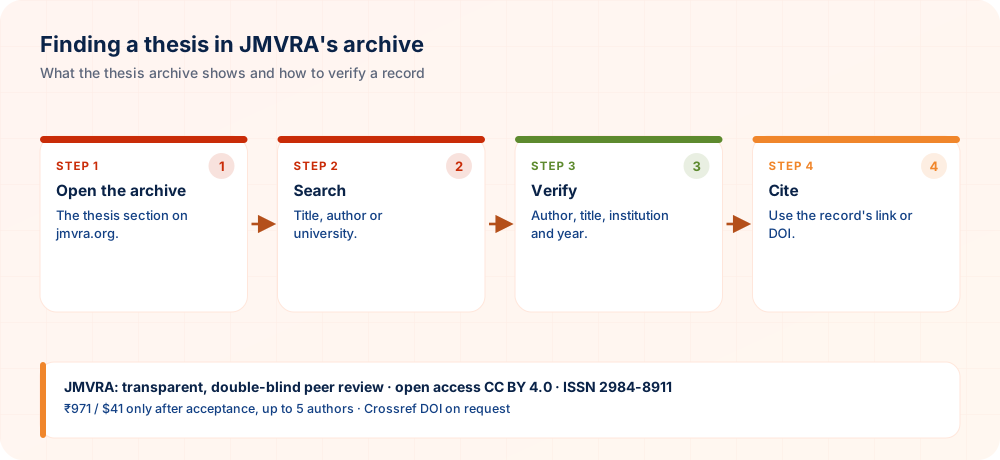
Contents of the Thesis Archive
On the present JMVRA thesis page, published theses are described as:
- Open access
- Peer reviewed
- Records of full-text articles
- Accompanied by abstract, keywords and citation details
- Paper/Registration IDs
- A DOI as an option, where it applies
A current count of archived theses is also shown on the page, but such counts keep changing, so a particular figure should never be treated as lasting, evergreen content.
Search Methods
- Go straight to the published thesis page
- Search by title
- Search by author
- Try the website search
- Search with Google:
site:jmvra.org "thesis title" - Search by DOI when one is given
Verification Checklist
- Title matches exactly
- Author matches
- The publication status is verified
- The journal and issue are identified
- Paper ID is present
- The DOI resolves properly, if there is one
- PDF is accessible
- The citation details are all present
At-a-Glance Checklist
- Exact title searchedOr the author name
- Record checkedDetails agree
- Link storedFor citing
- Citation formattedTo your required style
- Mistakes flaggedWith specifics
How to Cite a Thesis Published on JMVRA
When you have located a thesis in the archive, cite it as a published work and give enough detail that readers can trace it. A full reference usually includes the author, the year, the complete title, the kind of work, the institution that received it and the place where it is published. Keeping these elements consistent makes the reference easier to verify.
| Element | Sample arrangement (APA style) |
|---|---|
| Author | Surname, Initials. |
| Year | (Year). |
| Title | Thesis title written in sentence case |
| Type of work | [Doctoral thesis] or [Master’s dissertation] |
| Institution | Name of the awarding university |
| Where published | Journal of Modern and Versatile Research Approach (JMVRA), with the URL or DOI |
Follow whichever style your journal or university demands; our guide to citing journal articles sets out how APA, IEEE, Vancouver and Chicago differ.
Search Advice for a Hard-to-Find Thesis
- Use fewer words — two or three characteristic words from the title tend to work better than the whole title
- Try only the author’s surname — names are frequently written in different ways, such as with initials, middle names or transliterations
- Rely on the paper or registration ID — an ID is precise and sidesteps spelling trouble
- Add the site name to a web search — for instance, the title in quotation marks next to “jmvra.org”
- Look in national thesis repositories as well — in India, many doctoral theses are also placed in Shodhganga
Using Published Theses and Dissertations Responsibly in Your Own Work
A thesis is a long, detailed source that can guide your methods and literature search. These tips help students and supervisors use such records accurately and cite them correctly.
- Start with the reference list. A thesis bibliography is often a ready-made reading plan. Scan it for sources central to your topic, then retrieve those originals instead of relying only on the thesis summary.
- Confirm the degree and institution. Note the awarding university, department and level of the work before citing. These details tell your reader how much weight and what scope the study carries.
- Search with several keyword forms. Try synonyms, spelling variants and broader subject terms when a record is hard to find. Titles in theses can be longer and less direct than article titles.
- Distinguish findings from published articles. Some thesis chapters later appear as journal papers. If both exist, cite the peer-reviewed article for the result and the thesis only for extra detail.
- Respect the author's rights. Quote briefly, credit clearly and ask the author for permission before reusing figures or substantial passages in your own publication.
Use a thesis as a map to deeper sources, cite its level and institution precisely and credit the author for anything you reuse.
Questions Researchers Often Ask
The Parts of a Research Paper
Usual proportions for an empirical paper — guidance rather than a fixed rule.
- BackgroundExplain the gap in 1–2 sentences.
- ObjectiveWhat question or hypothesis is being tested.
- MethodsHow the study was designed, what data and which tools.
- ResultsPrincipal findings backed with figures.
- In SummaryWhat it means.
- Key Terms4–6 searchable terms.
Write the abstract last; at about 150–250 words it should hold all five parts. The complete rules are in JMVRA Publication Guidelines.
Ready to Publish? Submit to JMVRA
JMVRA is aligned with UGC's Suggested Parameters for Choosing Peer-Reviewed Journals.
JMVRA is a Transparent, Peer-Reviewed, Open Access Journal (Refereed Journal). Following the discontinuation of the UGC and UGC-CARE journal listing, and in alignment with the latest UGC-CARE recommendations and guidelines, JMVRA is aligned with UGC’s Suggested Parameters for Choosing Peer-Reviewed Journals.
Where to go next on jmvra.org
Key Terms
Subjects and search phrases this article addresses.
Related Reading
Further reading on the same theme from the JMVRA blog.
SEO for Journals Without Tricks
Read the guide RelatedFAQ
Read the guide RelatedLaunching a Journal: 50 Items to Finish Before Issue 1
Read the guide RelatedWhat a Journal Management System Does
Read the guide RelatedOpenRGATE (orwave.org): Open Repository & Discovery
Read the guide RelatedResearch Areas
Read the guideKeep Reading on the JMVRA Blog
Find this guide on the JMVRA journal blog, a collection of practical guidance on publishing, indexing, metrics and research integrity that favours verifiable content over promotion.