
Fifty Items Across Eleven Categories
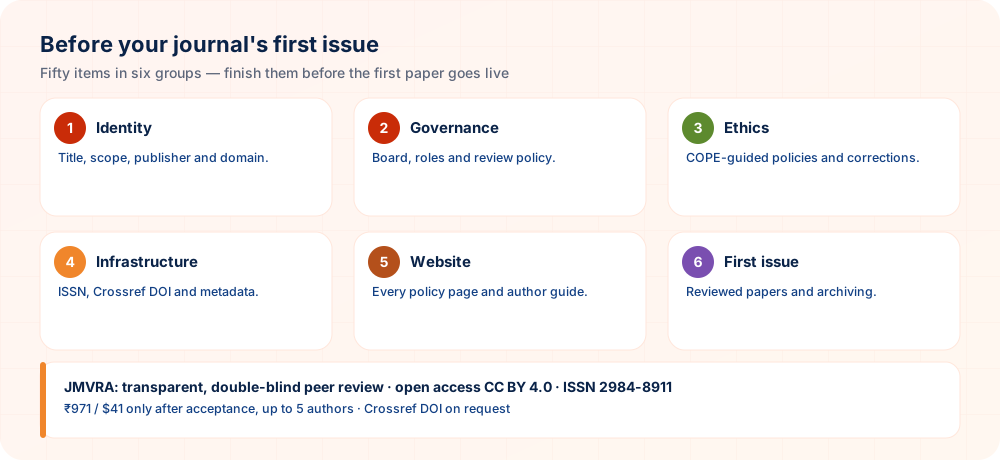
Launching a journal responsibly means covering eleven areas: identity, editorial governance, peer-review policy, publication ethics, the website, ISSN registration, DOI infrastructure, metadata standards, archiving and preservation, the practicalities of the first issue, and preparedness for later indexing review. A journal can technically publish with any of these missing, but the gap stays visible, and authors, directories and evaluators will sooner or later spot it. Keeping a dated record of each completed item makes later reviews far easier.
Identity
Editorial Governance and Peer-Review Policy
Publication Ethics
Website
ISSN & DOI Infrastructure
Metadata & Archiving
Readiness for the First Issue and Indexing
Selective indexes assess a proven publishing history, not a plan on paper. Applying to Scopus or Web of Science before a journal has built a steady record wastes the application and may mark the journal as too early. Time spent building a consistent record first is rarely wasted.
Launch Preparation Habits for New Journal Founders
A long launch checklist is easier to complete when the team works in a sensible order and keeps evidence of each decision. These practical habits help founders avoid rework and credibility problems.
- Assign one owner per task. Give every checklist item a named person and a target week. Shared responsibility often means nobody acts, and clear ownership makes progress visible at each team meeting.
- Write policies before building pages. Finalise scope, review model, ethics and copyright wording in a shared document first. Designers can then place real text on the website instead of filler that later needs rewriting.
- Recruit a few real reviewers early. Invite experienced reviewers before the first call goes out, and confirm that they are willing and available. A responsive pool prevents the slow start that frustrates early authors.
- Test the whole submission journey. Submit a dummy manuscript yourselves, move it through review and download the final files. Testing exposes broken emails, confusing forms and missing metadata before real authors encounter them.
- Keep an archive of decisions. Record why you chose a name, a licence or a policy and who approved it. Future editors will rely on these notes when questions arise from authors or institutions.
Order the work sensibly, assign owners, test everything as an author would, and document each decision so the journal starts on firm ground.
Ten Priorities If Time Is Short
- Fix scope and title — with clarity and uniqueness
- Build a genuine editorial board — with consent in writing
- Draft the peer review policy — then stick to it
- Release ethics, fee and licence policies — ahead of the first call
- Secure the ISSN — matching the right medium
- Create durable article pages — carrying citation metadata
- Organise DOI registration — via Crossref membership
- Organise preservation — with an archiving service
- Release a first issue punctually — favour quality over volume
- Retain records — for applications to indexes later on
Launch Errors That Are Difficult to Reverse
Misleading claims
Claiming indexing or metrics that do not yet exist.
A copied name
Being mistaken for a well-known journal.
Unstable URLs
Causes citation and indexing problems down the line.
Unreal board
Listing people without their consent.
FAQs on Launching a New Journal
How much time does it take to start a new academic journal?
There is no set timeline. Properly forming an editorial board, writing policies, getting an ISSN and gathering good manuscripts normally takes months rather than weeks.
Must I have an ISSN before releasing the first issue?
It is strongly advised, since the ISSN is what marks a journal as a recognised continuing serial, and most later steps assume that one exists.
Is it possible for a newly started journal to seek Scopus or Web of Science coverage right away?
No. Selective indexes first expect an established publishing history and proven regularity.
Does the law require a peer-review policy before a journal launches?
In most places it is not a legal requirement, yet a documented and transparent policy is a basic expectation for credibility.
Which item on this checklist gets skipped most often?
A written, public policy on ethics and on corrections and retractions is often absent from new journal websites.
Should the editorial board be settled before the website goes live, or afterwards?
Before. Going public while the board is still being formed leaves an inconsistent public record.
Is DOI registration needed for the first issue?
It is not strictly needed in order to publish, but preparing the infrastructure early spares you from registering retroactively.
What counts as "regular publication" when judging readiness for indexing?
A steady, predictable schedule kept up over a meaningful stretch of time, rather than one issue followed by silence.
Is JMVRA able to help with any of these steps?
This checklist is for education and fits any new journal. Check current, verified services directly instead of presuming that a feature exists.
What are the consequences of skipping archiving and preservation?
If the site ever goes offline, published articles may become permanently unreachable, which weakens the promise of DOI persistence.
What is the first thing a new journal should do?
Decide on its scope, recruit a genuine editorial board and make its policies public.
Is it acceptable for a new journal to say it will be Scopus-indexed?
No. It may describe its plans, but any indexing claim has to match its actual status.
Related Searches
Check It at the Source
Already Publishing? Find Where Your Paper Belongs
Rather than launching a journal, if you hold a finished manuscript, look over JMVRA's current scope and submit it online.
Submit Paper OnlineAt-a-Glance Checklist
- Title verifiedDistinct and correct
- Board agreedNames and affiliations confirmed
- Policies publishedReview, ethics, fees, OA
- DOIs preparedCrossref membership arranged
- Archiving arrangedAhead of the first issue
Your Paper's Journey at JMVRA, From Submission to Publication
- Send paperPaper ID provided
- ScreenScope & similarity
- ReviewDouble-blind
- DecideEmail & SMS
- ReviseAddressing each comment
- AcceptCopyright & fee
- ProduceDOI offered upon request
- PublishMonthly issue
How long review takes depends on the reviewers and on any revision required, so no set turnaround is promised; you are told of acceptance or rejection by email and WhatsApp.
Ready to Publish? Submit to JMVRA
JMVRA is aligned with UGC's Suggested Parameters for Choosing Peer-Reviewed Journals.
JMVRA is a Transparent, Peer-Reviewed, Open Access Journal (Refereed Journal). Following the discontinuation of the UGC and UGC-CARE journal listing, and in alignment with the latest UGC-CARE recommendations and guidelines, JMVRA is aligned with UGC’s Suggested Parameters for Choosing Peer-Reviewed Journals.
Related pages on jmvra.org
Key Terms
Subjects and search phrases this article addresses.
Related Reading
Further reading on the same theme from the JMVRA blog.
Drafting a Peer Review Policy for a New Journal
Read the guide RelatedAll Policy
Read the guide RelatedHelp Center
Read the guide RelatedOpenRGATE (orwave.org): Open Repository & Discovery
Read the guide RelatedAssembling an Editorial Board for a New Journal
Read the guide RelatedTransparent Peer Review: How the System, Certification and Steps Work
Read the guideKeep Reading on the JMVRA Blog
Published on the JMVRA journal blog, this guide gives practical direction on publishing, indexing, metrics and research integrity, with a focus on what can be verified instead of on promotion.