
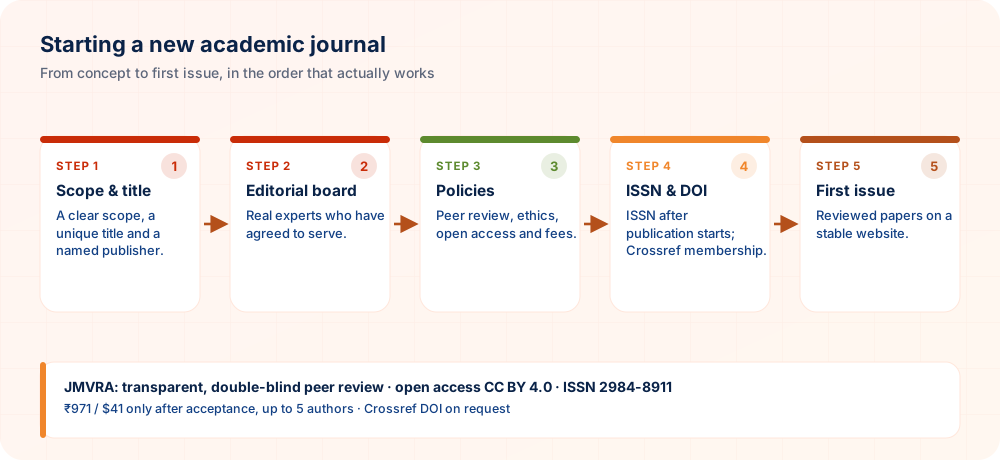
Quick answer: Launching a journal involves, in sequence: deciding on scope and readership, setting up a genuine publisher identity and editorial board, publishing peer-review and ethics policies, getting an ISSN, arranging article identifiers (DOI), creating a proper website, and releasing a real first issue — after which comes a long, unglamorous stretch of steady publication before selective indexing is a realistic goal. Planning that whole sequence in writing at the start saves effort later.
Groundwork: Scope, Title & Publisher Identity
Choose subject & scope
Narrow enough to draw suitable submissions, yet wide enough to fill regular issues.
Define readership
Decide who the journal is truly meant for, since this shapes every decision afterwards.
Choose and vet the title
Make sure it does not closely imitate a well-known, established journal.
Establish publisher identity
A genuine name, address and contact details — the base on which every later credibility check depends.
Editorial Governance
Put together a real editorial board of named editors and reviewers with subject expertise and affiliations that anyone can verify. This is the hardest element to fake convincingly, and it is the first thing that authors, institutions and database evaluators look at. Ask each member for written consent before listing them.
Required Policies
- Peer-review policy — the model, how reviewers are chosen, timelines and the decision process
- Publication ethics policy — plagiarism, authorship, conflicts of interest and disclosure of AI use
- Copyright & licensing statement — who owns the copyright and what reuse is allowed
- Author guidelines — formatting, structure and what a submission must include
- Publication-charge disclosure — the full fee stated upfront, where the journal charges one
ISSN & DOI
ISSN
Once the journal's identity and website are in place, apply via your national ISSN centre — our dedicated ISSN guide covers the whole process.
DOI
Register through Crossref membership or a route based on Crossref, so that each article receives a lasting identifier that resolves — see our Crossref DOI guide.
Website & First Issue
Create a website with every page that a scholarly-transparency check would expect — our journal website requirements guide gives the complete checklist. Then release a real first issue: actual submissions, actual review, actual decisions. A first issue filled out with invited padding damages the credibility that the rest of this process is meant to build. Keep records of how each paper was handled so the process can be shown to others.
A Realistic Roadmap to Indexing
Explore the Remaining Articles in the Series
ISSN, Crossref DOI, journal website requirements and journal authenticity are each explained in depth within this knowledge hub.
ISSN Guide Website RequirementsCommon Search Terms
Practical Tips for Founders Starting a Journal
Launching a journal is a long commitment rather than a quick project. These suggestions help founders build credibility from the beginning instead of repairing mistakes after authors have arrived.
- Define scope narrowly at first. A focused subject area attracts a recognisable community and makes reviewer selection easier. You can broaden the scope later, once your editorial processes have proved dependable.
- Recruit editors who will actually work. Invite people who can commit time and who agree in writing to be listed. Decorative boards weaken trust, whereas active editors improve decisions and attract authors.
- Draft policies before the first call. Prepare statements on peer review, ethics, conflicts, corrections and data sharing in advance. Authors and reviewers need these rules from the very first manuscript.
- Plan long-term preservation. Decide where articles will be stored and how links will remain stable if your website changes. Readers and authors expect papers to stay accessible for many years.
- Publish steadily, not hurriedly. Fill early issues only with manuscripts that pass genuine review, even if this means fewer articles. A modest, honest start builds a stronger name than padded volumes.
Build governance, policies and preservation plans first, and let reputation grow from consistent, honest editorial work.
Planning the Budget for a New Journal
| Area | Examples |
|---|---|
| Technology | Hosting, journal software and backups |
| Identifiers | ISSN, Crossref membership and DOI costs |
| People | Editorial office, production |
| Preservation | Archiving services |
The First Year
- Release a modest first issue — favour quality over quantity
- Develop a pool of reviewers — covering several subjects
- Keep to a publishing schedule — being regular counts
- Gather proof — for future indexing applications
Questions Researchers Often Ask
Which steps come first when starting an academic journal?
Settle on a clear subject scope and readership, pick a title and check that it does not clash with another, set up a genuine publisher identity, and assemble a real editorial board.
Must I have an ISSN prior to launch?
You need one before the journal can be catalogued and cited properly — apply as soon as the journal's basic identity and website are in place.
Should a new journal have a DOI system from the very start?
The first issue need not have them, yet early DOI registration lets articles be cited reliably and meets what most serious authors look for.
When can a new journal apply to Scopus or Web of Science?
There is no set timeline — both look first for an established, consistent publication record and demonstrated quality of content.
Which policies should a new journal publish before it takes submissions?
A peer-review policy, a publication ethics policy, a copyright and licensing statement, author guidelines and, where relevant, a fee disclosure.
Is it possible for a new journal to apply to DOAJ right away?
DOAJ usually looks for evidence of active publishing before accepting applications, which is why most new journals wait until they have a track record.
What is the earliest a new journal can apply to Scopus?
Scopus looks for a record of publishing; read its present eligibility rules.
Does OJS alone suffice for starting a journal?
It supplies the software, but editors, reviewers and policies are still needed.
Key References
What This Guide Covers
At-a-Glance Checklist
- Scope draftedFocused enough to be believable
- Board agreedConfirmed in writing
- Policies liveAhead of the first submission
- ISSN requestedFrom the national ISSN centre
- Indexing planPractical, one stage at a time
Your Paper's Journey at JMVRA, From Submission to Publication
- SubmitA paper ID is issued
- ScreenScope & similarity
- ReviewDouble-blind
- DecideEmail & SMS
- ReviseAnswer every point
- AcceptCopyright & fee
- ProduceDOI available on request
- PublishMonthly issue
How long review takes depends on the reviewers and on any revision required, so no set turnaround is promised; you are told of acceptance or rejection by email and WhatsApp.
Ready to Publish? Submit to JMVRA
JMVRA is aligned with UGC's Suggested Parameters for Choosing Peer-Reviewed Journals.
JMVRA is a Transparent, Peer-Reviewed, Open Access Journal (Refereed Journal). Following the discontinuation of the UGC and UGC-CARE journal listing, and in alignment with the latest UGC-CARE recommendations and guidelines, JMVRA is aligned with UGC’s Suggested Parameters for Choosing Peer-Reviewed Journals.
Helpful pages on jmvra.org
Key Terms
Subjects and search phrases this article addresses.
Related Reading
Further reading on the same theme from the JMVRA blog.
JMVRA RMS Reward Points Explained
Read the guide RelatedDisclaimer
Read the guide RelatedWhy a Multidisciplinary Journal Works for Any Field
Read the guide RelatedOpenAlex Explained for Researchers and Publishers
Read the guide RelatedJW Book: Self-Publish With ISBN and Global Reach
Read the guide RelatedTransparent Peer Review System: Certification and Process
Read the guideKeep Reading on the JMVRA Blog
This guide belongs to the JMVRA journal blog, which offers practical advice on publishing, indexing, metrics and research integrity, written to be checkable instead of promotional.