
Take time to read this disclaimer closely before you use JMVRA's services, submit a manuscript or cite content published on this website.
General Disclaimer
Content Disclaimer
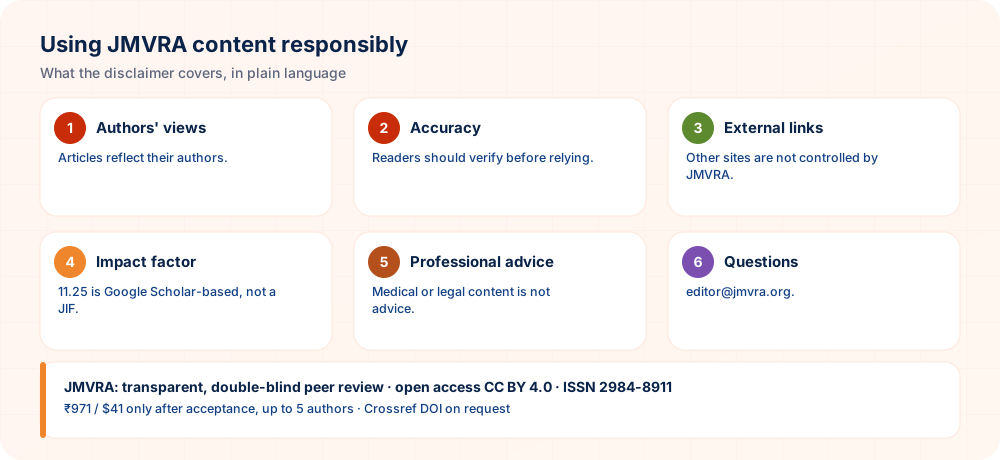
Articles in JMVRA express the opinions, results and conclusions of their individual authors, and they do not always match the official stance of JMVRA, its editors, reviewers or partner institutions. Readers should therefore treat each article as the authors' own work.
Accuracy Disclaimer
JMVRA takes every reasonable step to keep published information correct and current, yet it gives no warranty of any sort, stated or implied, regarding the completeness, accuracy, reliability or fitness of that information for a given purpose.
External Links
Pages on JMVRA's website may link out to other websites. We do not control what those sites contain, and we accept no responsibility for whether they stay available, for their content or accuracy, or for how they handle privacy. Linking to a site does not mean JMVRA endorses it. It is wise to read the terms of any external site you visit.
Impact Factor Disclaimer
Medical, Legal and Financial Disclaimer
Nothing published in JMVRA should be taken as medical, legal, financial or other professional advice. Anyone with a specific concern raised by a published study should consult a suitably qualified professional. A research finding rarely fits an individual situation exactly.
Questions Researchers Often Ask
No. JMVRA's Impact Factor is calculated on its own from Google Scholar data, which makes it different from the JCR Impact Factor of Clarivate Analytics. When you cite it, describe it as "Google Scholar-based IF".
No. What is published reflects the opinions of the individual authors, and it does not necessarily stand for the official position of JMVRA, its editors or its reviewers.
Have a Question Not Covered Here?
Contact the editorial team directly if you need clarification.
What This Guide Covers
At-a-Glance Checklist
- Findings checkedAgainst the source article
- Cited properlyWith DOI where available
- Metric stated correctlyGoogle Scholar-based 11.25
- Advice soughtFrom a professional, where needed
- Errors reportedTo the editorial office
Citing JMVRA Content Responsibly
- Cite the article itself, not the journal homepage — include the authors, the title and a DOI or link
- Read the whole article — an abstract alone is not enough
- Look for corrections — on the article's own page
- Credit the source when reusing — as CC BY 4.0 requires
Author Responsibility for Content
Reading a Journal Disclaimer Before You Rely on Its Content
Disclaimers are easy to skip, yet they explain where responsibility lies. These tips show authors and readers how to read them calmly and act on them sensibly.
- Separate opinion from verified fact. Views stated in an article are those of its authors. Before acting on findings, especially in health or policy, consult the original data and other independent sources.
- Cite the specific version. When you quote a paper, note the version and access date as your style requires. Online content can be corrected, and precise citation keeps your reference accurate.
- Take responsibility for your own claims. As an author, you remain answerable for the accuracy, originality and permissions of what you submit. Check each statement and source before you send the file.
- Do not assume outcomes in advance. Submitting a paper does not promise acceptance, timing or particular visibility. Plan your academic deadlines with that uncertainty in mind and have a backup venue.
- Ask when wording seems unclear. If a clause confuses you, write to the editorial office and request a plain explanation. Keep the answer with your submission records.
Read the disclaimer, verify claims independently, take responsibility for your own manuscript, and ask when anything is unclear.
Questions Researchers Often Ask
Does JMVRA agree with every opinion in its articles?
No. Each article presents its authors' views. Peer review assesses quality and methodology, not whether reviewers agree.
How do I quote JMVRA's impact factor correctly?
Write 11.25 and note that it is derived from Google Scholar data; it should not be mistaken for a Clarivate Journal Impact Factor.
What should I do if I spot a mistake in a published article?
Send the article details to [email protected]. JMVRA's corrections policy governs how such reports are dealt with.
Does JMVRA stand behind the views in published articles?
The views belong to the authors; the journal publishes work after review, but it does not back every opinion expressed.
Who must clear the rights for third-party images used in an article?
The authors are responsible for getting whatever permission is required.
Your Paper's Journey at JMVRA, From Submission to Publication
- SubmissionPaper ID assigned
- ScreenScope & similarity
- ReviewDouble-blind
- DecideEmail & SMS
- AmendItem by item
- AcceptCopyright & fee
- ProduceDOI provided when requested
- PublishMonthly issue
How long review takes depends on the reviewers and on any revision required, so no set turnaround is promised; you are told of acceptance or rejection by email and WhatsApp.
Ready to Publish? Submit to JMVRA
JMVRA is aligned with UGC's Suggested Parameters for Choosing Peer-Reviewed Journals.
JMVRA is a Transparent, Peer-Reviewed, Open Access Journal (Refereed Journal). Following the discontinuation of the UGC and UGC-CARE journal listing, and in alignment with the latest UGC-CARE recommendations and guidelines, JMVRA is aligned with UGC’s Suggested Parameters for Choosing Peer-Reviewed Journals.
Handy links within jmvra.org
Key Terms
Subjects and search phrases this article addresses.
Related Reading
Further reading on the same theme from the JMVRA blog.
Keep Reading on the JMVRA Blog
The JMVRA journal blog includes this guide, one of many practical pieces on publishing, indexing, metrics and research integrity, prepared so readers can verify them without any sales pitch.