
JMVRA adheres to the Committee on Publication Ethics (COPE) guidelines covering authorship, plagiarism, data integrity and conflicts of interest.
Ethical Standards Expected of Everyone
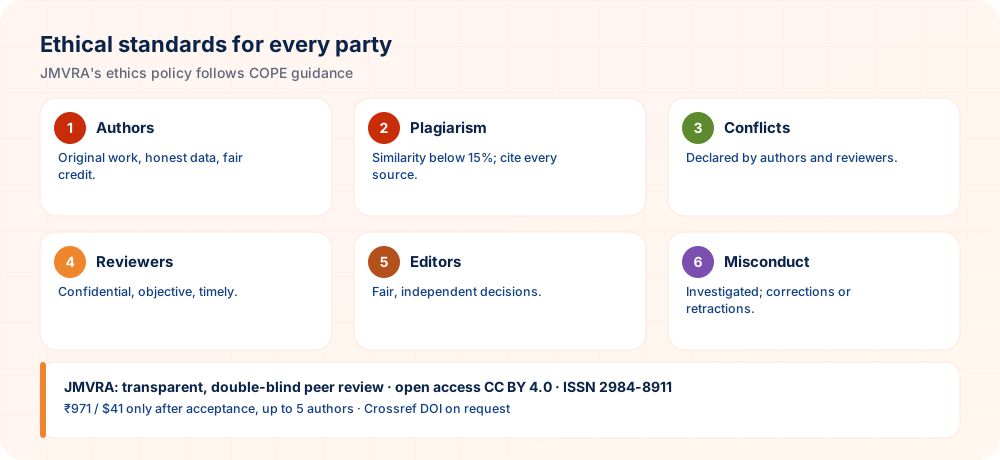
JMVRA is dedicated to the highest standards of publication ethics and follows the guidelines of the Committee on Publication Ethics (COPE). Authors, editors and reviewers alike are expected to observe them. Reading these standards before you submit saves time later.
Author Responsibilities
- Submitted work has to be original, free of plagiarism and not under review anywhere else
- Every source, dataset and contribution must be credited properly
- Authorship must match real contributions; ghost authorship is not allowed
- Any conflicts of interest have to be disclosed at the time of submission
- Fabricating, falsifying or selectively reporting data is strictly forbidden
- Duplicate submission and self-plagiarism are not allowed
Editorial Responsibilities
- Manuscripts are assessed purely on academic merit, with no discrimination
- Submitted manuscripts are treated as strictly confidential
- Editors declare conflicts of interest and step aside from them
- Every allegation of research misconduct is investigated
Reviewer Responsibilities
- Reviewers have to decline a review when they have a conflict of interest
- Information from reviews stays strictly confidential and is never used for personal benefit
- Reviewers give objective, constructive and timely feedback
- Reviewers must not approach authors directly
Plagiarism & Similarity Screening
Each submission is screened for similarity before reaching a reviewer. Manuscripts must stay within an accepted similarity threshold of 15%. Papers above it are sent back for revision, not rejected outright, unless the similarity points to deliberate misconduct. Authors can request a screening report.
Malpractice Handling & Retraction
Questions Researchers Often Ask
Manuscripts must stay within an accepted similarity threshold of 15%. Papers above it are sent back for revision instead of being rejected outright, unless the similarity points to deliberate misconduct.
Misconduct confirmed after publication is dealt with according to COPE flowcharts and can lead to a formal retraction notice being published in place of the retracted article.
Yes. Reviewers must decline a review when they have a conflict of interest, and every party — authors, editors and reviewers — must disclose conflicts of interest.
Publish Confidently Through an Ethical Process
Aligned with COPE · Double-blind peer review · Decisions made transparently.
What This Guide Covers
At-a-Glance Checklist
- Original workWith proper citations
- Authorship settledAll authors contributed
- Conflicts disclosedWithin the manuscript
- Honest dataNo fabrication or manipulation
- AI use statedWherever tools assisted
Who Counts as an Author
- A significant contribution — to the design, data, analysis or interpretation
- Drafting or revising — the manuscript with a critical eye
- Sign-off — on the final version
- Responsibility — for the work
Anyone else who helped can be thanked in the acknowledgements.
How Authors May Use AI Tools
Not an author
AI tools are unable to take responsibility for work.
Disclose use
Say how tools were used, where relevant.
Verify output
Verify facts and references yourself.
Protect data
Never upload confidential data to public tools.
Practising Publication Ethics in Authorship and Writing
Ethical publishing begins long before a paper is submitted. These habits help research teams protect their reputation and avoid disputes about credit, originality or the use of automated tools.
- Agree authorship early. Discuss who will be listed, in what order, and who is responsible for each part of the work before drafting begins. Written agreement prevents painful disagreements near submission.
- Keep a record of sources. Maintain notes showing where each idea, figure and sentence came from. When you paraphrase, rewrite the structure as well as the words, and always give the credit.
- Declare competing interests. If funding, employment or personal ties could influence how your work is read, disclose them openly. Transparency is far less damaging than a conflict discovered later.
- Be open about writing tools. If you used software to draft, translate or edit text, describe it as the journal's policy requires and remain responsible for checking every statement for accuracy.
- Correct errors promptly. If you find a mistake after publication, tell the editor at once. Responsible correction is regarded as honest scholarship, not as a failure.
Settle credit in writing, document your sources, disclose anything that could look like bias and correct mistakes the moment you notice them.
Questions Researchers Often Ask
Which ethics guidelines does JMVRA follow?
JMVRA's ethics policies are based on guidance from COPE, the Committee on Publication Ethics.
What follows if misconduct is discovered?
It is investigated under the ethics policy and can result in rejection, a correction or a retraction.
Must authors declare conflicts of interest?
Yes. Anyone involved, whether author, reviewer or editor, has to disclose an interest that might affect their judgement or appear to do so.
May an AI tool be named as an author?
No. Authors have to be able to take responsibility for the work.
Is it acceptable to add a senior colleague who made no contribution?
No. Gift authorship is a breach of ethics.
Your Paper's Journey at JMVRA, From Submission to Publication
- SubmitYou receive a paper ID
- ScreenScope & similarity
- ReviewDouble-blind
- DecideEmail & SMS
- RevisionReply to each point
- AcceptCopyright & fee
- ProduceA DOI if you ask for one
- PublishMonthly issue
How long review takes depends on the reviewers and on any revision required, so no set turnaround is promised; you are told of acceptance or rejection by email and WhatsApp.
Ready to Publish? Submit to JMVRA
JMVRA is aligned with UGC's Suggested Parameters for Choosing Peer-Reviewed Journals.
JMVRA is a Transparent, Peer-Reviewed, Open Access Journal (Refereed Journal). Following the discontinuation of the UGC and UGC-CARE journal listing, and in alignment with the latest UGC-CARE recommendations and guidelines, JMVRA is aligned with UGC’s Suggested Parameters for Choosing Peer-Reviewed Journals.
More useful pages at jmvra.org
Key Terms
Subjects and search phrases this article addresses.
Related Reading
Further reading on the same theme from the JMVRA blog.
Recognising a Predatory Journal
Read the guide RelatedSimilarity Check Service for Papers & Theses
Read the guide RelatedGetting Your Research Cited the Ethical Way
Read the guide RelatedCloned & Fake Journal Alert: Protect Your Paper
Read the guide RelatedPlagiarism Guidelines
Read the guide RelatedIs This Journal Genuine? A 20-Step Authenticity Check
Read the guideKeep Reading on the JMVRA Blog
You are reading part of the JMVRA journal blog, a source of hands-on guidance about publishing, indexing, metrics and research integrity that aims to be verifiable, not promotional.