
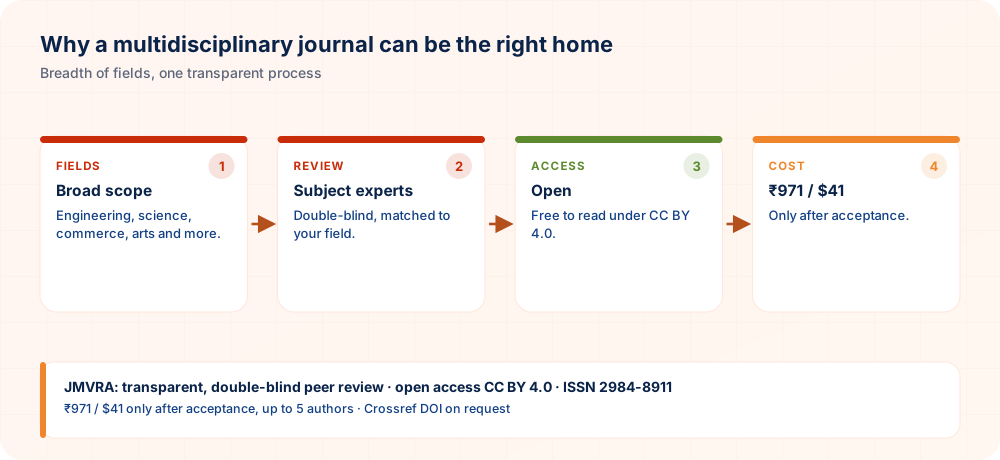
Getting research published is about more than one extra entry on your CV — it builds a lasting academic presence that advances your career, attracts citations and links your work to scholars around the world. The journal you pick shapes how your research is received, how easily it can be found, and how strongly it informs later studies. When your work does not sit comfortably inside one narrow subject area, a genuinely multidisciplinary journal is frequently a more practical choice than a niche, subject-specific title.
Picking a Journal Involves More Than Padding Your CV
A narrow, subject-specific journal may be the correct choice if your study belongs firmly to one established field that has its own specialised venues. Yet much real-world research — interdisciplinary engineering projects, applied social science, or health policy that spans medicine and public administration — does not fit that mould, and pushing it into a very narrow journal can lead to a slower, clumsier review than the paper merits. Matching a manuscript to the right audience early saves time and avoids needless desk rejections.
Why a Truly Multidisciplinary Journal Matters
- Open access policy — articles that anyone can read online reach the widest audience, and wide readership leads to more citations
- Rigorous, genuine peer review — whatever discipline a manuscript belongs to, it is still judged on originality, methodology and clarity
- Crossref DOI availability — a lasting, citable identifier that helps your paper stay easy to find for decades
- Affordable, transparent pricing — students and early-career researchers should not be priced out of publishing simply because their subject does not suit a narrow niche journal
- One trusted venue across a research career — handy when your own interests drift into neighbouring fields as the years go by
Which Disciplines JMVRA Really Accepts
Original research is welcome at JMVRA from seven broad domain groups, each containing dozens of specific specialisations:
- Engineering & Technology — Computer Science & IT, Electronics & Communication, Electrical, Mechanical, Civil, Chemical, Automobile, Aerospace, Robotics & AI, and more
- Science & Mathematics — Physics, Chemistry, Biology, Environmental Science, Geology, Astronomy, Pure & Applied Mathematics, Statistics
- Commerce & Management — Business Administration, Economics, Finance & Accounting, Marketing & HR, E-commerce
- Arts & Humanities — Fine Arts, Literature & Linguistics, Philosophy, History, Cultural Studies
- Social Sciences — Education, Psychology, Sociology, Political Science, Law, Anthropology
- Pharmacy & Medical Sciences — Pharmacy, Pharmaceutical Sciences, Medical Sciences, Nursing, Public Health, Biomedical Sciences, Dentistry, Ayurveda & Homeopathy
- All other subjects — the list above gives examples only and is not complete; JMVRA does not limit submissions to a fixed list of subjects
To see every accepted specialisation broken down tag by tag, open the complete Research Areas page.
What JMVRA Offers You in Practice
| What You Get | Detail |
|---|---|
| Publication fee | No hidden charges: ₹971 INR for Indian authors and $41 USD for international authors |
| Peer review | Transparent double-blind review, with the decision delivered by email and WhatsApp |
| Crossref DOI | Available on request for a small optional charge (ask the editorial office) |
| Open access | Published under CC BY 4.0 and free for anyone to read worldwide, with no paywall for readers |
| Indexing | Google Scholar indexed, UGC Status & Parameters |
| Certificate | Every author receives a digital publication certificate |
An Honest Look at Where JMVRA Stands
Should your institution specifically demand indexing in Scopus or Web of Science, check any journal's real status yourself on the Clarivate Master Journal List or the Scopus Source List prior to submission. Should what you need instead be real peer review, UGC CARE compliance and affordable, transparent publishing in any discipline, JMVRA is designed for exactly that. Note the date you checked, since listings can change.
Checking Any Multidisciplinary Journal Before You Submit
- The UGC-CARE list has been discontinued, so check the journal against UGC's Suggested Parameters and your institution's rules using its published evidence and the ISSN Portal, instead of relying only on what the journal says
- Make sure the ISSN is genuine and that the editorial board is listed with real institutional affiliations
- Find out whether authors actually receive reviewer comments and the reasoning behind decisions, not merely a bare verdict
- Study the fee schedule closely — a truly transparent journal lists its base fee and any optional extras (DOI, hard copy) separately and in advance
- Be wary of any journal that offers to bypass peer review, or promises acceptance, in return for a larger fee
At-a-Glance Checklist
- Scope matchesYour field appears there
- Relevant reviewersSubject experts
- Fee understoodAfter acceptance
- Recognition confirmedWith your institution
- CheckedISSN and review policy
Examples of Research That Crosses Fields
Engineering + environment
Affordable water treatment for villages.
Commerce + technology
How small businesses take up digital payments.
Health + data science
Forecasting risk from everyday records.
Education + psychology
Staying motivated while learning online.
Writing for Readers Beyond Your Field
- Define specialised terms — when first used
- Say why it matters — outside your own field
- Make methods easy to follow — readers from other fields must understand them
- Choose informative figures — they speak across disciplines
Preparing a Cross-Field Paper for a Broad Audience
When a journal welcomes many fields, your reader may come from a different background. These suggestions help researchers present specialised work so that it is understood, trusted and useful beyond a single discipline.
- Define jargon at first use. Explain technical terms briefly the first time they appear, even if colleagues would know them. Short definitions cost little and keep outsiders reading.
- State the wider significance. Add a sentence in the introduction explaining why the problem matters beyond your own specialism. Editors and reviewers from other areas need this context to judge relevance.
- Explain your method simply. Describe the reasoning behind your approach as well as the steps. Readers from other disciplines can then judge whether the evidence supports your conclusions.
- Use figures that stand alone. Design graphs and diagrams with clear labels and captions so they can be understood without searching the text. Clear visuals travel well between disciplines.
- Test readability with an outsider. Ask someone from a neighbouring field to read your abstract and tell you what they understood. Their confusion points directly to passages that need rewriting.
Write as though an intelligent reader from another field will judge your paper, and your work will be clearer for everyone.
Questions Researchers Often Ask
Your Paper's Journey at JMVRA, From Submission to Publication
- SubmitYou receive a paper ID
- ScreenScope & similarity
- ReviewDouble-blind
- DecideEmail & SMS
- RevisionReply to each point
- AcceptCopyright & fee
- ProduceA DOI if you ask for one
- PublishMonthly issue
How long review takes depends on the reviewers and on any revision required, so no set turnaround is promised; you are told of acceptance or rejection by email and WhatsApp.
Ready to Publish? Submit to JMVRA
JMVRA is aligned with UGC's Suggested Parameters for Choosing Peer-Reviewed Journals.
JMVRA is a Transparent, Peer-Reviewed, Open Access Journal (Refereed Journal). Following the discontinuation of the UGC and UGC-CARE journal listing, and in alignment with the latest UGC-CARE recommendations and guidelines, JMVRA is aligned with UGC’s Suggested Parameters for Choosing Peer-Reviewed Journals.
More useful pages at jmvra.org
Key Terms
Subjects and search phrases this article addresses.
Related Reading
Further reading on the same theme from the JMVRA blog.
Company Policy
Read the guide RelatedDisclaimer
Read the guide RelatedMendeley, Zotero or EndNote? Pick a Reference Manager
Read the guide RelatedOpenAlex or Google Scholar? Key Differences
Read the guide RelatedFAQ
Read the guide RelatedBecome a JMVRA Reviewer or Editorial Board Member
Read the guideKeep Reading on the JMVRA Blog
You are reading part of the JMVRA journal blog, a source of hands-on guidance about publishing, indexing, metrics and research integrity that aims to be verifiable, not promotional.