
Open Data Graph or Search Engine
OpenAlex is an open, structured graph of scholarly data whose main purpose is programmatic access through a free API, which suits building tools, bulk analysis or feeding scholarly data into another system. Google Scholar, by contrast, is a search and crawling engine made for people to browse, has no official public API, and is commonly used to find papers by hand and check citation counts. Their coverage overlaps considerably, but each was built for a different purpose. Deciding what task you need done first makes the choice of tool much easier.
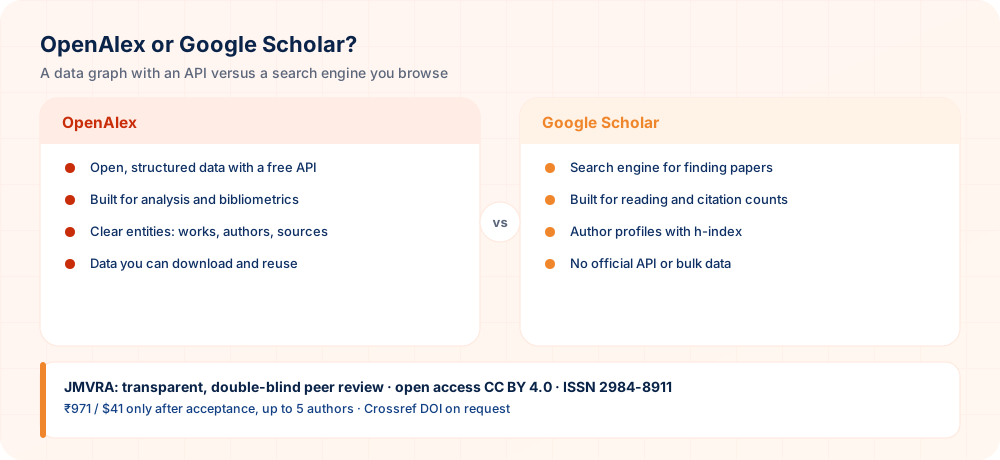
Comparison Table
| Aspect | OpenAlex | Google Scholar |
|---|---|---|
| Primary design | Open graph of structured data | Search/crawl engine |
| Public API | Yes — free of charge, with documentation | No official API |
| Best for | Large-scale data pulls, building tools, analysis | Hands-on searching and browsing |
| Selection model | Wide-ranging data collection without a curation filter | Algorithmic crawling |
| Citation counts | Counted using its own data sources | Counted using its own crawling |
| Cost | Free | Free |
When to Use Which
- Choose Google Scholar when you want a familiar interface for quick manual searches and a rapid look at citation counts
- Pick OpenAlex if you need programmatic access or large data sets, or if you plan to build something on scholarly metadata
- Look at both from time to time for your own publications, because their coverage and figures may truly diverge
- Neither one replaces the selective, curated evaluation carried out by Scopus or Web of Science
Choosing Between OpenAlex and Google Scholar for Tasks
Both tools are free and widely used, but they suit different jobs. These tips help you pick the right one for each task and avoid presenting their results as more exact than they are.
- Use Scholar for quick discovery. A familiar search box is convenient for finding a paper, its versions and related citing work. It works well for exploratory reading when you only need to locate documents.
- Use OpenAlex for structured counts. When you need filters, exports or repeatable queries, a structured data source is more suitable. It lets you describe exactly how a list was produced.
- Expect different citation numbers. Tools collect different sources and apply different matching rules, so counts will rarely agree. Always state which tool and which day your figures come from.
- Inspect duplicates and gaps. Scan results for repeated versions of one paper, missing items and mis-assigned authors. Clean the list manually before using it in a report or application.
- Avoid ranking people by counts. Citation totals depend on field, career stage and database coverage. Use them as one piece of context beside the actual contribution of the work.
Match the tool to the task, state your method and date, and treat counts from either tool as context rather than verdicts.
Simple Analyses with OpenAlex
- Look up a source (journal) — using its name or ISSN
- Review the number of works per year — to follow output across time
- Examine citation figures — across the journal’s articles
- Download the results — into a spreadsheet so you can analyse them yourself
Where Each Tool Falls Short
| Tool | Limits |
|---|---|
| Google Scholar | Offers no bulk export or API, and its coverage is not disclosed |
| OpenAlex | Record quality varies with the underlying sources, and some entries are incomplete |
| Both | Being listed does not signal quality |
Common Questions: OpenAlex vs Google Scholar
Can OpenAlex take the place of Google Scholar?
Not quite; their coverage overlaps, yet they are designed and meant to be used differently.
Is there a public API for Google Scholar?
It has no official API, and that is a major reason researchers turn to OpenAlex when they need programmatic access.
Which of them displays citation counts?
Each one does, although the figures may not match because they come from different sources.
Which suits occasional use better?
Most people find the search interface of Google Scholar more familiar when browsing by hand.
Do the two cover identical articles?
They overlap a great deal, yet what they cover and when can truly differ.
Does appearing in just one of them cause trouble?
Not always; review each one from time to time instead of assuming they match completely.
Which one is free?
Searching either one costs nothing, but only OpenAlex provides an official free API.
Is it worth looking up my paper in both?
Yes, since that gives a fuller view of how findable and cited it is.
Is OpenAlex free?
Yes — OpenAlex is a free, open index of scholarly works.
Does being listed in OpenAlex show that a journal is selective?
No. OpenAlex aims at wide coverage instead of selecting titles.
Related Searches
Read Next
After Publishing, Monitor How Discoverable You Are
Your paper becomes easier to locate in any discovery tool when its metadata is complete and it carries a DOI.
Submit Paper OnlineAt-a-Glance Checklist
- Purpose chosenSearching or analysing
- Source creditedName the database and the date
- Records reviewedYour papers, in both tools
- Metrics compared with careCoverage is not identical
- Profiles kept currentScholar and ORCID
Where JMVRA Appears — With Current Figures
See whether Google Scholar covers the journal in one minute
- Title searchPaste the full title of the article into Google Scholar.
- Apply source:Key in
source:"Journal Name"to bring up a journal’s papers. - Go to the profileStudy the citation profile of the journal, assuming it has been created.
Links to all the records above sit on the Indexing & Discovery page (figures as of 30 Sep 2026).
Ready to Publish? Submit to JMVRA
JMVRA is aligned with UGC's Suggested Parameters for Choosing Peer-Reviewed Journals.
JMVRA is a Transparent, Peer-Reviewed, Open Access Journal (Refereed Journal). Following the discontinuation of the UGC and UGC-CARE journal listing, and in alignment with the latest UGC-CARE recommendations and guidelines, JMVRA is aligned with UGC’s Suggested Parameters for Choosing Peer-Reviewed Journals.
Pages worth visiting on jmvra.org
Key Terms
Subjects and search phrases this article addresses.
Related Reading
Further reading on the same theme from the JMVRA blog.
Conference Management Systems Explained
Read the guide RelatedTutorials
Read the guide RelatedNaming a New Academic Journal
Read the guide RelatedKeeping Publication Moving Without Rushing Review
Read the guide RelatedCompany Policy
Read the guide RelatedJW Book: Self-Publish With ISBN and Global Reach
Read the guideKeep Reading on the JMVRA Blog
As part of the JMVRA journal blog, this guide shares practical help on publishing, indexing, metrics and research integrity, and is written to be verifiable rather than promotional.