
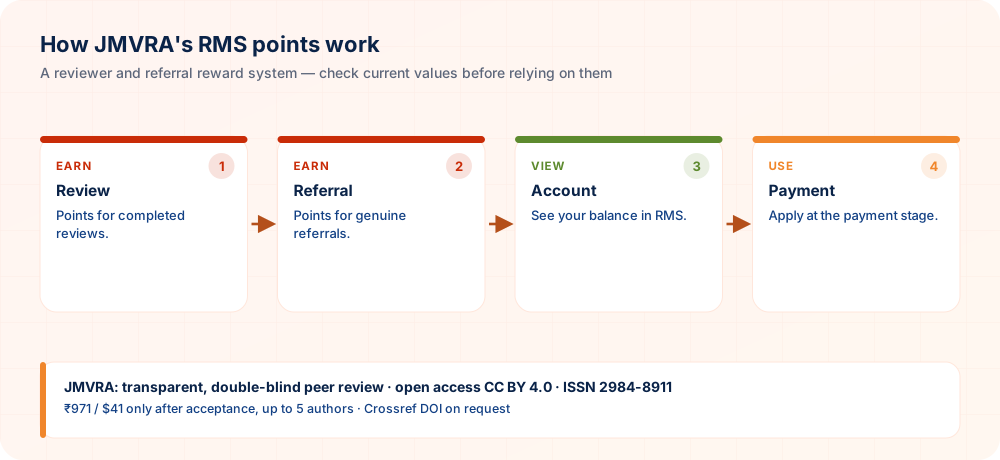
In short: RMS stands for JMVRA's Reviewer Management System, a reviewer and referral program in which eligible activity earns points. Public JMVRA pages have displayed varying point values over time, so regard your live RMS dashboard and the current RMS terms as the sole authority on your real balance and redemption rules. Note down any figure you rely on, together with the day you saw it.
Important Accuracy Note
What Is RMS?
The abbreviation RMS means Reviewer Management System, the name for JMVRA's joint reviewer and referral program.
Ways Points Can Be Earned
Content now public presents successful referrals, meaning a paper you referred that later gets published, as one route to earning points. Verify against the current RMS terms what qualifies as a “successful referral” and which other activities count, instead of assuming. Save the terms page when you read it, so you can compare later if the wording changes.
How to See Your Points
Check your balance on the live RMS dashboard linked to your account. This guide intentionally avoids naming a menu path or button, because the live site controls portal navigation and may alter it without warning.
The Link Between Points and Publication
Any publication benefit based on points depends on current RMS eligibility, the balance you hold, verification, and the publication terms that apply. The Using JMVRA RMS Points Toward Publication guide walks through the process step by step.
At-a-Glance Checklist
- Latest values confirmedPages can disagree
- Points ≠ acceptancePeer review decides
- Balance checkedAhead of use
- Terms studiedLimits and expiry
- Office contactedWhen figures clash
The Case for Recognising Reviewers
Peer review relies on volunteers who contribute their time and expertise. Many journals and publishers acknowledge that effort, through certificates, thank-you notes, reviewer profiles or reward schemes, to encourage thorough and prompt reviews. The key point is that recognition must never influence the decision on any paper. Reviewers should also decline a paper whenever a conflict of interest could colour their judgement.
Acceptable recognition
Expressing thanks, issuing review certificates, showing contributions on reviewer profiles, and offering modest perks.
Unacceptable recognition
Whatever pays out for a specific decision, links benefits to papers being accepted, or allows authors to purchase influence.
Review work that earns recognition also helps a researcher's own career; read how to become a reviewer.
Tracking Your Points and Reviews
- Maintain a review log — note the paper ID, the date you accepted, the date you submitted, and any certificate you received
- Review your balance from time to time — and tell the editorial office quickly about any mismatch
- Get the terms in writing — before you plan around points, since schemes may change
- Keep confidential details private — in double-blind review, reviewer identities and manuscript content remain confidential
Practical Tips for Keeping Track of Reviewer Recognition
Recognition schemes are most useful when you understand their limits. These suggestions help reviewers and referrers record their contributions properly and keep expectations realistic.
- Review for the right reasons. Accept review invitations because the topic is within your expertise and you can give careful, constructive feedback, not because of any reward attached to the task.
- Keep your own review log. Record the date, subject area and outcome of each task in a personal file. It helps with annual appraisals and does not depend on any single platform.
- Maintain confidentiality always. Never discuss manuscript details with colleagues or on social media while claiming recognition. Confidentiality remains your duty regardless of what you later gain.
- Refer honestly. When you recommend the journal to peers, describe it accurately and let them judge the fit. Overstating benefits to collect credit damages your reputation and theirs.
- Verify balances periodically. Look at your account now and then to confirm entries are correct. Report discrepancies politely with dates and reference details so they can be checked without delay.
Review and refer on merit, keep independent records, and treat any recognition as a secondary courtesy rather than the purpose.
Questions Researchers Often Ask
How Transparent Peer Review Works, Stage by Stage
- SubmissionTo begin, the paper's plagiarism level, formatting and subject scope are reviewed.
- Reviewer appointmentScholar9 portal appointments put subject experts on the paper.
- Double-blind reviewAll of significance, clarity, method and originality come under evaluation.
- DecisionAcceptance, a revision request or rejection is announced to authors over email and WhatsApp.
- RevisionIn turn, the authors respond to every comment.
- TransparencyLook on Scholar9 for the review record; the report can be requested when needed.
Open reports, optional reviewer identity and open participation are the three approaches to transparency, and how JMVRA applies them is what is covered on this page.
Ready to Publish? Submit to JMVRA
JMVRA is aligned with UGC's Suggested Parameters for Choosing Peer-Reviewed Journals.
JMVRA is a Transparent, Peer-Reviewed, Open Access Journal (Refereed Journal). Following the discontinuation of the UGC and UGC-CARE journal listing, and in alignment with the latest UGC-CARE recommendations and guidelines, JMVRA is aligned with UGC’s Suggested Parameters for Choosing Peer-Reviewed Journals.
Quick links across jmvra.org
Key Terms
Subjects and search phrases this article addresses.
Related Reading
Further reading on the same theme from the JMVRA blog.
Keep Reading on the JMVRA Blog
Our JMVRA journal blog carries this guide along with other practical advice on publishing, indexing, metrics and research integrity, all written so that claims can be verified and nothing is promotional.