
"Open access" suggests a single arrangement, yet it covers several funding models that differ in practical ways for authors, chiefly in who pays and at what moment the paper becomes freely readable.
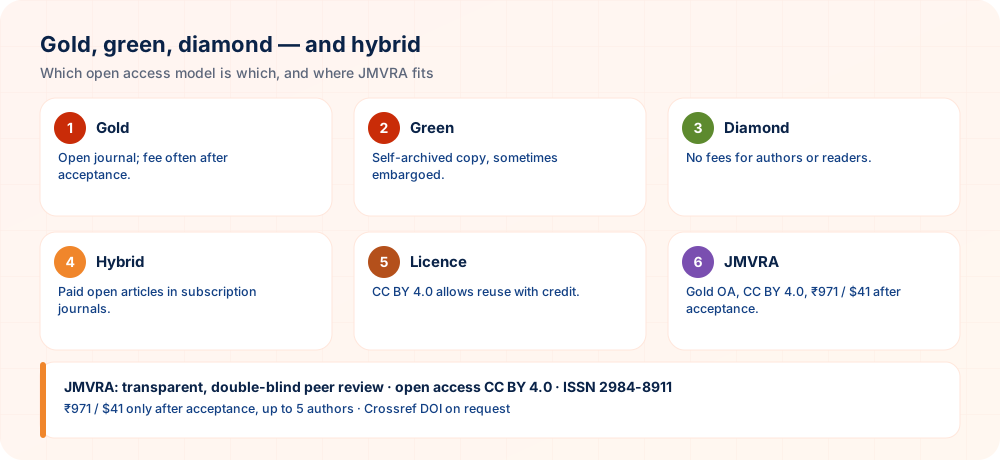
Why the Words "Open Access" Are Not Enough
Two journals may both describe themselves as "open access" while working in completely different ways: one asks authors for a publication fee in return for immediate free access, while another bills readers a subscription and merely permits a delayed copy archived by the author elsewhere. Once you know which model applies, you know what to expect and who is supposed to cover which cost. It is worth reading a journal's access policy before you commit a paper to it.
Gold Open Access
The final published version is available at once, and free of charge, on the journal's own website. It is usually paid for through an Article Processing Charge (APC) covered by the author (or the institution or funder) instead of the reader. This is the simplest model: pay one time, publish, and anyone can read the paper for free permanently.
Green Open Access
Here the journal can still be subscription-based, but the author may place a copy of the paper in an institutional repository or on a platform like arXiv; this is often the peer-reviewed accepted manuscript, before the journal's final typesetting. An embargo period may also delay when that free copy can be released to the public.
Diamond Open Access
Neither author nor reader pays. Instead the journal is supported by an institution, a government grant, a scholarly society or comparable third-party backing. That removes the cost for authors altogether, but it relies on funding that not every journal, field or publisher can obtain, which is precisely why independently run journals use it less often than Gold OA.
About Hybrid Journals
Certain subscription journals provide a "hybrid" choice: by default the journal runs on subscriptions, but an author may pay an APC so that one specific article is openly accessible inside an otherwise closed journal. In practice this is Gold OA used selectively, article by article, instead of across the whole journal. Check what the fee covers before choosing it.
Comparing Them Side by Side
| Model | Author Pays? | Reader Pays? | Immediate Access? |
|---|---|---|---|
| Gold | Yes (APC) | No | Yes |
| Green | No (usually) | Possibly, for the version in the journal | The free version is often held back by an embargo |
| Diamond | No | No | Yes |
| Hybrid | Yes, per-article | Only for articles in the same journal that are not OA | Yes, for the article that is paid for |
Which Model Does JMVRA Follow?
At-a-Glance Checklist
- Model identifiedFor every journal
- Licence checkedShown on the article
- When the fee is dueOnce accepted
- Archiving rightsFor your own version
- Funder rulesChecked
Selecting a Route for Your Paper
| Your situation | Route to consider | Check |
|---|---|---|
| No funds for fees | A diamond OA journal, or green OA alongside a subscription journal | The quality of the journal and the policy of the repository |
| Your funder demands immediate open access | Gold or diamond OA, or green OA that meets the rules | The funder’s rules about licences and embargoes |
| You want the largest readership as soon as possible | Gold or diamond OA under a CC BY licence | The licence shown on the article |
| The journal you are aiming for runs on subscriptions | Green OA using your accepted manuscript | The self-archiving policy of the journal |
Licences: What Authors Frequently Overlook
CC BY
Anyone may reuse the work provided they credit you — the most open and widespread licence for OA articles, and the one JMVRA applies is CC BY 4.0.
CC BY-NC
Reuse is permitted with credit to the author, but commercial use is excluded.
CC BY-ND
Reuse is permitted with credit to the author, but adapted versions are not allowed.
All rights reserved
It may be free to read, but reusing it requires permission, so it is not fully open access.
Weighing Open Access Routes Before You Choose One
Selecting an open access model affects cost, rights and readership. Considering your own circumstances before you submit leads to fewer surprises than comparing models only after acceptance.
- Check your funder's conditions. Research grants and institutions sometimes require particular licences or repositories. Read these conditions first, since they may decide which route is permitted for your work.
- Ask who bears any charge. Find out clearly whether the author, institution or a sponsor pays, and what that payment covers. Never assume a free-to-read article was free to publish.
- Read the licence wording. Look at what readers may do with the paper, including copying, adapting and commercial reuse. Make sure those permissions match your expectations before you agree.
- Keep your accepted manuscript. Retain the version accepted after review, because some routes allow you to deposit it in a repository. Check the embargo and version rules before posting.
- Ask about hybrid arrangements. Subscription journals with open options can create double costs for institutions. Ask your librarian whether an agreement already covers your payment.
Compare funding rules, charges, licences and repository permissions together before choosing a route, and keep your accepted manuscript safely stored.
Questions Researchers Often Ask
Open Access Models Side by Side
JMVRA is gold open access under CC BY 4.0, so everyone can read at once without an embargo, and the ₹971 INR / $41 USD charge falls due only when a paper is accepted.
Ready to Publish? Submit to JMVRA
JMVRA is aligned with UGC's Suggested Parameters for Choosing Peer-Reviewed Journals.
JMVRA is a Transparent, Peer-Reviewed, Open Access Journal (Refereed Journal). Following the discontinuation of the UGC and UGC-CARE journal listing, and in alignment with the latest UGC-CARE recommendations and guidelines, JMVRA is aligned with UGC’s Suggested Parameters for Choosing Peer-Reviewed Journals.
Further reading on jmvra.org
Key Terms
Subjects and search phrases this article addresses.
Related Reading
Further reading on the same theme from the JMVRA blog.
After You Submit to JMVRA: Status, Review & Next Steps
Read the guide RelatedPublishing a Research Paper in a Journal (2026)
Read the guide RelatedJMVRA Help Center for Authors, Reviewers & Organisers
Read the guide RelatedDownload Your JMVRA Certificate and Paper
Read the guide RelatedThesis Publication: Journal Paper or Book?
Read the guide RelatedFind Your Published Paper on the JMVRA Website
Read the guideKeep Reading on the JMVRA Blog
This article sits on the JMVRA journal blog, where practical guidance covering publishing, indexing, metrics and research integrity is written to be verifiable, not promotional.