
Journals commonly ask authors for ₹20,000 to ₹3,00,000 per article. For most students, PhD scholars and early-career researchers in India that amount is out of reach, so worthwhile research stays unpublished. JMVRA exists to take that barrier away. This guide shows how the journal operates: the source of its income, its spending, how the publication fee is set, and why a low-cost journal can still run full peer review. Before judging any journal's price, it helps to know what the money actually pays for.
What Keeps the JMVRA Fee Low
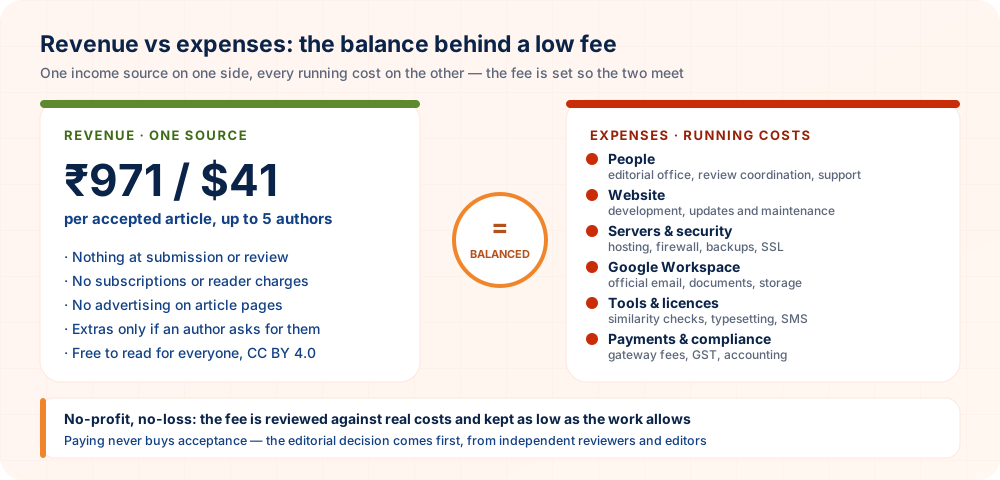
The goal of JMVRA is straightforward: let students and researchers publish real, peer-reviewed work without facing a fee beyond their means. The journal operates on a no-profit, no-loss basis. It requires enough income to pay its team and to keep the website, servers and archive running securely, but its fee is not set to earn a profit.
The Working of a Low-Cost Journal Publication Model
An open access journal run at low cost depends on a single income stream: a one-time publication fee that authors pay after acceptance of their paper. Readers are not charged: there are no subscriptions, institutional licences or pay-per-view access. This one source must cover everything it takes to run the journal. Authors comparing options should always ask what a fee actually covers.
- Submission₹0No payment due
- Screening₹0Scope and similarity checks
- Peer review₹0Double-blind and transparent
- Accepted₹971 INR / $41 USDDue only at this point, once per article
- ReadingFreeOpen to all, permanently
- No payment is due at submission, in screening or throughout review.
- One fee applies per accepted article, and it includes as many as 5 authors.
- Payment cannot purchase acceptance; reviewers and editors decide beforehand.
- The present fee is listed on Publication Charges ahead of submission.
The Cost of Running a Journal
Online publishing is not free of cost. Every article rests on a chain of work and services that need payment each month, whether the journal releases ten papers or a thousand. Seeing these costs laid out makes fee levels easier to judge:
People
The editorial office: screening submissions, finding reviewers and chasing them, replying to authors, plus production and support. This is the biggest single cost.
Website
Developing and maintaining jmvra.org, covering submission, tracking, article pages, certificates and the archive, and keeping it all current.
Servers & hosting
Hosting the website, the database and every published PDF, with capacity enough for readers across the world.
Security & backups
Firewall security, SSL certificates, daily backups and disaster recovery, which keep the archive and author data protected.
Google Workspace & messaging
Official @jmvra.org email, shared documents and storage, plus the email and WhatsApp notices sent at every stage.
Similarity-check tools
Licences for similarity-checking software of the Turnitin / iThenticate type, applied ahead of review; the permitted limit is below 15%.
Typesetting & certificates
Typesetting accepted papers, producing certificates and confirmation letters, and assembling every monthly issue.
Payments & compliance
Payment-gateway fees, GST, invoicing and bookkeeping for each transaction.
Archiving & reserve
Long-term preservation, domain renewals, office expenses and a modest reserve, so the journal does not stall through lack of money.
Some costs are fixed (the website, servers, Google Workspace, software licences, the core team) while others rise with every paper (screening, coordinating reviews, typesetting, certificates, payment charges). Good journal management holds fixed costs down and shares them among many papers.
What Your ₹971 INR Pays For
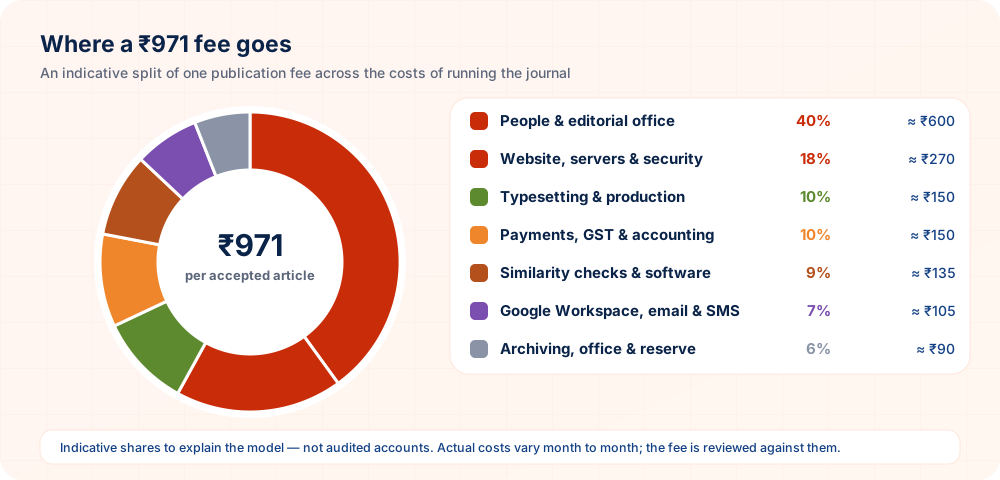
The chart below gives an indicative breakdown of one publication fee across these costs. Its purpose is to explain the model; it is not audited accounts, and actual shares shift from one month to the next.
| Cost area | Share | Of ₹971 INR | What it pays for |
|---|---|---|---|
| People & editorial office | 40% | ≈ ₹600 | Staff for screening, review coordination, author support and production |
| Website, servers & security | 18% | ≈ ₹270 | Software development, hosting, firewall, SSL and backups |
| Typesetting & production | 10% | ≈ ₹150 | Typesetting, certificates, confirmation letters and issue assembly |
| Payments, GST & accounting | 10% | ≈ ₹150 | Payment gateway fees, invoicing and tax compliance |
| Similarity checks & software | 9% | ≈ ₹135 | Licences for similarity checking and editorial tools |
| Google Workspace, email & WhatsApp | 7% | ≈ ₹105 | Official email, documents, storage and alerts |
| Archiving, office & reserve | 6% | ≈ ₹90 | Archiving, domain names, office and a contingency reserve |
Look at what the list leaves out: no investor profit share, no big marketing budget and no print runs. Those omissions explain most of the gap between this journal and a high-fee one.
How JMVRA Sets Its Fee
The fee comes from calculating costs, not from guessing what the market will tolerate:
- Total the running costs — each item in the cost list above, month by month.
- Divide by the number of articles published — fixed costs are spread over all of them.
- Include no profit margin — just a small reserve to keep the journal going through a quiet month.
- Test affordability — could a student realistically afford it?
- Announce it ahead of submission — and revisit it only when costs truly change.
Low-Cost Journals Versus High-APC Journals
Article processing charges (APCs) at many international journals range from ₹20,000 to ₹3,00,000 or more. Set beside JMVRA’s fee, the difference is plain:
| What drives the fee | High-APC journal | The low-cost JMVRA model |
|---|---|---|
| Profit | Frequently a profit margin for owners or shareholders | No profit goal; no-loss |
| Brand & sales | Big marketing and sales departments | Little marketing; authors discover the journal themselves |
| Printing and distribution runs | Online first; printed copies only on request | |
| Selectivity cost | Each acceptance funds many rejections | Sound, reviewed work gets published |
| Pricing currency | Priced in USD or EUR for global markets | Priced in INR for Indian authors |
| Peer review | Yes | Yes — double-blind and transparent |
A high fee does not automatically signal quality, and a low fee is not automatically a red flag. What counts is whether the journal does the work: real review, similarity checks, a stable archive and honest claims. Ask for evidence of these practices rather than relying on a journal's own description. See Free vs Low-Cost Journal Publication for a comparison of funding models.
How Such a Low Fee Can Work
- Online first. There are no regular print runs, storage or postage; printed copies are made only when an author requests one.
- Shared infrastructure. A single website, server set-up and editorial system support the journal’s monthly issues, which spreads fixed costs over many papers.
- Lean team, clear workflow. Tracking and submitting online replaces lengthy email threads; each author receives a Registration ID, and decisions arrive by email and WhatsApp.
- No profit target. The fee pays for costs and a small reserve, and that is all.
- Pay only for the extras you want. A Crossref DOI and printed copies are optional, available on request, so the base fee is not weighed down by services not every author needs.
- Reviewers are thanked, not billed to authors. A panel of 3,000+ reviewers earns certificates as recognition, instead of per-paper charges being passed on to you.
Fee Levels Across the JMVRA Network
The JMVRA Publication network follows the same thinking. Its three journals set their own fees, each covering that journal’s own costs:
Every journal posts its current fee on its own website. Check the fee page of the journal you plan to submit to before you send your paper.
What This Means for Students
For an undergraduate, master’s student or PhD scholar, a ₹20,000 fee can represent months of saving, and ₹1,00,000 or more is out of the question for most. As a result, good projects, theses and first papers never find readers. A fee of ₹971 INR, due only after the paper is accepted, makes publication something a student can budget for instead of a privilege.
Low Cost, Unchanged Standards
A low fee reflects trimmed overheads, not shortcuts. These parts of the process stay identical regardless of the fee:
- A similarity check against a declared limit, below 15%, before review.
- Transparent, double-blind peer review by subject experts, and a Transparent Peer Review Report available on request.
- Ethics, correction and refund policies are published and follow COPE guidance.
- Open access under CC BY 4.0, with copyright retained by authors.
- A lasting online archive, plus a Crossref DOI if requested.
Keeping a Low-Fee Model Trustworthy
Any author-funded journal faces the same built-in risk: revenue grows as more papers are accepted. A low fee does not remove that risk, so JMVRA depends on safeguards instead of promises:
- Ask for payment only after an independent decision — the decision rests with reviewers and editors, and payment comes afterwards.
- State the fee openly — ahead of submission, with no concealed extras.
- Keep rejection genuine — papers that fail the similarity check or review are either revised or declined.
- Explain the costs — the way this page does — so authors can assess the model themselves.
JMVRA is a Transparent, Peer-Reviewed, Open Access Journal (Refereed Journal). Following the discontinuation of the UGC and UGC-CARE journal listing, and in alignment with the latest UGC-CARE recommendations and guidelines, JMVRA is aligned with UGC’s Suggested Parameters for Choosing Peer-Reviewed Journals. UGC public notice (PDF)
At-a-Glance Checklist
- Fee stated up frontThe figure appears on the website before you submit
- Billed after acceptanceNever at submission or while under review
- Costs made clearThe journal states what the fee covers
- Review stays genuineA named model plus reviewer comments
- Similarity verifiedA declared tool and limit (JMVRA: below 15%)
- Extras are optionalDOI and printed copies only on request
Comparing This Model With Others
| Model | Who pays |
|---|---|
| Subscription | Readers or libraries |
| Open access with a high APC | Authors or funders, frequently paying large fees |
| Diamond open access | Institutions or sponsors |
| Open access at low cost (JMVRA) | Authors, paying a modest fee once accepted |
Signs That a Low Cost Can Be Sustained
Consistent issues
Steady publishing across many years.
Published policies
Transparent fees and procedures.
Efficient technology
Costs fall with online systems.
Honest disclosures
Accurate statements about indexing and metrics.
Judging Whether a Low-Fee Journal Model Is Sustainable
Authors sometimes wonder how a journal can charge little and still operate properly. These tips give you a neutral way to evaluate any low-fee model using information you can check yourself.
- Look for a stated purpose of fees. A trustworthy journal explains in plain words what charges cover. Descriptions that mention editorial handling, hosting and production are more reassuring than silence on the subject.
- Check editorial team visibility. Named editors with institutional email addresses and verifiable profiles indicate real people doing the work. Faceless operations make it harder to hold anyone accountable for decisions.
- Examine published article quality. Read several recent papers critically. If the writing, figures and referencing are consistently poor, the journal may not be investing in its screening and production.
- Watch for sudden changes in terms. Fees or policies that change after acceptance without notice suggest weak governance. Keep copies of the terms displayed when you submit.
- Compare behaviour with promises. Notice whether the journal replies within a reasonable period and follows its own published process. Consistency between statements and actions is the best sign of reliability.
Judge a low-fee journal by its transparency, visible people and consistent behaviour, and verify those signs independently before submitting.
Questions Researchers Often Ask
When Payment Is Due at JMVRA
- Submit — ₹0Sending in your paper is free
- Screening — ₹0Scope and similarity checks (below 15%)
- Peer review — ₹0Transparent double-blind review by subject experts
- Accepted — ₹971 INR / $41 USDA single fee for up to 5 authors
- Published — free to readOpen access licensed under CC BY 4.0
More detail: Publication Charges · Refund policy · Revenue model on the transparency page.
Ready to Publish? Submit to JMVRA
JMVRA is aligned with UGC's Suggested Parameters for Choosing Peer-Reviewed Journals.
JMVRA is a Transparent, Peer-Reviewed, Open Access Journal (Refereed Journal). Following the discontinuation of the UGC and UGC-CARE journal listing, and in alignment with the latest UGC-CARE recommendations and guidelines, JMVRA is aligned with UGC’s Suggested Parameters for Choosing Peer-Reviewed Journals.
Where to go next on jmvra.org
Key Terms
Subjects and search phrases this article addresses.
Related Reading
Further reading on publication charges and low-cost publishing from the JMVRA journal blog.
Affordable Journal Publication in the Philippines
Read the guide RelatedWhy JMVRA Charges Just ₹971 INR / $41 USD Without Lowering Standards
Read the guide RelatedJournal Fees Decoded: APC, Taxes & Add-Ons
Read the guide RelatedFree or Low-Cost Publication: Which Suits You?
Read the guide RelatedWhat a ₹1200 Publication Fee Can Realistically Cover
Read the guide RelatedPublication Charges
Read the guide RelatedHow Journal Charges Work: APCs to Add-Ons
Read the guideKeep Reading on the JMVRA Blog
Find this guide on the JMVRA journal blog, a collection of practical guidance on publishing, indexing, metrics and research integrity that favours verifiable content over promotion.