
Searching for low-cost journal publication in the Philippines? Affordable, even free, publishing is within reach: a number of Philippine journals ask authors for no fee, and plenty of international open access titles keep their charges modest. Here you will find why fees differ, what article processing charges actually cover, how to compare cheaper journals on equal terms, and the checks that tell a genuine low-cost journal from a predatory one. The advice holds equally for a student in Davao City, a faculty member in Iloilo City or a Ph.D. scholar in Quezon City. A little checking before you commit often saves more than any discount ever could.
Why Publication Fees Differ So Widely
Charges run from zero to the equivalent of thousands of US dollars, and the gap seldom reflects the effort spent on a single article. It comes from how a journal is funded (university, society, subscriptions or authors), its overheads (brand, sales, print and staff), its selectivity (the number of rejections for every acceptance) and whether profit is the goal. Knowing which of these drivers applies helps you judge whether a quoted price is reasonable.
What Article Processing Charges Are
An article processing charge (APC) is what an author, institution or funder pays so that an accepted article can be published open access and read free of charge. A reasonable APC pays for actual work: running peer review, similarity screening, typesetting, hosting, DOI registration and long-term archiving. The amount should be stated before submission and collected only after acceptance.
Free Compared With Paid Journal Publication
| Model | Who pays | Reader access | Example |
|---|---|---|---|
| Diamond / platinum open access | Institution or society | Free | Kritike; Humanities Diliman (no APC, as stated) |
| Free institutional journal | University or agency | Often free online | NRCP Research Journal (free to publish, as stated) |
| Gold open access with an APC | Author or funder, after acceptance | Free | Many international journals, including JMVRA ($41 USD) |
| Subscription journal | Readers and libraries | Paid | Many established international journals |
| Hybrid | Optional APC for open access | Mixed | Some large publishers |
Philippine journals that report no charge to authors
| Journal | Publisher | Field | Fee statement |
|---|---|---|---|
| Humanities Diliman | UP Diliman | Humanities (multilingual) | No article processing charge (as stated) |
| Kritike: An Online Journal of Philosophy | University of Santo Tomas | Philosophy | No author fee — platinum open access (as stated) |
| NRCP Research Journal | National Research Council of the Philippines (DOST) | Multidisciplinary | Free to publish (as stated) |
Each fee statement reflects what the journal itself published on 4 October 2026. Policies can change, so consult the up-to-date author guidelines before you submit.
What Affects Publication Fees
Funding model
Support from an institution can eliminate author fees altogether.
Publisher overheads
Big brands, sales staff and printing push costs up.
Selectivity
A high rejection rate means costs are shared among few accepted papers.
Currency
Fees set in USD or EUR hit authors who pay in pesos harder.
Services included
DOI, editing, print copies and certificates can cost extra.
Profit motive
Certain publishers build in a margin, while others operate without profit.
To see a worked example of how a journal derives a low fee from its running costs, read the low-cost journal publication model.
Comparing Affordable Journals
- Compare the total: the APC together with any extra charges for additional authors, DOI, certificates or page count.
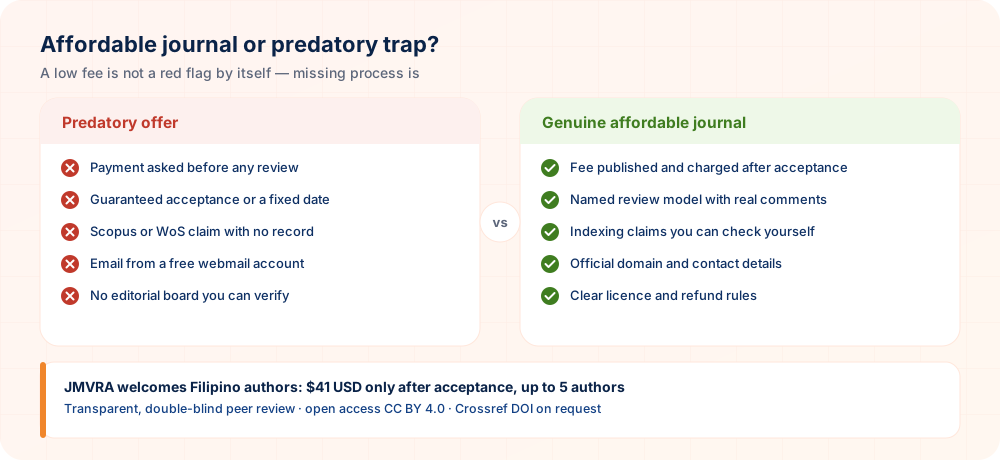
- Check when you pay: payment after acceptance is normal; a demand before review is a warning sign.
- Compare what you get: evidence of peer review, the open access licence, DOI, archiving and indexing.
- Check recognition: does your university or any CHED-related requirement accept the journal?
- Ask about waivers: certain journals lower the fee for students or authors working in lower-income settings.
A Fee-Comparison Worksheet to Fill In
Put your shortlisted journals next to each other in a basic worksheet before deciding. Take the details from each journal’s own website rather than from adverts or third-party lists, and turn every amount into pesos on the same day so the comparison stays fair. Note the date you gathered each figure, since journals revise their charges from time to time.
| Item | Journal A | Journal B | Journal C |
|---|---|---|---|
| Base publication fee (APC) | From the journal site | ||
| Currency and amount in pesos | Same-day conversion | ||
| Authors covered by the fee | e.g. up to 5 | ||
| Extra charges (pages, colour, authors) | List each one | ||
| DOI included or optional? | |||
| When the fee is charged | After acceptance? | ||
| Peer review model | Named model? | ||
| Indexing you can verify | Database and record | ||
| Recognised by your institution? | Ask in writing | ||
| Total cost to you | Add the lines above |
Journals with similar headline fees can turn out very different once charges for extra authors, DOI and pages are included. Conversely, a journal that charges nothing may suit you best if it matches your paper and your requirement.
Funding Options and Support for Filipino Authors
Find out what help is available before paying out of pocket. Research offices at many Philippine universities — in Metro Manila, Cebu City, Davao City, Cagayan de Oro, Iloilo City and elsewhere — give publication incentives or refund fees for papers in journals meeting their standards, frequently those indexed in Scopus or Web of Science. Grants from government agencies may also treat publication costs as an allowable expense. Because rules vary a great deal:
- Ask your research office for its current incentive or reimbursement policy before you pick a journal.
- Find out whether the policy pays the fee, rewards a published paper afterwards, or does both.
- Hold on to the acceptance letter, invoice and receipt; most claims need all three.
- Students should ask their adviser if the department backs publications drawn from a thesis.
Recognising Transparent Publication Charges
- The fee is shown on the journal’s website ahead of submission, in a named currency.
- The page explains what the fee covers and which items are optional.
- Payment is requested only after acceptance and goes through an official channel.
- A refund policy is available in writing.
- The invoice or receipt identifies the journal, the article and the amount.
Why Low Fees Do Not Signal Poor Quality
Quality is a product of peer review, editing and ethics rather than price. A number of respected Philippine journals ask authors for nothing because a university or agency pays their costs, and many genuine international journals hold fees down through online-first publishing, small teams and no profit margin. By the same token, a steep fee is no guarantee of quality. Judge a journal by its process. Reading a few of its recent articles is a quick way to see that process in action.
Avoiding Predatory Journals
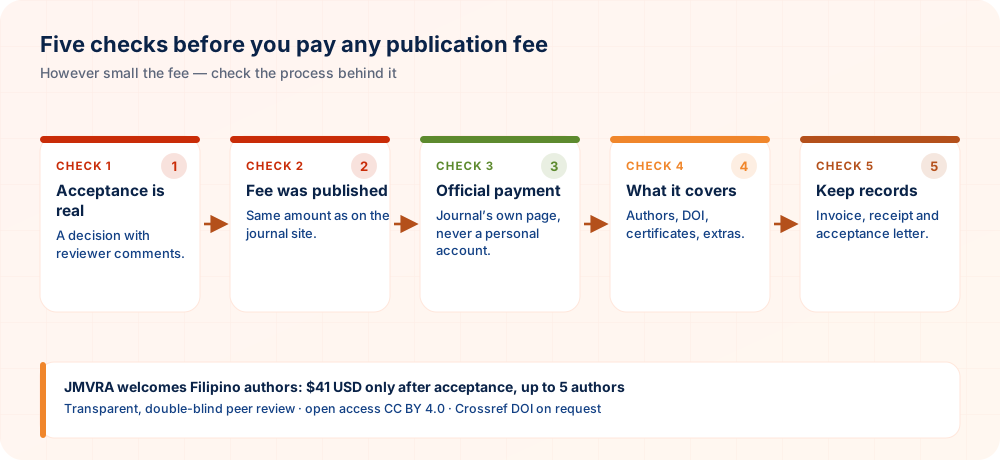
Predatory publishers go after researchers who must publish fast or cheaply. Typical warning signs are unsolicited flattering emails, acceptance within days without comments, made-up impact factors, false Scopus or Web of Science claims, and demands for payment before review. Cloned websites that borrow a real journal’s name are an especially serious risk. Apply five checks before you submit or pay.
Quality of Peer Review and Editing
Find out how many reviewers read each paper, whether review is single- or double-blind, and whether decisions come with specific comments. A journal that explains what influences review time is more believable than one promising a set date. Look at two or three published articles; careful editing and sound methods are encouraging signs.
Author Checklist Before You Pay
- Genuine acceptanceA decision letter that includes reviewer comments
- Fee agrees with the siteThe amount and currency match what is published
- Official payment routeNot an individual’s bank or e-wallet account
- Inclusions checkedAuthor count, DOI, certificates
- Refund terms reviewedPrior to payment
- Records savedAcceptance letter, invoice and receipt
How JMVRA suits Filipino authors
JMVRA runs its fee on a no-profit, no-loss basis: $41 USD for foreign authors, authors in the Philippines included, due only once the paper is accepted.
- Fee: $41 USD for foreign authors, due only after acceptance and covering up to 5 authors; nothing is charged at submission or during review.
- Review: open, double-blind peer review by subject experts; the similarity score must stay below 15%.
- Access: published open access under CC BY 4.0, with authors retaining copyright; a Crossref DOI can be requested.
- Where we stand on indexing: Google Scholar covers the journal, while Scopus, Web of Science and DOAJ do not.
Also see what international authors need to know about JMVRA and the author guidelines.
Planning Publication Costs in Philippine peso (PHP)
| Item | What to check |
|---|---|
| Publication fee | Currency and when charging happens; JMVRA asks foreign authors for $41 USD, but only after acceptance |
| Payment charges | Bank or card charges on an international payment from the Philippines |
| Authors covered | Confirm that the fee takes in all co-authors (JMVRA: up to five) |
| Optional services | Extras such as language editing, a DOI or print copies, taken only when you want them |
Making an International Fee Payment From the Philippines
- Wait until the acceptance email arrives — genuine journals do not ask for payment before review
- Never improvise on payment details — use what the journal’s website or the acceptance email gives, and nothing else
- Confirm the amount in Philippine peso (PHP) — your bank applies its own exchange rate
- Keep receipts safe — for reimbursement and for your own files
Practical Tips for Filipino Authors Comparing Journal Fees
Filipino researchers often balance a modest research budget against the wish to publish in a trustworthy venue. These suggestions help you spend carefully without giving up on quality or transparency.
- Ask your institution first. Before paying from personal funds, ask your research office or library whether any publication support exists. Many universities keep informal guidance that never appears on public web pages.
- Keep a written fee record. Save the journal's fee statement as a screenshot or PDF when you submit. If the quoted charge changes later, you will have dated evidence to discuss calmly with the editor.
- Convert costs before committing. Foreign charges are billed in another currency, so estimate the peso amount including bank and transfer costs. A small difference at the quoted rate can grow once these extras are added.
- Test the journal's responsiveness. Send a short, polite question about scope or fees and note how quickly and clearly the editorial office answers. Vague or pushy replies are an early warning worth heeding.
Compare total cost, document every fee statement, and confirm the journal's review practice before any payment leaves your account.
Questions Researchers Often Ask
See also: research journals in the Philippines, Philippine e-journals and Scopus and Web of Science journals.
Summary and What to Do Next
Filipino researchers can realistically publish at low cost: certain Philippine journals ask authors for nothing, and numerous genuine international journals keep charges small. The safest route is to assess journals by their process — review, transparency, licence and recognition — and consider price last. Treat your shortlist as a living document and revisit it whenever a policy changes.
- Make a list of journals suited to your paper, then record each one’s fee and what it covers.
- Confirm that each fee is published in advance and collected only after acceptance.
- Carry out the predatory-journal checks before submitting to any journal.
- Go through the checklist above before making any payment.
Ready to send in your paper?
JMVRA accepts manuscripts from authors anywhere in the Philippines. Submission is online and free of charge; transparent, double-blind review comes first, and the $41 USD publication fee is due only if your paper is accepted.
Related searches
Researchers in the Philippines who read this guide often search as well for journal publication in Philippines, paper publication fees, Scopus and Web of Science indexed journals, high impact factor journals and affordable open access journals. The guides below respond to those searches:
References and Sources
These sources were used to check the facts in this guide on 4 October 2026. Indexing, fees and policies may change, so verify them again before you submit.
- NRCP Research Journal
- Philippine E-Journals
- ISSN Portal
- Scopus Sources
- Clarivate Master Journal List
- Think. Check. Submit.
Publishing in the Philippines Through JMVRA
- Submit onlineAvailable across the Philippines; nothing to pay at submission
- First reviewThe paper is checked for scope and for similarity (below 15%)
- Double-blind reviewSpecialist reviewers; the decision is sent by email
- Accepted — $41 USDSingle charge for as many as 5 authors
- PublicationReleased as open access (CC BY 4.0); ask if you want a DOI
Details: Publication charges · Peer review · Advice for authors outside India.
Ready to Publish? Submit to JMVRA
JMVRA is aligned with UGC's Suggested Parameters for Choosing Peer-Reviewed Journals.
JMVRA is a Transparent, Peer-Reviewed, Open Access Journal (Refereed Journal). Following the discontinuation of the UGC and UGC-CARE journal listing, and in alignment with the latest UGC-CARE recommendations and guidelines, JMVRA is aligned with UGC’s Suggested Parameters for Choosing Peer-Reviewed Journals.
Pages worth visiting on jmvra.org
Key Terms
Subjects and search phrases this article addresses.
Related Reading
Further guides on publishing from the Philippines and selecting a journal.
The Complete Researcher’s Guide to Journals in the Philippines
Read the guide RelatedPhilippine E-Journals (PEJ): A Practical Guide
Read the guide RelatedScopus & Web of Science Journals: Philippines
Read the guide RelatedHigh-Impact Journals for Filipino Researchers
Read the guide RelatedHow JMVRA's Low-Cost Model Balances the Books
Read the guide RelatedFive Checks Before You Submit or Pay
Read the guideKeep Reading on the JMVRA Blog
As part of the JMVRA journal blog, this guide shares practical help on publishing, indexing, metrics and research integrity, and is written to be verifiable rather than promotional.