
Are you after high impact factor journals in the Philippines? First decide which figure you are talking about. Clarivate’s Journal Citation Reports supplies the Journal Impact Factor, whereas CiteScore and SJR are drawn from Scopus data. The guide breaks down each metric, names Philippine journals whose metrics you can look up, and demonstrates how to locate and verify high-impact journals, as well as why impact factor alone should never settle where you submit your paper.
Understanding the Journal Impact Factor
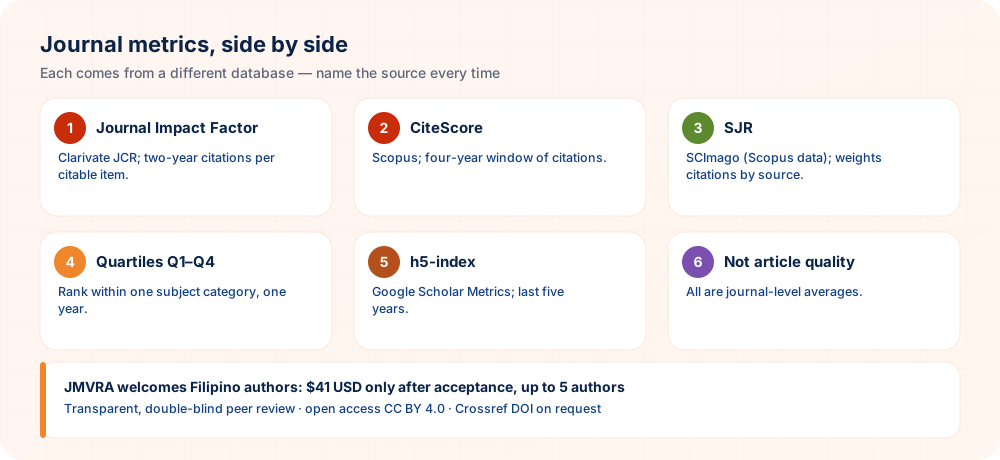
Each year Clarivate releases the Journal Impact Factor (JIF) in its Journal Citation Reports. Roughly speaking, a year’s value divides the citations that year to items the journal printed in the two preceding years by the count of citable items from those two years. A JIF is awarded only to journals indexed in the Web of Science Core Collection. Because it is a journal-level average, it cannot reliably predict how often one particular article will be cited. Treat it as one signal about a journal rather than a verdict on your own paper.
Impact Factor, CiteScore and SJR Explained
| Journal Impact Factor | CiteScore | SJR | |
|---|---|---|---|
| Provider | Clarivate | Elsevier (Scopus) | SCImago (Scopus data) |
| Window | Two years | Four years | Three years |
| Weighting | All citations equal | All citations equal | Citations from more prestigious sources carry extra weight |
| Coverage | Web of Science Core Collection | Scopus | Scopus |
| Where to check | JCR (subscription) | Scopus Sources (free) | scimagojr.com (free) |
Figures taken from different databases are not directly comparable. A journal with an SJR of 0.5 and one with a JIF of 2.0 cannot be ranked against each other using only those values. Be wary of “impact factors” quoted by unfamiliar websites, and see impact factor vs Google Scholar metrics.
Philippine Journals Whose Metrics You Can Check
Every journal listed below reports Scopus coverage, which means Scopus metrics (CiteScore, SJR) are available for you to look up, and those also found in Web of Science may carry a Journal Impact Factor. The figures themselves are left out here since they shift annually, so consult the links for current values. Write down the year beside any figure you record so later comparisons stay fair.
| Journal | Field | Reported coverage | Check metrics |
|---|---|---|---|
| Philippine Journal of Science | Natural sciences, engineering, mathematics, social sciences | Scopus; Web of Science | JCR · Scopus · SCImago |
| The Philippine Agricultural Scientist | Tropical agriculture and related sciences | Scopus; Web of Science | JCR · Scopus · SCImago |
| Philippine Journal of Veterinary Medicine | Veterinary and biomedical science | Scopus; Web of Science: Zoological Record | JCR · Scopus · SCImago |
| Acta Medica Philippina | Medicine and health sciences | Scopus; PubMed Central | JCR · Scopus · SCImago |
| Mindanao Journal of Science and Technology | Science, engineering and technology | Scopus; Web of Science ESCI | JCR · Scopus · SCImago |
| Asia-Pacific Social Science Review | Social sciences | Scopus | JCR · Scopus · SCImago |
| DLSU Business & Economics Review | Accounting, business, economics, finance, marketing | Scopus | JCR · Scopus · SCImago |
| The Asia-Pacific Education Researcher | Education | Scopus; Web of Science SSCI | JCR · Scopus · SCImago |
| Humanities Diliman | Humanities (multilingual) | Scopus | JCR · Scopus · SCImago |
| Philippine Studies: Historical and Ethnographic Viewpoints | History, ethnography, Philippine studies | Scopus | JCR · Scopus · SCImago |
| Kritika Kultura | Literary, language and cultural studies | Scopus; Web of Science AHCI | JCR · Scopus · SCImago |
| Kritike: An Online Journal of Philosophy | Philosophy | Scopus; Web of Science | JCR · Scopus · SCImago |
| Philosophia: International Journal of Philosophy | Philosophy | Scopus; Web of Science AHCI | JCR · Scopus · SCImago |
| Recoletos Multidisciplinary Research Journal | Multidisciplinary | Scopus | JCR · Scopus · SCImago |
According to De La Salle University, The Asia-Pacific Education Researcher has been placed in Q1 of the Social Sciences Citation Index within its education category (DLSU announcement). Since quartiles are recalculated annually, verify the present standing in JCR. Announcements are best used as a pointer, with the live database entry as the final check.
A number of Filipino researchers aim as well for international high-impact journals in their discipline. The approach is identical: locate such titles via JCR or Scopus subject categories instead of relying on lists from unfamiliar websites.
Understanding Journal Quartiles
A quartile splits the journals of one subject category into four equal groups ranked by a metric, with Q1 as the top 25% and Q4 as the bottom 25%. Promotion or incentive rules that speak of “high impact” frequently mean Q1 and Q2 journals. Keep in mind that quartiles depend on both category and year, and that Clarivate and SCImago can assign one journal to different quartiles.
Steps for Finding High-Impact Journals
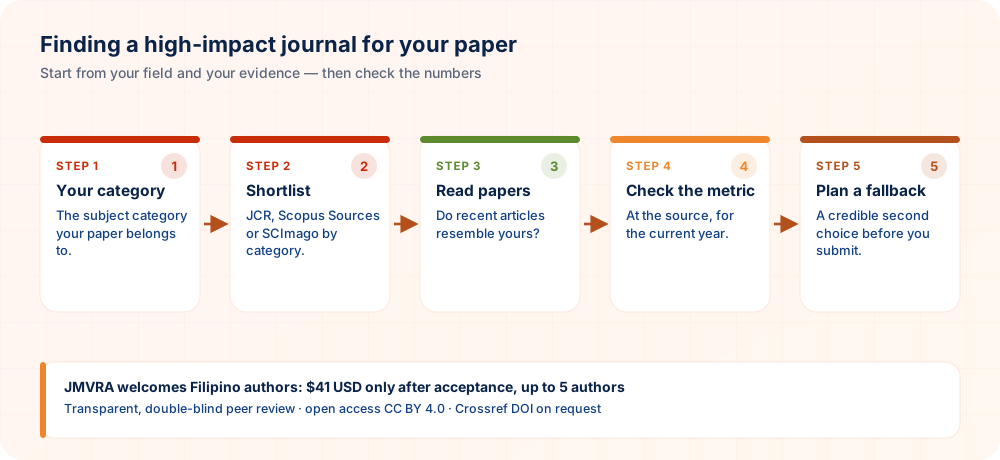
- Pinpoint your subject category, meaning the field your paper’s readers and references come from.
- Build a shortlist by category using JCR (when your library has a subscription), Scopus Sources or SCImago.
- Go through recent articles from every candidate journal; their methods, length and scope should be close to your paper’s.
- Review your own reference list; the journals you cite most often are logical targets.
- Choose a backup journal ahead of submission so that a rejection does not waste weeks.
Verifying a Journal Impact Factor
- Look the journal up in Journal Citation Reports via your university library, or confirm its status in the Master Journal List.
- Make sure the value, year and category agree with the journal’s own claim.
- To see Scopus metrics, view the journal’s entry in Scopus Sources and on SCImago.
- Be suspicious of any “impact factor” credited to an unfamiliar provider.
Choosing a Journal by Subject Area
| Field | Philippine journals worth reading first | Then search |
|---|---|---|
| Health & medicine | Acta Medica Philippina | JCR / Scopus medicine categories |
| Agriculture & veterinary | The Philippine Agricultural Scientist; Philippine Journal of Veterinary Medicine | Agronomy, veterinary sciences |
| Science & engineering | Philippine Journal of Science; Mindanao Journal of Science and Technology | Multidisciplinary sciences, engineering |
| Education | The Asia-Pacific Education Researcher | Education & educational research |
| Business & economics | DLSU Business & Economics Review | Business, economics |
| Social sciences & humanities | Asia-Pacific Social Science Review; Philippine Studies; Kritika Kultura; Kritike | Social sciences, history, literature, philosophy |
Impact Factor Within the Philippine Setting
Metrics matter to many Filipino academics because of institutional rules. Promotion schemes at universities and research incentive programmes often reward articles in journals indexed in Scopus or Web of Science, and some assign greater weight to higher quartiles. CHED’s Journal Incentive Program has supported Philippine journals that gain Scopus or Web of Science indexing, which partly explains why more local journals now display those badges. Ask your research office for the exact wording of any scheme before you plan around it.
These rules differ by institution and change with time, so handle them as an item to verify rather than something to assume:
- Work out what your rule actually names: a database such as Scopus or Web of Science, an index like SSCI, or a particular quartile.
- Confirm which year’s metric is applied: submission, acceptance or publication.
- Store dated proof of the journal’s indexing and quartile alongside your submission records.
Satisfying the rule and picking the right journal for your paper are two different questions, and both must be answered before you submit.
Why Impact Factor on Its Own Falls Short
- Fit counts for more: no matter how strong a paper is, it will be turned down if it lies beyond the journal’s scope.
- Disciplines differ: citation customs vary, which means a “high” JIF in mathematics could be only average in medicine.
- Readership counts: a regional journal can put your work in front of those who will really apply it.
- Time and money count: very selective journals may need many months and sometimes levy high APCs.
Typical Journal Selection Errors
- Picking a journal on impact factor without reading what it has published recently.
- Believing an impact factor that appears solely on the journal’s own site.
- Overlooking whether the journal remains indexed or was discontinued.
- Sending a local case study to a journal that accepts only wide-ranging international studies.
Hands-On Tips for Submitting Your Manuscript
Compose a cover letter that says in three sentences why the paper fits this journal, stick closely to the template, run a similarity check and cite your own earlier work, and respond to reviewers point by point. Should the paper be rejected, use the feedback to strengthen it before it goes to your backup journal. A concise, honest letter helps editors decide quickly and sets a professional tone.
How JMVRA suits Filipino authors
JMVRA’s 11.25 impact factor comes from Google Scholar data. It is not a Clarivate Journal Impact Factor, and the journal is not indexed in Scopus or Web of Science. Authors who want an affordable, peer-reviewed open access venue, not a JCR-ranked title, are the ones it serves.
- Fee: Foreign authors pay $41 USD, due solely once the paper is accepted; the charge covers up to 5 authors, and nothing is collected at submission or while the paper is under review.
- Review: Subject experts carry out a transparent, double-blind peer review, and the similarity score has to stay under 15%.
- Access: Articles are open access under a CC BY 4.0 licence, authors retain their copyright, and a Crossref DOI can be requested.
- Where we stand on indexing: present in Google Scholar; not included in Scopus, Web of Science or DOAJ.
Also take a look at the essentials for international authors submitting to JMVRA and the author guidelines.
At-a-Glance Checklist
- Name the metricState whether it is JIF, CiteScore or SJR, and where it comes from
- Year and categoryA quartile is valid only for a single category and year
- Checked at the sourceUse JCR, Scopus Sources or SCImago
- Matching scopeLatest articles are similar to your manuscript
- Backup optionA reputable second journal is picked out
A Step-by-Step Path to High-Impact Journals for Authors in the Philippines
| Stage | Goal |
|---|---|
| First papers | Strong research, reported clearly and published in genuine peer-reviewed journals from the Philippines and beyond |
| Building | Partnerships throughout ASEAN, bigger samples and more robust methods |
| Targeting | Journals in the Q1 or Q2 bands of your subject category, as verified in JCR or Scopus |
| Sustaining | Following one steady research line, sharing data and acting as a journal referee |
The Role of Journal Metrics in the Philippines
- Say which metric applies — JIF, CiteScore or SJR, or a number built on Google Scholar
- Find out where it originates — then check the journal there on your own
- Compare only within a single discipline — not across different ones
- Note down every check — with its date, so evaluators can review it
Verifying Journal Metrics Advertised to Filipino Researchers
Filipino authors will meet many journals that advertise impressive-sounding figures. The steps below turn verification into a routine habit so that no claim is accepted on trust alone.
- Trace each claim to its origin. When a journal website shows a metric, look for the independent provider that produces it and search for the title there. If you cannot find it, treat the claim as unproven.
- Compare names and ISSNs carefully. Dishonest sites sometimes imitate well-known titles with small spelling changes. Match the exact title and ISSN against an official listing before you rely on any figure.
- Consider the discipline's norms. Citation patterns vary widely between subjects, so a modest figure in one field may be respectable in another. Compare journals only against others in the same subject.
- Ask your research office about local rules. Your university research office can explain which evidence your institution requires for grants or promotion. Confirm requirements in writing before committing to a venue.
- Screenshot evidence for your records. Save dated captures of the pages you used to verify a journal. If questions arise later, you can show the checks you made at the time.
Treat every advertised metric as a claim to be confirmed at its source, and keep dated proof of the checks you carried out.
Questions Researchers Often Ask
Worth reading as well: journals in the Philippines covered by Scopus and Web of Science, along with the research journals list for the Philippines and affordable journal publishing.
Summary and What to Do Next
A high-impact venue may give solid research wider visibility, yet the figure displayed on a journal’s homepage is merely a starting point. Work out which metric it is, confirm it at the original source for the present year, and select the journal whose audience and scope match your paper. Keeping a dated note of each check makes later reporting to your institution much simpler.
- Pin down your subject category along with any metric your institution requires.
- Build a shortlist by category using JCR, Scopus Sources or SCImago.
- Confirm the up-to-date metric and quartile, then go through some recent articles.
- Send the manuscript to the closest match and hold a reputable alternative in reserve.
Ready to send in your paper?
Authors from across the Philippines are welcome to send manuscripts to JMVRA. Submitting online costs nothing, transparent double-blind review happens first, and the $41 USD publication fee falls due only when your paper is accepted.
Related searches
Anyone in the Philippines using this guide is probably also researching journal publication in Philippines, paper publication fees, journals indexed by Scopus and Web of Science, high impact factor journals and open access journals that are affordable. Each topic is covered by the guides below:
References and Sources
We compared the facts here with the following sources on 4 October 2026. Because indexing, fees and policies may change, confirm them once more prior to submitting.
- Journal Citation Reports
- Clarivate Master Journal List
- Scopus Sources
- SCImago Journal & Country Rank
- De La Salle University — TAPER ranked Q1 in SSCI
- Philippine E-Journals — Scopus accredited journals
Philippine Authors Publishing in JMVRA
- Online submissionPossible from any location in the Philippines, with no charge when you submit
- ScreeningChecks on scope and similarity (below 15%)
- Double-blind reviewSubject experts review it; the decision is emailed to you
- Accepted — $41 USDA single fee, covering up to 5 authors
- PublicationOpen access under CC BY 4.0, with a DOI available if requested
Details: Publication charges · Peer review · Advice for authors outside India.
Ready to Publish? Submit to JMVRA
JMVRA is aligned with UGC's Suggested Parameters for Choosing Peer-Reviewed Journals.
JMVRA is a Transparent, Peer-Reviewed, Open Access Journal (Refereed Journal). Following the discontinuation of the UGC and UGC-CARE journal listing, and in alignment with the latest UGC-CARE recommendations and guidelines, JMVRA is aligned with UGC’s Suggested Parameters for Choosing Peer-Reviewed Journals.
Helpful pages on jmvra.org
Key Terms
Subjects and search phrases this article addresses.
Related Reading
Further guides about publishing from the Philippines and selecting a journal.
A Researcher’s Complete Guide to Journals in the Philippines
Read the guide RelatedPhilippine E-Journals (PEJ): A Practical Guide
Read the guide RelatedScopus & Web of Science Journals: Philippines
Read the guide RelatedAffordable Journal Publication in the Philippines
Read the guide RelatedJournal Impact Factor vs Google Scholar Metrics
Read the guide RelatedWeb of Science Q1–Q4 Quartiles Explained
Read the guideKeep Reading on the JMVRA Blog
This guide belongs to the JMVRA journal blog, which offers practical advice on publishing, indexing, metrics and research integrity, written to be checkable instead of promotional.