
Need a list of journals in the Philippines? What follows is a verified starting list of 18 Philippine research journals, giving each one's publisher, subject area and reported indexing, and then a hands-on way to pick among them and confirm a journal is genuine before submitting. Students, Ph.D. scholars and faculty nationwide can use it, whether in Quezon City, Manila, Cebu City, Davao City or Cagayan de Oro.
How Academic Journal Publishing Works in the Philippines
Three kinds of publisher underpin research publishing in the Philippines: universities (including Ateneo de Manila, De La Salle, the University of Santo Tomas, the University of the Philippines system and many regional state and private institutions), government research bodies like the Department of Science and Technology (DOST) and the National Research Council of the Philippines (NRCP), and professional and learned societies. A large share of their journals appear on Philippine E-Journals, which carries more than 280 journals from over 150 publishers.
How publications are counted is influenced by two national bodies. The Commission on Higher Education (CHED) defines research and publication expectations for higher education institutions, and it has operated journal accreditation and incentive schemes that favour journals indexed in Scopus or Web of Science. The Department of Science and Technology issues the long-established Philippine Journal of Science and backs national research via the NRCP. Still, it is your own university’s research office that determines what counts toward promotion, a thesis or an incentive, so follow its written rule first.
Directory of Research Journals in the Philippines
Each journal below was picked because it is active, peer-reviewed and issued by a Philippine institution that can be identified. What the journal, its publisher or Philippine E-Journals declares appears in the “reported coverage” column; since indexing changes, confirm it in Scopus Sources or the Clarivate Master Journal List prior to submitting.
| Journal | Publisher | Subject area | Reported coverage |
|---|---|---|---|
| Philippine Journal of Science | DOST – Science and Technology Information Institute | Natural sciences, engineering, mathematics, social sciences | Scopus; Web of Science |
| The Philippine Agricultural Scientist | UP Los Baños, College of Agriculture and Food Science | Tropical agriculture and related sciences | Scopus; Web of Science |
| Philippine Journal of Veterinary Medicine | UP Los Baños, College of Veterinary Medicine | Veterinary and biomedical science | Scopus; Web of Science: Zoological Record |
| Acta Medica Philippina | University of the Philippines Manila | Medicine and health sciences | Scopus; PubMed Central |
| Mindanao Journal of Science and Technology | University of Science and Technology of Southern Philippines | Science, engineering and technology | Scopus; Web of Science ESCI |
| Asia-Pacific Social Science Review | De La Salle University | Social sciences | Scopus |
| DLSU Business & Economics Review | De La Salle University | Accounting, business, economics, finance, marketing | Scopus |
| The Asia-Pacific Education Researcher | De La Salle University with Springer | Education | Scopus; Web of Science SSCI |
| Humanities Diliman | UP Diliman | Humanities (multilingual) | Scopus |
| Philippine Studies: Historical and Ethnographic Viewpoints | Ateneo de Manila University | History, ethnography, Philippine studies | Scopus |
| Kritika Kultura | Ateneo de Manila University | Literary, language and cultural studies | Scopus; Web of Science AHCI |
| Kritike: An Online Journal of Philosophy | University of Santo Tomas | Philosophy | Scopus; Web of Science |
| Philosophia: International Journal of Philosophy | Philippine National Philosophical Research Society | Philosophy | Scopus; Web of Science AHCI |
| Recoletos Multidisciplinary Research Journal | University of San Jose–Recoletos | Multidisciplinary | Scopus |
| Asian Journal of Biodiversity | Liceo de Cagayan University | Biodiversity and ecology | Listed by PEJ as Clarivate-accredited |
| NRCP Research Journal | National Research Council of the Philippines (DOST) | Multidisciplinary | EBSCO (Scopus/WoS application stated as planned) |
| Silliman Journal | Silliman University | Humanities, social sciences and sciences | Check current indexing at source |
| Philippine Sociological Review | Philippine Sociological Society | Sociology | JSTOR archive; check indexing at source |
Verified on 4 October 2026 using each journal’s website, its publisher and Philippine E-Journals. Treat it as a starting list, neither a ranking nor a full count of Philippine journals.
Philippine Journals Organised by Discipline
| Discipline | Journals in this list |
|---|---|
| Multidisciplinary & sciences | Philippine Journal of Science; NRCP Research Journal; Recoletos Multidisciplinary Research Journal; Silliman Journal; Mindanao Journal of Science and Technology |
| Agriculture, veterinary & biodiversity | The Philippine Agricultural Scientist; Philippine Journal of Veterinary Medicine; Asian Journal of Biodiversity |
| Medicine & health | Acta Medica Philippina |
| Business, economics & education | DLSU Business & Economics Review; The Asia-Pacific Education Researcher |
| Social sciences | Asia-Pacific Social Science Review; Philippine Sociological Review; Philippine Studies: Historical and Ethnographic Viewpoints |
| Humanities & philosophy | Humanities Diliman; Kritika Kultura; Kritike; Philosophia: International Journal of Philosophy |
Should your field be missing, look through Philippine E-Journals by subject or institution, because the majority of universities issue at least one institutional research journal and many professional societies run one for their discipline.
Research Centres in the Philippine Regions
Most journal publishing happens near the big research universities, yet researchers in every region publish. The cards present the 18 regions and their main cities, and name the publisher wherever a journal from this guide is issued in that region.
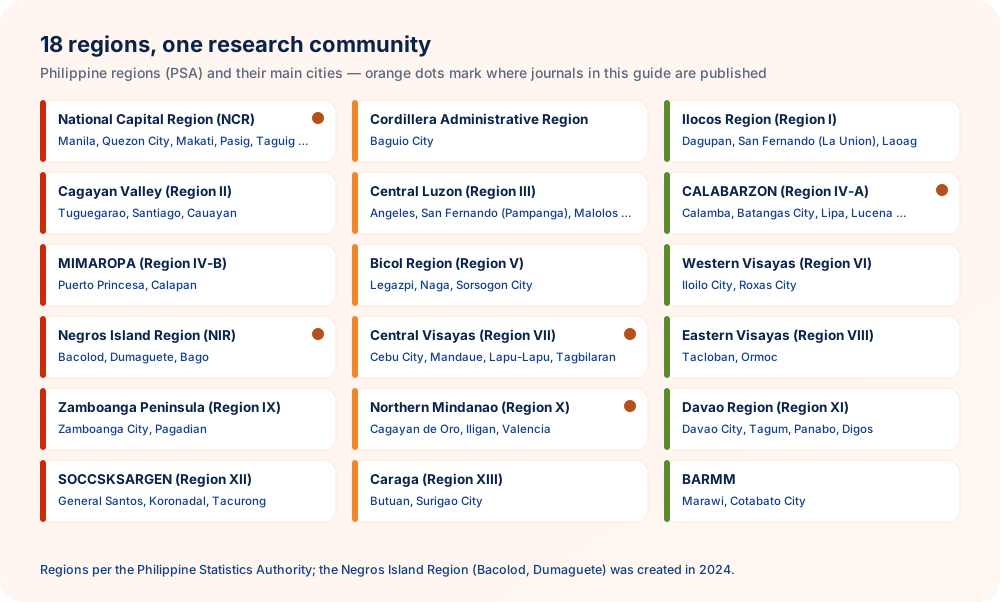
Where you live does not restrict where you can publish, since submission, review and publication all happen online. Someone in Baguio City, Iloilo City, Legazpi, Tacloban, Zamboanga City or General Santos may submit to a journal in Manila or abroad under identical conditions.
University Journals Compared With Independent Academic Journals
| University journal | Independent or international journal | |
|---|---|---|
| Publisher | A university press or research office | A society, a commercial or independent publisher |
| Scope | Often the university’s strengths, sometimes multidisciplinary | Usually a defined subject or a broad multidisciplinary scope |
| Authors | Mix of internal and external authors | Authors from many institutions and countries |
| Fees | Often low or none (check each journal) | From none to high APCs |
| What to check | External reviewers and independence of decisions | Publisher identity, review policy and fee terms |
Neither category wins by default. A university journal with outside reviewers and a transparent policy can suit a paper very well, and the same goes for a carefully run independent journal. Evaluate the individual journal rather than its type. Ask who actually makes the editorial decisions and on what basis.
Multidisciplinary Versus Specialized Research Journals
Papers that span several fields or address a general academic readership fit multidisciplinary journals such as the Philippine Journal of Science, the Recoletos Multidisciplinary Research Journal or the NRCP Research Journal. With specialized journals — Acta Medica Philippina for health research, The Philippine Agricultural Scientist for agriculture, Kritike for philosophy — you reach the readers and reviewers nearest to your topic. Generally, pick a specialised title if the paper addresses one community mainly, and a multidisciplinary one if its strength is linking disciplines.
Choosing the Right Journal
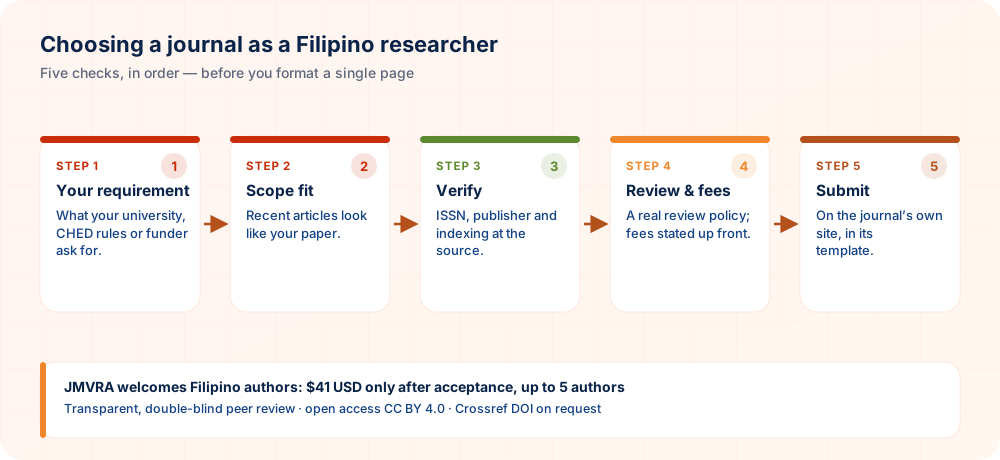
- Begin with your requirement. Is Scopus or Web of Science needed by your university, or a CHED-recognised journal, or only a peer-reviewed one?
- Check the scope fits. Go through three recent articles, and if none looks like yours, try another journal.
- Think about readership. Decide whether local practitioners, regional scholars or an international field should read the paper.
- Study the author guidelines. They cover length, referencing style, language and any article processing charge.
- Have a backup ready. Select a trustworthy second option before submitting to your first.
how to choose a journal in seven steps offers a fuller method.
Ways to Confirm a Journal's Credibility
- The title on the ISSN Portal corresponds exactly to the ISSN.
- Publisher, editorial board and contact address all exist and can be verified.
- A named model appears in the peer review policy, and decisions arrive with reviewer comments.
- Each indexing claim can be found in the database itself and not merely on a logo.
- Fees are stated ahead of submission and billed solely after acceptance.
Websites cloned from a real journal’s name and ISSN are a recognised problem, and five checks to spot predatory and cloned journals explains how to catch them.
Checklist Before You Submit a Manuscript
- Journal decidedScope, requirement and indexing double-checked
- Template observedFormat, style of references and length
- Similarity assessedEvery source referenced, including your own work earlier
- Ethics ensuredConflicts declared and approval and consent recorded
- Author details matchNames and affiliations formatted as they should be published
- Cover letter setWhy the paper is a good fit for this journal
Frequent Errors to Steer Clear Of
- Picking a journal because of an advert or WhatsApp message rather than its own website.
- Taking a Philippine E-Journals listing to mean indexing in Scopus or Web of Science.
- Sending one paper to two journals simultaneously.
- Overlooking the journal’s template and referencing style.
- Handing over a fee prior to getting a real acceptance accompanied by reviewer comments.
JMVRA's place for Filipino authors
JMVRA is an India-based international, multidisciplinary open access journal (ISSN 2984-8911). Although it is not a Philippine journal, it welcomes papers from authors in every region of the Philippines.
- Fee: $41 USD for foreign authors, due only following acceptance and valid for up to 5 authors; nothing is charged at submission or while under review.
- Review: transparent, double-blind peer review carried out by subject experts, with similarity required to stay under 15%.
- Access: published openly under CC BY 4.0, with copyright retained by authors and a Crossref DOI obtainable on request.
- Indexing in brief: the journal is in Google Scholar; it is not in Scopus, Web of Science or DOAJ.
Read what international authors should know about JMVRA as well as the author guidelines.
A 12-Month Publishing Roadmap for Researchers in the Philippines
| Months | Focus |
|---|---|
| 1–3 | Settle on a focused question and two or three target journals, then consult national systems like CHED journal accreditation and Philippine E-Journals (PEJ) along with the international databases |
| 4–6 | Obtain and analyse data, writing directly within the template of the journal you target |
| 7–9 | Ask a supervisor or colleague for feedback, and submit to just one journal at a time |
| 10–12 | Address reviewers’ comments in a revision; share the published work and keep ORCID and Google Scholar current |
Choosing a Language as an Author in the Philippines
Researchers in the Philippines work in Filipino and English. Choose the language according to who needs to read the paper.
Write in Filipino
Gets the work to readers, practitioners and policy makers in the Philippines.
Publishing in English
It is seen by readers, reviewers and indexes across the globe.
Abstract in two languages
Pairing a Filipino-language paper with an English title and abstract helps it be found internationally.
Language editing support
Have a colleague or editor read the final version before you submit.
Practical Advice for Filipino Authors Choosing a Journal
Researchers in the Philippine archipelago often work across campuses, islands and disciplines. These suggestions help you turn a long list of journals into a confident, well-reasoned choice.
- Check your agency's expectations early. Before drafting, ask your graduate office or research unit what they expect of a publication outlet. Requirements for theses, promotion and grants differ, and learning them late can force costly rewrites.
- Use local relevance as a strength. If your study concerns Philippine communities, schools or ecosystems, favour journals whose readers care about that context. Explain the local setting clearly so international reviewers can follow your reasoning.
- Write abstracts for a wider audience. Many readers will find your article through an abstract alone. Keep it plain, state the main finding clearly, and avoid abbreviations that only your own institution would recognise.
- Share drafts with a language reader. Whether you write in English or another language, ask a trusted colleague outside your topic to read the draft. Confusing sentences are easier for a fresh reader to spot.
- Plan around academic calendars. Schedule submission around teaching loads, enrolment periods and field trips, and leave room for revision. Reviewer comments can arrive at inconvenient moments, so keep your data organised and accessible.
Match the journal to your study's audience and your institution's requirements, and prepare the manuscript for readers beyond your own campus.
Questions Researchers Often Ask
Next steps: explore Philippine e-journals and online platforms, view the Scopus and Web of Science journals in the Philippines, or learn about Affordable Journal Publication in the Philippines.
Summary and What to Do Next
Research publishing in the Philippines is active, spanning national science journals and university journals in each major region. The list above is a dependable starting point, while the checks and checklist help you find a journal suited to your paper and requirement and sidestep the traps that snare hurried authors.
- Note your requirement (university, CHED-related or funder) before you shortlist journals.
- Pick two or three journals from the directory and go through their latest articles.
- Check every journal with the indexing checks in our Scopus and Web of Science guide.
- Format the manuscript to the selected journal’s template and submit through that journal's own website.
Ready to send in your paper?
Authors from all over the Philippines are welcome to send manuscripts to JMVRA. Submitting online costs nothing, a transparent double-blind review comes first, and the $41 USD publication fee applies only if the paper is accepted.
Related searches
Readers of this guide in the Philippines often search too for journal publication in Philippines, paper publication fees, Scopus and Web of Science indexed journals, high impact factor journals and affordable open access journals. The guides below address those topics:
References and Sources
The facts here were verified on 4 October 2026 using the sources listed. Because indexing, fees and policies can change, recheck them prior to submitting.
Publishing With JMVRA From the Philippines
- Submit onlineAvailable throughout the Philippines; no fee when submitting
- Pre-reviewScope assessment and similarity (below 15%)
- Double-blind reviewExperts in the field assess it; you are told by email
- Accepted — $41 USDOne charge applies to up to 5 authors
- PublishedOpen access under CC BY 4.0; DOI available on request
Details: Publication charges · Peer review · Advice for authors outside India.
Ready to Publish? Submit to JMVRA
JMVRA is aligned with UGC's Suggested Parameters for Choosing Peer-Reviewed Journals.
JMVRA is a Transparent, Peer-Reviewed, Open Access Journal (Refereed Journal). Following the discontinuation of the UGC and UGC-CARE journal listing, and in alignment with the latest UGC-CARE recommendations and guidelines, JMVRA is aligned with UGC’s Suggested Parameters for Choosing Peer-Reviewed Journals.
Where to go next on jmvra.org
Key Terms
Subjects and search phrases this article addresses.
Related Reading
More guides on publishing from the Philippines and on choosing a journal.
Research Journals in Indonesia: SINTA & Scopus
Read the guide RelatedResearch Journals in Malaysia: MyCite & Scopus
Read the guide RelatedPhilippine E-Journals (PEJ): A Practical Guide
Read the guide RelatedScopus & Web of Science Journals: Philippines
Read the guide RelatedAffordable Journal Publication in the Philippines
Read the guide RelatedHigh-Impact Journals for Filipino Researchers
Read the guide RelatedChoosing a Journal: A 7-Step Scoring Framework
Read the guide RelatedFive Checks Before You Submit or Pay
Read the guideKeep Reading on the JMVRA Blog
Find this guide on the JMVRA journal blog, a collection of practical guidance on publishing, indexing, metrics and research integrity that favours verifiable content over promotion.