
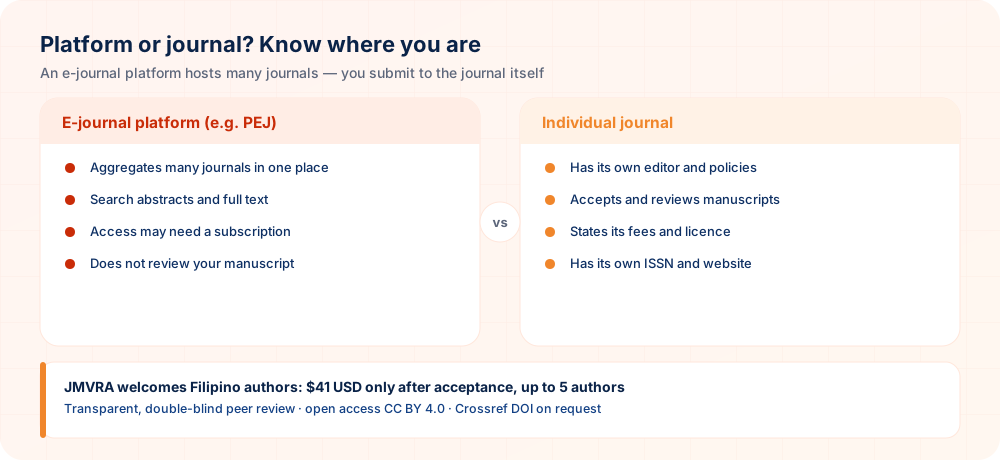
A Philippines e-journal is a scholarly journal published on the internet, generally by a university or professional body in the country. The best-known place to look for them is Philippine E-Journals (PEJ), an online collection with more than 280 journals and over 32,000 articles. This guide describes how PEJ and university journal platforms operate, how to locate and read full-text papers, and how to submit your own paper online, while keeping apart a platform that hosts journals and a journal that publishes your work.
What Counts as a Philippine E-Journal?
An "e-journal" is simply a journal whose articles are published and read on the internet. Most university and society journals in the Philippines now appear electronically, frequently next to a printed edition. A number run their own sites on systems like Open Journal Systems, and many also deposit issues on a platform so that a wider readership can find them. Knowing which route a journal uses tells you where to look for its latest issue.
E-journals simplify two tasks for researchers: locating Philippine research that international databases seldom index, and sending in work without mailing printed copies.
An Introduction to Philippine E-Journals (PEJ)
Philippine E-Journals presents itself as an online collection of scholarly publications from higher education institutions and professional organisations. Its homepage on 4 October 2026 showed 284 journals, 32,781 articles, 48,195 authors and 157 publishers. KITE Digital Educational Solutions operates it, and CE-Logic distributes it.
Journals A–Z
Each journal listed by title, with its publisher and issues.
Articles & authors
Look up keywords, titles or authors across every journal.
Abstracts & full text
Abstracts can be read freely; full text might call for an institutional subscription.
Scopus & Clarivate pages
Pages that list the titles PEJ labels as accredited by Scopus or Web of Science.
New issues
The homepage features journals and issues that were published recently.
Subscribers
Libraries pay for access so that their students and faculty can read the full text.
Online Academic Journal Platforms: A List
Apart from PEJ, a number of Philippine universities host their journals on platforms of their own. The list below distinguishes platforms, where you search and read, from journals, where you submit.
Philippine E-Journals (PEJ)
A collection of journals from universities and professional bodies in the Philippines; abstracts are free and full text frequently needs a subscription. It has separate pages for the journals it lists as accredited by Scopus and Web of Science.
UP Diliman Journals Online
An open journal site that hosts UP Diliman titles, for example Humanities Diliman.
UPLB journal repository
A university repository holding UP Los Baños journals, among them agricultural and veterinary titles.
Ateneo journals online
Journals from Ateneo de Manila, Philippine Studies among them; Archium Ateneo also hosts Kritika Kultura.
DLSU Animo Repository
The De La Salle University repository, which hosts journals like the Asia-Pacific Social Science Review.
NRCP Research Journal
A journal rather than a platform, belonging to the National Research Council of the Philippines; submissions are taken online and publishing is free.
E-Journals Compared With Open-Access Journals
| E-journal | Open-access journal | |
|---|---|---|
| Meaning | Published online | Anyone can read it free, right away |
| Reader cost | A subscription may be needed | None |
| Licence | Differs; all rights are often reserved | Typically a Creative Commons licence, such as CC BY |
| Author cost | Varies | Ranges from no charge (diamond) to an APC (gold) |
| Example | Numerous journals on PEJ (full text by subscription) | Humanities Diliman, Kritike, Acta Medica Philippina |
An e-journal may be open access, but not all of them are. When you want anyone to be able to read your paper free of charge, look at the journal's licence before submitting. Open Access in Practice: Routes and Licences describes the gold, green and diamond routes. A licence stated clearly on the journal website is a good sign of an open policy.
Searching for Academic Articles
- Begin widely on PEJ with two or three keywords, and write down the journals that keep turning up.
- Look up an author when you have found an important researcher in your area.
- Try Google Scholar with the same terms, as it frequently links to a free copy of a paper.
- Look at university platforms like UP Diliman Journals Online or the DLSU Animo Repository.
- Keep a log of your searches, including terms, dates and results, particularly for a literature review.
Getting Full-Text Research Papers
- Via your library: many universities subscribe to PEJ, so sign in through the library website, either on campus or remotely.
- Via open-access journals: journals with a CC licence can be read free on their own websites.
- Via repositories: university repositories frequently keep free copies.
- Ask the authors: a courteous email to the corresponding author often succeeds.
Submitting a Research Paper Online
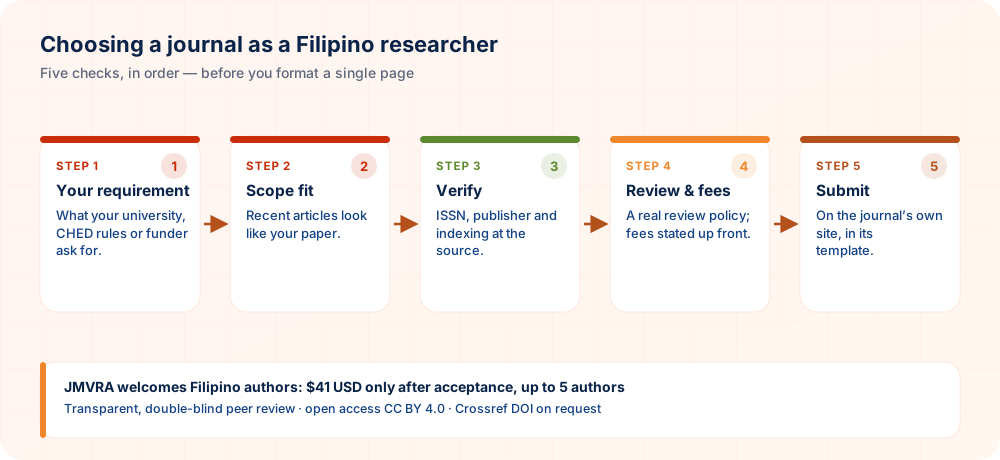
- Locate the journal's own website, not the platform page, and read the author guidelines.
- Create an author account in the journal's submission system, using an email address that you read regularly.
- Get the files ready that the journal requests: for double-blind review an anonymised manuscript, plus a title page, figures and declarations.
- Fill in the metadata precisely: names, affiliations, ORCID iDs, abstract and keywords.
- Submit, then save the reference number, and include it in every message to the editor.
Advantages of Publishing in an E-Journal
Wider reach
Readers in other regions and countries can locate the paper online.
Faster dissemination
Once a paper is published there is no delay for printing and mailing.
Discoverability
Google Scholar and databases can lead readers to online articles.
Permanent links
Articles in journals that assign DOIs get a link that stays stable.
Lower costs
Publishing online first keeps the costs of production lower.
For students
A first paper is simpler to submit, follow and share.
Philippine E-Journals by Subject Area
The table indicates where some familiar Philippine journals can be read online. Many are available on their own website and on a platform as well, so pick whichever one gives you full text through your library.
| Journal | Field | Read it on |
|---|---|---|
| Philippine Journal of Science | Multidisciplinary sciences | The journal's own site (DOST) |
| Humanities Diliman | Humanities | UP Diliman Journals Online |
| Philippine Studies: Historical and Ethnographic Viewpoints | History, ethnography | Ateneo journals online |
| Kritika Kultura | Literary and cultural studies | Archium Ateneo |
| Asia-Pacific Social Science Review | Social sciences | DLSU Animo Repository; Philippine E-Journals |
| Recoletos Multidisciplinary Research Journal | Multidisciplinary | Its own site; Philippine E-Journals |
| Acta Medica Philippina | Medicine and health | Its own site (UP Manila) |
| NRCP Research Journal | Multidisciplinary | Its own site (DOST-NRCP) |
Advice for students who use e-journals
- Sign in with your school account. Libraries in Manila, Cebu City, Davao City and other university centres often hold subscriptions for you, and access from off campus normally goes through the library portal.
- Begin with review articles. They sum up a field and direct you towards its main papers.
- Choose the version of record. Cite the final published article rather than an early draft, adding its DOI if there is one.
- Use a reference manager. With Zotero or Mendeley you can save records directly from journal pages.
Citing an article from a Philippine e-journal
An online article is cited like any other journal article, with the DOI or a stable URL added. In APA 7 style: Author, A. A. (Year). Title of the article. Journal Name, volume(issue), pages. https://doi.org/xxxx. When no DOI exists, give the journal's own article URL instead of a PEJ search page, so readers arrive at the article itself. A link that leads straight to the paper saves your readers time.
Recognising Genuine Online Journals
- A real publisher, such as a university, government agency or society that you can find on your own.
- An ISSN that agrees with the title on the ISSN Portal.
- A peer review policy, an editorial board and an ethics policy, all published.
- Any fees are announced before submission and charged after acceptance.
- Indexing claims that can be confirmed in the database itself.
How JMVRA Suits Filipino Authors
JMVRA (ISSN 2984-8911) is a multidisciplinary, international open access e-journal based outside the Philippines; it appears online monthly and welcomes manuscripts from Filipino authors. Check that the journal’s scope matches your subject before preparing the manuscript.
- Fee: Foreign authors pay $41 USD, due solely once the paper is accepted; the amount covers as many as 5 authors, and nothing is charged when submitting or during review.
- Review: Subject experts run a transparent, double-blind peer review, and the similarity score has to stay under 15%.
- Access: Papers are open access under CC BY 4.0, copyright stays with the authors, and a Crossref DOI can be requested.
- Our indexing position: Google Scholar includes us, while Scopus, Web of Science and DOAJ do not.
Read a guide for international authors on JMVRA along with the author guidelines.
At-a-Glance Checklist
- Correct platformYou can tell hosting sites apart from the journals that publish papers
- Library accessFull text opens with your university sign-in
- Journal verifiedYou have confirmed the ISSN, publisher and peer review policy
- Licence understoodYou know whether it is subscription or open access
- Sent to the journalVia the journal’s own system rather than a platform listing
How to Search Philippine E-Journals Well
- Begin with precise keywords — English or Filipino both work
- Narrow by subject and year — to trim the result list
- Look at the journal behind every article — its publisher and peer review
- Give complete citation details — add the DOI when there is one
Reaching International Journals as a Philippine Author
Understand what accreditation you require
Review the requirements of CHED and your institution.
Use international formats
Follow APA, IEEE or whichever style the journal sets.
Mind the currency
Overseas journals frequently quote fees in USD; foreign authors at JMVRA pay $41 USD once accepted.
Share locally too
Brief summaries aimed at Filipino readers.
Practical Tips for Searching and Citing Philippine E-Journals
Online journal platforms from the Philippines contain valuable local scholarship that is easy to overlook. These suggestions help students and researchers find, read and cite such sources with care.
- Search with local vocabulary. Try Filipino and regional terms, alternative spellings and place names alongside English keywords. Local studies are often indexed under words an international search would never include.
- Check the journal's publisher. Look for a named university, society or agency behind a journal, with contact details you can verify. Clear ownership is a basic sign that an outlet is accountable.
- Record full citation details. Note volume, issue, page range, DOI or stable web address when you find an article. E-journal pages sometimes move, and complete notes let you cite accurately later.
- Contribute to local conversation. When your topic concerns Philippine communities, cite relevant local studies alongside global ones. This acknowledges existing knowledge and helps readers see where your work fits.
Search broadly, confirm who stands behind each journal, and cite local scholarship fully so it receives the visibility it deserves.
Questions Researchers Often Ask
You may also want the full list of research journals in the Philippines, the page on Philippine journals in Scopus and Web of Science, and the overview of journals with a high impact factor.
Summary and What to Do Next
E-journals from the Philippines let you find local research and publish online much more easily. Search and read through platforms like Philippine E-Journals and university journal sites, then confirm a journal is legitimate before submitting to the one that suits your paper. Skimming a few recent issues first shows whether a journal’s standards suit your work.
- Find out from your library if your university has a Philippine E-Journals subscription.
- Run searches on PEJ and Google Scholar side by side, noting the terms you use.
- Draw up a shortlist of journals from the list of research journals in the Philippines.
- Always use the journal’s own submission system, not an intermediary.
Ready to send in your paper?
Authors from across the Philippines are welcome to send manuscripts to JMVRA. Submitting online costs nothing, a transparent double-blind review comes first, and the $41 USD publication fee applies only if your paper is accepted.
Related searches
After this guide, Philippine researchers frequently search for these related subjects: affordable open access journals, high impact factor journals, paper publication fees, journal publication in Philippines, and Scopus and Web of Science indexed journals. Each one is covered in the guides below:
References and Sources
We verified the facts in this guide on 4 October 2026 using the sources below. Because indexing, fees and policies may change, confirm them again prior to submitting. Keeping a dated note of what you verified makes later re-checks quicker.
- Philippine E-Journals
- Philippine E-Journals and Scopus accredited journals
- Philippine E-Journals and Web of Science accredited journals
- NRCP Research Journal
- ISSN Portal
- Think. Check. Submit.
Philippine Authors Publishing With JMVRA
- Submit onlineOpen to anywhere in the Philippines, with no charge at submission
- ScreeningScope and overlap check (similarity below 15%)
- Double-blind reviewField experts do the reviewing; you get the decision by email
- Accepted — $41 USDOne fee that covers up to 5 authors
- PublishedOpen access under CC BY 4.0, with a DOI if requested
Details: Publication charges · Peer review · Advice for authors outside India.
Ready to Publish? Submit to JMVRA
JMVRA is aligned with UGC's Suggested Parameters for Choosing Peer-Reviewed Journals.
JMVRA is a Transparent, Peer-Reviewed, Open Access Journal (Refereed Journal). Following the discontinuation of the UGC and UGC-CARE journal listing, and in alignment with the latest UGC-CARE recommendations and guidelines, JMVRA is aligned with UGC’s Suggested Parameters for Choosing Peer-Reviewed Journals.
Related pages on jmvra.org
Key Terms
Subjects and search phrases this article addresses.
Related Reading
More guides on publishing from the Philippines and choosing a journal.
The Complete Guide to Philippine Journals for Researchers
Read the guide RelatedScopus & Web of Science Journals: Philippines
Read the guide RelatedAffordable Journal Publication in the Philippines
Read the guide RelatedHigh-Impact Journals for Filipino Researchers
Read the guide RelatedOpen Access in Practice: Routes and Licences
Read the guide RelatedOnline Paper Publishing for First-Time Authors
Read the guideKeep Reading on the JMVRA Blog
Published on the JMVRA journal blog, this guide gives practical direction on publishing, indexing, metrics and research integrity, with a focus on what can be verified instead of on promotion.