
Nearly every journal now operates online. Authors send manuscripts through a web portal, follow progress on a dashboard, approve proofs by email, and see the finished article appear on the web, frequently as open access. Because these systems can bewilder newcomers, this guide covers online publishing from opening an account to sharing the final paper. Reading each screen carefully before you click saves you from avoidable mistakes.
Popular Online Submission Platforms
| System | Used by | Notes |
|---|---|---|
| Open Journal Systems (OJS) | Used by independent journals by the thousand | Free open-source software, widely used in India |
| ScholarOne Manuscripts | Many large publishers | Author portal that tracks submission status |
| Editorial Manager | Journals run by numerous societies and publishers | Distinct roles for authors and reviewers |
| Custom portals | Some independent journals | Capabilities differ, so check for a paper ID and status tracking |
Step by Step: Account Through Publication
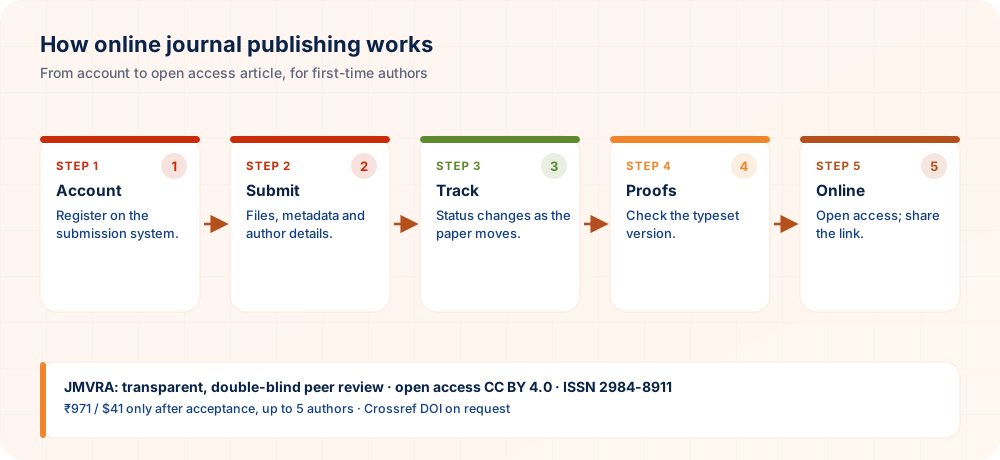
- Register an account. Sign up with your institutional email, and connect your ORCID iD when the option exists.
- Begin a new submission. Pick the article type and section, then fill in the title, abstract, keywords and authors.
- Attach your files. Include the manuscript, figures, cover letter and any supplementary material.
- Confirm the declarations. These cover originality, ethics, funding, conflicts of interest and AI use.
- Follow your paper ID. The status progresses from screening to review to a decision.
- Revise and resubmit. Send the updated file together with a reply addressed to the reviewers.
- Approve the proofs. Go through names, affiliations, figures and references with care.
- Publication. Your article is released online and carries a DOI if one is registered.
What Follows Once the Article Is Online
With an open-access journal, readers can access your article free from the day it appears, typically under a CC BY licence. Search engines and academic crawlers like Google Scholar can index the whole text, so the metadata (title, authors, abstract, references) needs to be correct from the outset. Proofreading these details before submission is far easier than requesting corrections later.
After Publication
- List the paper on both your Google Scholar profile and your ORCID record
- Circulate the DOI link instead of passing around a PDF
- Upload the version you are allowed to share to your institutional repository
- Store your acceptance letter, the invoice and the final published PDF
Frequent Online Submission Troubles
- Several accounts opened with different emails; stick to a single one.
- Co-author email addresses not at hand; gather them before you begin.
- Wrong file formats; stay within the file requirements the journal sets.
- Sending again a paper that is still being reviewed; never do so, and write to the office instead.
Submission Statuses Decoded
| Status you see | Typical interpretation |
|---|---|
| Submitted / received | Awaiting initial editorial screening |
| With editor | Under screening or being matched with reviewers |
| Under review | The paper is being assessed by reviewers |
| Required reviews completed | An editorial decision is being drafted |
| Decision in process | A verdict will come shortly |
| Revision requested | Revisions are required before you resubmit |
| Accepted | Review cleared, with production next |
| In production / proofs | Layout work and your last review |
Wording changes from one system to another, yet the order of stages is much the same throughout.
The 10 Most-Searched Questions on This Topic
Here are the ten questions researchers search for most on this subject, each with a direct answer.
online paper publishing journal
A periodical that takes manuscripts and releases articles on the web, frequently under open access.
how to submit paper online to journal
Register, open a new submission, attach your files, accept the declarations and monitor your paper ID.
Open Journal Systems submission
OJS is a popular open-source platform, and its five-step submission wizard guides you through.
ScholarOne author centre
ScholarOne's author dashboard, which lists the status of every manuscript.
paper status under review meaning
Reviewers have received your paper and are assessing it.
how to approve journal proofs
Verify all details, including names, affiliations, figures, equations and references, and respond before the deadline.
online journal open access
A web-based journal that lets anyone read its articles at no cost.
low cost online journal publication
Web publishing for a small fee; make sure review, a DOI and archiving are in place.
fast online publication
Digital processes cut out postal delays, although peer review still needs time.
add paper to Google Scholar profile
Select “Add articles” in your Scholar profile, or simply wait for automatic matching.
How JMVRA Fits In
JMVRA is a Transparent, Peer-Reviewed, Open Access Journal (Refereed Journal). Following the discontinuation of the UGC and UGC-CARE journal listing, and in alignment with the latest UGC-CARE recommendations and guidelines, JMVRA is aligned with UGC’s Suggested Parameters for Choosing Peer-Reviewed Journals. UGC public notice (PDF)
Through its submission page, JMVRA takes papers online whenever authors are ready, acknowledges each with a paper ID, and puts accepted articles into monthly issues as open access.
- ISSN
- 2984-8911 (online) · publishing since June 2023
- Issues
- Monthly issues across many disciplines
- Review
- Two-way anonymous review by specialists
- Access
- CC BY 4.0, open to all readers
- Fee
- ₹971 INR for Indian and $41 USD for foreign authors, due only after acceptance
- DOI
- Crossref — available as an optional extra
- Indexing
- Covered in Google Scholar, not in Scopus, Web of Science or DOAJ
- Impact factor
- 11.25, derived from Google Scholar data
Screening begins the moment a paper arrives and each decision is sent as soon as it is reached, yet JMVRA never promises a set number of days: actual review time depends on the reviewers and on how much revision the paper needs.
At-a-Glance Checklist
- Accurate detailsThroughout each field
- Status clearMeaning of every stage
- Inbox monitoredSpam folder too
- Proof checkedCarefully
- Link circulatedOnce published
Getting Your Files Ready for Online Submission
| File | Tip |
|---|---|
| Manuscript | Editable file with a brief title as its name |
| Figures | The resolution and format asked for |
| Cover letter | One page, directed to the editor |
| Declarations | Ethics, conflicts of interest, funding and data availability |
| Supplementary files | Labelled plainly and cited within the text |
Email Practices to Prevent Missed Messages
- Pick an address you read every day and keep it consistent
- Save the journal in your contacts so its mail is less likely to be filtered as spam
- Look in your spam folder once you submit and while review continues
- Answer within the original thread and cite your paper ID
Practical Tips for First-Time Authors Submitting Papers Online
Online submission systems are logical but unforgiving, and small slips can delay a new author for days. These tips help you get through the process with fewer surprises.
- Gather everything beforehand. Collect your title page, abstract, keywords, author details, figures and declarations in one folder. Having each item ready lets you complete the form in a single calm sitting.
- Use a stable email address. Register with an address you will keep for years, not a temporary student account. Editorial messages and proofs may arrive long after your course or contract ends.
- Check the converted proof. Systems often convert your files into a single review document. Open it and confirm that tables, equations and figures have survived intact before you finalise submission.
- Whitelist the journal's sender. Add the editorial address to your contacts and glance at the spam folder regularly. Missing a reviewer request or proof deadline is a common and entirely preventable problem.
Prepare materials in advance, use a lasting email address and check the converted file so submission goes smoothly.
Questions Researchers Often Ask
Your Paper's Journey at JMVRA, From Submission to Publication
- SubmissionPaper ID is issued
- ScreenScope & similarity
- ReviewDouble-blind
- DecideEmail & SMS
- ReworkEach point answered
- AcceptCopyright & fee
- ProduceYou can request a DOI
- PublishMonthly issue
How long review takes depends on the reviewers and on any revision required, so no set turnaround is promised; you are told of acceptance or rejection by email and WhatsApp.
Ready to Publish? Submit to JMVRA
JMVRA is aligned with UGC's Suggested Parameters for Choosing Peer-Reviewed Journals.
JMVRA is a Transparent, Peer-Reviewed, Open Access Journal (Refereed Journal). Following the discontinuation of the UGC and UGC-CARE journal listing, and in alignment with the latest UGC-CARE recommendations and guidelines, JMVRA is aligned with UGC’s Suggested Parameters for Choosing Peer-Reviewed Journals.
Where to go next on jmvra.org
Key Terms
Subjects and search phrases this article addresses.
Related Reading
Further reading on the same theme from the JMVRA blog.
Speed, Cost or Prestige: Choosing Your Trade-Off
Read the guide Related10 Free Journal Finder Tools for Your Paper
Read the guide RelatedVerify an Indian Journal Before You Submit
Read the guide RelatedGetting Your Research Paper Found in Google Scholar: A Step-by-Step Guide
Read the guide RelatedORCID iD: The Researcher ID Everyone Needs
Read the guide RelatedWhat a Journal Management System Does
Read the guideKeep Reading on the JMVRA Blog
Find this guide on the JMVRA journal blog, a collection of practical guidance on publishing, indexing, metrics and research integrity that favours verifiable content over promotion.