
Thousands of journals come out of India, ranging from long-standing society publications to independent open-access titles. Plenty are excellent and some are not. Since Indian authors are frequently approached with “fast, low-cost” offers, spending a few minutes on verification before submitting is worth more than any ranking. What follows is a practical checklist designed for Indian journals.
Step 1: Verify the ISSN Carefully
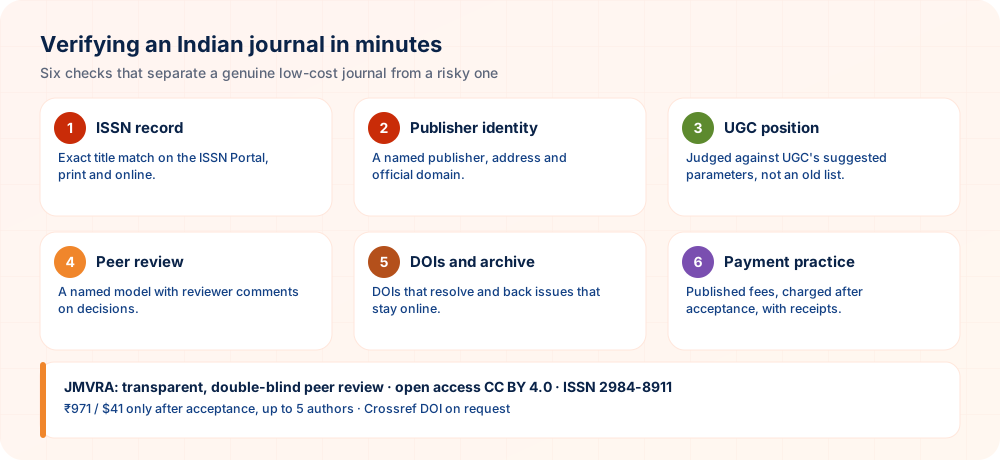
Look the ISSN up on the ISSN Portal. Its record ought to list an identical title, the medium (print or online) and the country. The ISSN National Centre for India, based at CSIR-NIScPR, issues Indian ISSNs. Having an ISSN shows only that a serial is registered — it does not make the journal approved or peer reviewed.
Step 2: Find Out Who the Publisher Is
- An identified publisher with a street address in India
- A reachable phone line plus an official email address under the journal’s own domain
- An editor-in-chief and board members listed by name whom you can check independently
- A website domain that stays the same and agrees with the ISSN record
Step 3: Know Where UGC Stands
No “UGC approved” list or UGC-CARE list is in force today; UGC ended CARE listing and now refers people to suggested parameters for choosing peer-reviewed journals. A badge claiming “UGC approved 2026” therefore cannot be verified. Consult your own institution’s present rule instead, and read our guide to the CARE list’s current status.
Step 4: Examine How the Journal Operates
| Practice | Good sign | Warning sign |
|---|---|---|
| Review | A stated review model, with reports given to authors | “Accepted inside 24 hours” |
| Payment | Once accepted, against an invoice | Ahead of review, into a personal account |
| DOI | Leads to the article through doi.org | DOI-like numbers that lead nowhere |
| Archive | Every earlier issue available online | Absent issues or dead links |
| Contact | Answers sent from an official address | Contact through WhatsApp or personal email alone |
Fast, Low-Cost Publishing Is Fine — If You Have Verified It
Plenty of genuine Indian journals hold fees down and handle papers efficiently. Speed and affordability are not suspicious by themselves; they become so when review, identity or permanence is skipped to achieve them. The checklist above helps you tell which is which.
Save Proof for Your Records
- A screenshot of the ISSN record, noting the date you checked
- Letter of acceptance and the invoice
- Link to the published article, plus its DOI
- The institutional rule that you depended on
How to Read an ISSN Record
| Field on the record | What to compare |
|---|---|
| Key title | Has to be identical to the journal’s name |
| Medium | Online or print, consistent with the ISSN that the journal displays |
| Country | The place of registration of the journal |
| URL (if listed) | Ought to agree with the website you are visiting |
| Record status | A provisional or ceased record calls for questions |
Mismatches in title or URL are the commonest indication of a cloned or hijacked journal.
The 10 Most-Searched Questions on This Topic
Here are the ten questions researchers search for most on this subject, each with a direct answer.
best journals to publish papers in India
Titles that your institution recognises and that clear basic checks on ISSN, publisher, review, DOI and archive.
how to verify Indian journal
Consult the ISSN Portal and examine the publisher’s identity, review practice, DOIs and archive.
ISSN India national centre
Indian ISSNs are allotted by the ISSN National Centre for India, which sits at CSIR-NIScPR.
UGC approved journal list 2026
UGC does not keep an approved list any more; institutions judge journals on the evidence.
ISSN check online India
Look up the ISSN at portal.issn.org and compare the title and country.
fake journal India
Be alert to editorial boards that cannot be verified, fees demanded before review and DOI-style numbers that fail to resolve.
journal payment to personal account
A major red flag; make payments only to official accounts and obtain an invoice.
fast publication journal India
A number of genuine Indian journals work efficiently, but confirm that review happens before you trust speed claims.
low cost journal India
A small fee is acceptable provided review, permanence and transparency are genuine.
journal evidence for API file
Store the ISSN, acceptance, invoice, published link and your institution’s rule together.
How JMVRA Fits In
JMVRA is a Transparent, Peer-Reviewed, Open Access Journal (Refereed Journal). Following the discontinuation of the UGC and UGC-CARE journal listing, and in alignment with the latest UGC-CARE recommendations and guidelines, JMVRA is aligned with UGC’s Suggested Parameters for Choosing Peer-Reviewed Journals. UGC public notice (PDF)
Apply these checks to JMVRA too. Its ISSN is 2984-8911, its publisher is JMVRA Publication, you can reach it at [email protected], its Crossref DOIs work, and fees are paid only after acceptance.
- ISSN
- 2984-8911 (online) · publishing since June 2023
- Issues
- Monthly issues across many disciplines
- Review
- Two-way anonymous review by specialists
- Access
- Open access published under CC BY 4.0
- Fee
- ₹971 INR for Indian and $41 USD for foreign authors, due only after acceptance
- DOI
- Crossref — available as an optional extra
- Indexing
- Google Scholar can display it, whereas Scopus, Web of Science and DOAJ do not
- Impact factor
- 11.25, derived from Google Scholar data
Screening begins the moment a paper arrives and each decision is sent as soon as it is reached, yet JMVRA never promises a set number of days: actual review time depends on the reviewers and on how much revision the paper needs.
At-a-Glance Checklist
- ISSN confirmedTitle and publisher agree with the ISSN record
- Publisher identifiedPostal address, phone and an official email domain
- UGC stance clearThe CARE list gave way to parameters
- Review policy studiedThe model, the reviewers and how decisions are made
- Proof retainedScreenshots and links kept for your file
Publishing in Languages of India
Work written in Indian languages can reach communities and practitioners who may never see English papers. JMVRA accepts papers in English as well as in Indian and foreign languages.
- Supply an English title and abstract — so more readers can find it
- Keep transliteration uniform — across names and terms
- Choose Unicode fonts — to keep the text searchable
- Confirm referencing conventions — when sources use multiple scripts
Documents Frequently Requested by Indian Institutions
| Document | Tip |
|---|---|
| Acceptance letter | Save both the email and the PDF |
| Payment receipt | Issued in the name needed for reimbursement |
| The article’s link along with the PDF | Taken from the journal’s website |
| Journal details | ISSN 2984-8911, plus the publisher and policy pages |
Keeping a Verification Record for Indian Journals
Checking a journal is only half the job; being able to show what you checked is the other half. A simple record protects you when committees or colleagues question your choice.
- Create a one-page journal sheet. For each journal you consider, note the title, publisher, contact address and the date you inspected it. A single sheet per journal makes comparison easy and gives you evidence on demand.
- Capture screenshots of key pages. Save images of the editorial board, author guidelines and payment statement as they appeared when you decided. Websites change, and your screenshots show what you relied on.
- Test the contact details. Send a short, polite email with a simple query and see whether a real person answers sensibly. A journal that hides its address or never responds deserves caution.
- Compare names carefully. Some predatory titles imitate respected journals with slight spelling changes. Compare the name, website address and ISSN record letter by letter before trusting any claim.
- Ask a senior colleague. Share your sheet with a trusted faculty member or librarian before paying anything. A second pair of eyes often notices a detail that you have become used to.
Document your checks as you make them, so your choice of journal can be explained clearly whenever someone asks.
Questions Researchers Often Ask
Anatomy of a JMVRA DOI
Resolver → prefix 10.5555 (an example Crossref prefix) → suffix: journal, volume 14, issue 9, article identifier. A format example: doi.org/10.5555/12345678
Look any JMVRA DOI up through Crossref Search or in the Crossref journal record, whichever you prefer.
Ready to Publish? Submit to JMVRA
JMVRA is aligned with UGC's Suggested Parameters for Choosing Peer-Reviewed Journals.
JMVRA is a Transparent, Peer-Reviewed, Open Access Journal (Refereed Journal). Following the discontinuation of the UGC and UGC-CARE journal listing, and in alignment with the latest UGC-CARE recommendations and guidelines, JMVRA is aligned with UGC’s Suggested Parameters for Choosing Peer-Reviewed Journals.
Quick links across jmvra.org
Key Terms
Subjects and search phrases this article addresses.
Related Reading
Further reading on the same theme from the JMVRA blog.
Publishing From Abroad: USD Fees, Payments & Paperwork
Read the guide Related10 Legitimate Places to Publish or Share Research
Read the guide Related10 Checks Before Paying Any Publication Fee
Read the guide RelatedLow-Cost Journals in India: Checking UGC Claims
Read the guide RelatedDOI vs ISSN: Two Identifiers, Two Jobs
Read the guide RelatedRecognising a Predatory Journal
Read the guideKeep Reading on the JMVRA Blog
Our JMVRA journal blog carries this guide along with other practical advice on publishing, indexing, metrics and research integrity, all written so that claims can be verified and nothing is promotional.