
A small publication fee is easy to hand over without a second thought, which is precisely why it calls for a checklist. The money is not the real danger; the danger is losing your paper to a journal that neither reviews, archives nor gets recognised. Go through these ten checks before paying any journal, no matter how small the amount.
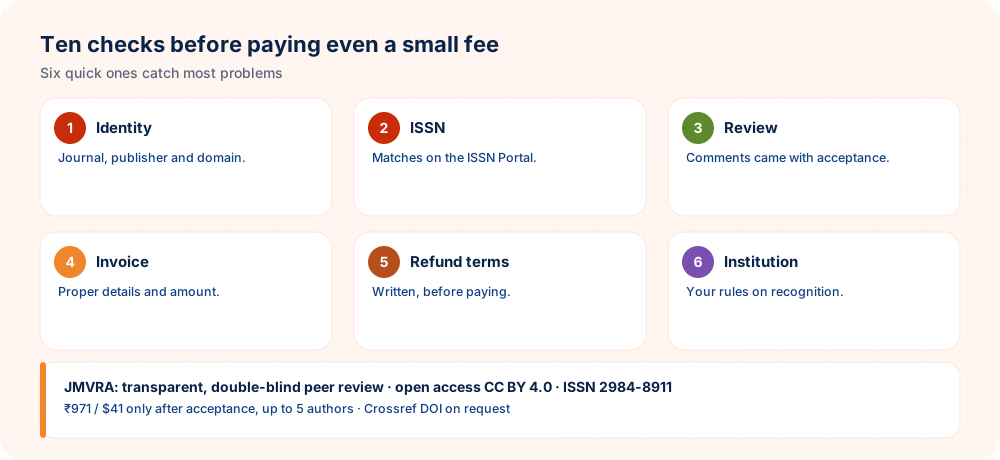
The Ten Checks
- Who publishes it? A named organisation with a postal address and an official email domain.
- Is the ISSN genuine? Its ISSN Portal record agrees with the title and website.
- Did a review take place? You were given particular reviewer comments or a clear review decision.
- Does payment follow acceptance? You hold a formal acceptance, rather than merely a “provisional” one linked to payment.
- Will you get an invoice? It should show the publisher name, paper ID, amount, taxes and invoice number.
- Is the payee official? Money goes to the publisher and not to a private person.
- What are the refund terms? Written conditions covering withdrawal or non-publication.
- Is the DOI genuine? DOIs the journal already issued work when opened through doi.org.
- Will it remain available? Earlier issues are all there, and archiving arrangements are described.
- Will it be recognised for you? Your institution’s present rules allow this type of journal.
Why Even Small Fees Deserve Checks
Cheap offers frequently come with urgency, such as “pay today to be included in this month’s issue”. Urgency is a cue to slow down. A genuine journal will still publish your paper after you spend a day verifying it.
Documents to Keep
Acceptance letter
Evidence that the paper was reviewed and passed.
Invoice and receipt
Evidence of the amount paid and the recipient.
Published article
The PDF along with a permanent link or DOI.
Your verification notes
A screenshot of the ISSN record and the rule you relied on, each with its date.
When Things Go Wrong
- Request publication or a refund in writing, citing your paper ID and invoice.
- Never make extra payments in order to “release” a paper.
- Inform your supervisor or institution when you suspect a journal is fake.
- Submit elsewhere only once you have formally withdrawn the paper.
Green and Red Flags in Brief
| Green flag | Red flag |
|---|---|
| Invoice from the publisher after acceptance | Payment request before any review |
| Official email domain | Personal Gmail/WhatsApp only |
| Specific reviewer comments | No comments at all |
| DOIs that resolve | DOI-like numbers that do not |
| Complete archive | Missing issues, broken links |
| Written refund terms | “No refunds under any circumstances” |
The 10 Most-Searched Questions on This Topic
Here are the ten questions researchers search for most on this subject, each with a direct answer.
checks before paying journal fee
Confirm who the publisher is, then the ISSN, review, acceptance, invoice, payee account, refund policy, DOI, archive and recognition.
journal asking payment before review
That is a red flag; reputable journals ask for payment after acceptance.
journal invoice format
Invoice number and date, paper ID, amount, taxes, plus the publisher’s name and address.
journal refund policy
Refund terms in writing for cases of withdrawal or non-publication.
provisional acceptance payment
Take care if acceptance hinges on paying first.
UPI payment journal fee
Transfer money only to accounts held in the publisher’s name, and get an invoice.
low publication fee journal
A modest fee is acceptable provided review, permanence and transparency are genuine.
journal scam signs
Urgency to pay, payment demanded before review, private accounts and claims that cannot be verified.
acceptance letter journal meaning
Formal confirmation from the journal that your paper cleared review.
journal fee receipt
Store it together with your acceptance letter and the published article.
How JMVRA Fits In
JMVRA is a Transparent, Peer-Reviewed, Open Access Journal (Refereed Journal). Following the discontinuation of the UGC and UGC-CARE journal listing, and in alignment with the latest UGC-CARE recommendations and guidelines, JMVRA is aligned with UGC’s Suggested Parameters for Choosing Peer-Reviewed Journals. UGC public notice (PDF)
JMVRA charges its fee (₹971 INR / $41 USD) only once a paper has been accepted after double-blind review, and you can verify the publisher, ISSN, contact details and DOI prefix, all of which are published, beforehand.
- ISSN
- 2984-8911 (online) · publishing since June 2023
- Issues
- Monthly issues across many disciplines
- Review
- Two-way anonymous review by specialists
- Access
- Free to read, CC BY 4.0 licence
- Fee
- ₹971 INR for Indian and $41 USD for foreign authors, due only after acceptance
- DOI
- Crossref — available as an optional extra
- Indexing
- Present in Google Scholar; Scopus, Web of Science and DOAJ do not include it
- Impact factor
- 11.25, derived from Google Scholar data
Screening begins the moment a paper arrives and each decision is sent as soon as it is reached, yet JMVRA never promises a set number of days: actual review time depends on the reviewers and on how much revision the paper needs.
At-a-Glance Checklist
- Acceptance realWith review comments
- Invoice checkedJournal and paper ID
- Official payment pageTyped yourself
- Refund rule readBefore paying
- Documents keptReceipt and letters
Three Situations and How to Respond
| Scenario | What to do |
|---|---|
| Asked to pay before review | Do not pay; ask for the policy in writing; consider another journal |
| Fee higher than published | Ask for an explanation and the published fee before paying |
| No receipt after payment | Request one immediately, quoting the paper ID |
Making Payments Through Official Channels
Official payment page
Follow the link on the journal’s official website.
No personal accounts
Never send money to a private person’s account or wallet.
Quote your paper ID
Within the payment note.
Keep proof
Screenshots and receipts, retained until publication is finished.
Practical Tips Before Paying Any Journal Publication Fee
Fees are common and legitimate in open access publishing, but payment should follow evidence, not pressure. These practical habits protect your money, your manuscript and your reputation.
- Pay only after written acceptance. Wait for a formal acceptance and an invoice that names the journal, publisher and what the charge covers. Be wary of requests for money at the moment of first submission.
- Use traceable payment methods. Prefer official channels that issue a receipt in the publisher's name. Avoid personal accounts or informal transfers, which leave you little recourse if something goes wrong.
- Keep every message. Save emails, review reports, invoices and receipts in one folder. If a dispute arises, a complete, dated record is the strongest support for your case.
- Confirm your institution's rules. Some universities and funders have policies on which charges they reimburse. Ask your accounts or research office before paying so you do not discover a restriction afterwards.
- Speak up early if something seems wrong. If terms change, reviews seem missing or replies stop, write politely and ask for clarification. Early, documented questions leave more options than silence and delay.
Pay only against written acceptance and a clear invoice, use traceable channels, and keep a full record of every exchange.
Questions Researchers Often Ask
Your Paper's Journey at JMVRA, From Submission to Publication
- SubmitPaper ID given
- ScreenScope & similarity
- ReviewDouble-blind
- DecideEmail & SMS
- UpdateOne point at a time
- AcceptCopyright & fee
- ProduceRequest a DOI
- PublishMonthly issue
How long review takes depends on the reviewers and on any revision required, so no set turnaround is promised; you are told of acceptance or rejection by email and WhatsApp.
Ready to Publish? Submit to JMVRA
JMVRA is aligned with UGC's Suggested Parameters for Choosing Peer-Reviewed Journals.
JMVRA is a Transparent, Peer-Reviewed, Open Access Journal (Refereed Journal). Following the discontinuation of the UGC and UGC-CARE journal listing, and in alignment with the latest UGC-CARE recommendations and guidelines, JMVRA is aligned with UGC’s Suggested Parameters for Choosing Peer-Reviewed Journals.
Pages worth visiting on jmvra.org
Key Terms
Subjects and search phrases this article addresses.
Related Reading
Further reading on the same theme from the JMVRA blog.
From Manuscript to DOI: How Long Publishing Takes
Read the guide RelatedFake Indexing Claims on Publication Sites
Read the guide RelatedTypes of Research Publishers and How to Assess Them
Read the guide RelatedRecognising a Predatory Journal
Read the guide RelatedWhy JMVRA Charges Just ₹971 INR / $41 USD Without Lowering Standards
Read the guide RelatedDOI vs ISSN: Two Identifiers, Two Jobs
Read the guideKeep Reading on the JMVRA Blog
As part of the JMVRA journal blog, this guide shares practical help on publishing, indexing, metrics and research integrity, and is written to be verifiable rather than promotional.