
The most useful “paper publishing sites” do not publish your paper at all; they help you discover which journal should. A number of free tools match your title and abstract against thousands of journals or let you browse by subject and metric. Combined, they replace guesswork with an informed shortlist. Record why each suggestion fits or does not, so the final choice rests on evidence.
Ten Free Tools
| Tool | What it does | Watch out for |
|---|---|---|
| Elsevier JournalFinder | Matches your abstract to Elsevier journals | Only Elsevier titles |
| Springer Nature journal search | Suggests Springer Nature journals | Only Springer Nature titles |
| Wiley Journal Finder | Suggests Wiley journals | Only Wiley titles |
| Taylor & Francis Journal Suggester | Suggests T&F journals | Only T&F titles |
| Master Journal List (Manuscript Matcher) | Matches to Web of Science journals | Needs a free account |
| SCImago Journal Rank | Browse by subject, country, quartile | Only Scopus-indexed journals |
| Scopus Sources | Search indexed titles and status | Metrics lag by a year |
| DOAJ | Search vetted open-access journals | Covers OA only |
| JANE | Matches biomedical abstracts to journals | Biomedical focus |
| Google Scholar Metrics | Top venues by h5-index per field | Top 20 per category only |
Getting the Best Out of Them
- Enter a refined title and abstract. These tools rely on your wording, so a fuzzy abstract produces fuzzy suggestions.
- Try three tools or more. A publisher’s tool suggests nothing but its own journals.
- Note the overlaps. A journal that turns up in several tools is a strong candidate.
- Check every candidate. Look at its scope, recent issues, fees and review model.
The Overlooked Tool: Your Own Reference List
See which journals published the ten most relevant papers you cite. They already carry work similar to yours, and their reviewers are familiar with your topic. This takes five minutes and frequently beats any algorithm for accuracy.
What These Tools Cannot Reveal
- Whether your institution gives a journal recognition
- Actual review times at present
- If an independent, non-indexed journal is genuine — that is for you to check
- If your paper is good enough for a selective venue
Turning Tool Results Into a Decision
Move the three to five strongest matches into a simple comparison sheet covering requirement, fit, review, indexing, fee and timeline, following our 7-step journal selection framework.
Worked Example: Running One Abstract Through Three Finder Tools
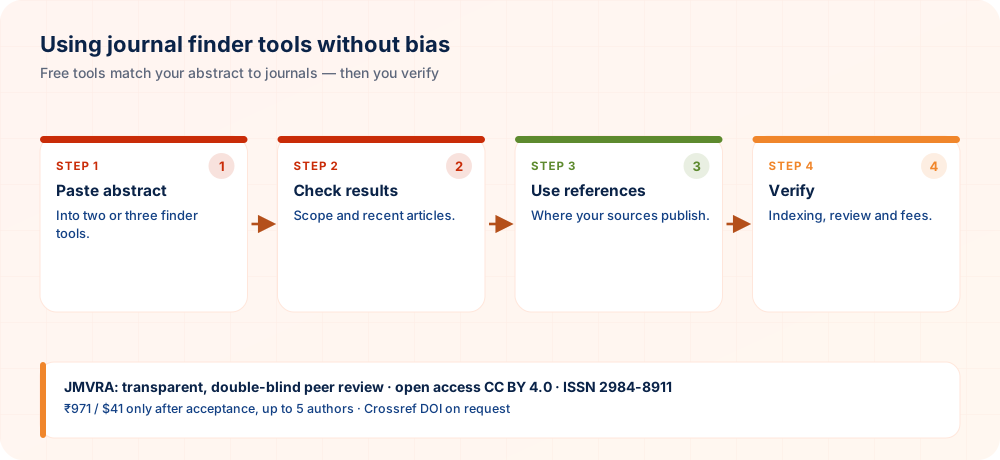
- Get a clean abstract ready. Use the final version, key terms included.
- Use a publisher tool. Write down the five best suggestions and what each covers.
- Try the Master Journal List matcher. See where it coincides with the first list.
- Explore SCImago within your subject category. See how the shared journals rank and whether they are still active.
- Go through your reference list. Include the journals that carried the most closely related studies.
- Narrow it to three. Test each one against this guide’s checklist.
The 10 Most-Searched Questions on This Topic
Here are the ten questions researchers search for most on this subject, each with a direct answer.
journal finder tool
A tool that proposes journals based on your title and abstract, or through subject browsing.
Elsevier journal finder
Proposes Elsevier journals based on your title and abstract.
Springer journal suggester
Proposes Springer Nature journals suited to your manuscript.
Web of Science manuscript matcher
A Master Journal List feature that pairs your abstract with indexed journals.
SCImago journal search
Explore journals by subject, country and quartile using Scopus data.
DOAJ journal search
Locate vetted open-access journals by subject, along with fee and licence information.
JANE journal finder
Links biomedical abstracts to suitable journals and related articles.
Google Scholar top publications
Ranks leading venues in each field by h5-index.
paper publishing sites top 10
Helpful sites assist your choice of journal, while the journal is what actually publishes the paper.
how to find a journal for my research paper
Combine several finder tools with your reference list, and then check every candidate.
How JMVRA Fits In
JMVRA is a Transparent, Peer-Reviewed, Open Access Journal (Refereed Journal). Following the discontinuation of the UGC and UGC-CARE journal listing, and in alignment with the latest UGC-CARE recommendations and guidelines, JMVRA is aligned with UGC’s Suggested Parameters for Choosing Peer-Reviewed Journals. UGC public notice (PDF)
Publisher finder tools may not list independent multidisciplinary journals like JMVRA, so look at them directly: JMVRA openly shares its ISSN, scope, review policy, fees and DOI prefix on jmvra.org.
- ISSN
- 2984-8911 (online) · publishing since June 2023
- Issues
- Monthly issues across many disciplines
- Review
- Two-way anonymous review by specialists
- Access
- CC BY 4.0 open access
- Fee
- ₹971 INR for Indian and $41 USD for foreign authors, due only after acceptance
- DOI
- Crossref — available as an optional extra
- Indexing
- Indexed on Google Scholar and not on Scopus, Web of Science or DOAJ
- Impact factor
- 11.25, derived from Google Scholar data
Screening begins the moment a paper arrives and each decision is sent as soon as it is reached, yet JMVRA never promises a set number of days: actual review time depends on the reviewers and on how much revision the paper needs.
At-a-Glance Checklist
- Several tools usedPublisher and independent
- References minedJournals you cite
- Results verifiedAt source
- Bias notedPublisher tools favour their journals
- Decision recordedWith reasons
Crafting an Abstract That Finder Tools Can Match
Specific terms
Include the technical terms people in your field search for.
Method named
Name the design or technique clearly.
Context stated
Population, setting or material.
Outcome clear
Your key finding, in a single sentence.
Converting Tool Output Into a Shortlist
| Criterion | Question |
|---|---|
| Scope fit | Has the journal recently carried comparable papers? |
| Recognition | Does it satisfy what your institution requires? |
| Cost | How much is the full fee, and at what point is it charged? |
| Transparency | Are the review process, fees and policies made public? |
Practical Tips for Using Journal Finder Tools Wisely
Journal finder tools can quickly suggest venues, but they work from your words and cannot judge your paper. Use these habits to turn their lists into a sensible, evidence-based shortlist.
- Try more than one tool. Different finders rely on different data and algorithms, so their suggestions overlap only partly. Run your abstract through several and note which journals appear repeatedly.
- Rewrite your abstract between runs. Small changes in vocabulary alter results. Try variations using the terms your intended readers would actually use, and keep the version that returns the most relevant journals.
- Open recent issues, not just profiles. A journal's summary page may be outdated. Skim the latest issues to see whether your topic, method and article length appear regularly.
- Check the practical details manually. Finders rarely confirm current fees, review model or licence. Read the journal's own pages and keep notes beside each candidate so comparisons are consistent.
- Ask a supervisor to rank the shortlist. Experienced colleagues know which outlets suit your field and career stage. Share your notes and invite a quick opinion before you commit to a final choice.
Let the tools generate ideas, then decide by reading the journals themselves and consulting someone who knows your field.
Questions Researchers Often Ask
Your Paper's Journey at JMVRA, From Submission to Publication
- SubmissionPaper ID assigned
- ScreenScope & similarity
- ReviewDouble-blind
- DecideEmail & SMS
- AmendItem by item
- AcceptCopyright & fee
- ProduceDOI provided when requested
- PublishMonthly issue
How long review takes depends on the reviewers and on any revision required, so no set turnaround is promised; you are told of acceptance or rejection by email and WhatsApp.
Ready to Publish? Submit to JMVRA
JMVRA is aligned with UGC's Suggested Parameters for Choosing Peer-Reviewed Journals.
JMVRA is a Transparent, Peer-Reviewed, Open Access Journal (Refereed Journal). Following the discontinuation of the UGC and UGC-CARE journal listing, and in alignment with the latest UGC-CARE recommendations and guidelines, JMVRA is aligned with UGC’s Suggested Parameters for Choosing Peer-Reviewed Journals.
Handy links within jmvra.org
Key Terms
Subjects and search phrases this article addresses.
Related Reading
Further reading on the same theme from the JMVRA blog.
Verify an Indian Journal Before You Submit
Read the guide RelatedPublishing From Abroad: USD Fees, Payments & Paperwork
Read the guide Related10 Legitimate Places to Publish or Share Research
Read the guide RelatedJournal Finder — Shortlist an Affordable, Quality, UGC CARE-Aligned Journal in Minutes
Read the guide RelatedScopus, Web of Science, DOAJ & Google Scholar Compared
Read the guide RelatedVerifying UGC-CARE, Scopus & Web of Science Claims
Read the guideKeep Reading on the JMVRA Blog
The JMVRA journal blog includes this guide, one of many practical pieces on publishing, indexing, metrics and research integrity, prepared so readers can verify them without any sales pitch.