
Searching for a list of journals in Indonesia? No other country publishes as many open access journals as Indonesia, so the real task is picking wisely. This guide presents leading Indonesian journals by publisher, subject and reported indexing, describes SINTA ranks and the Garuda portal, and explains how to verify a journal. It is aimed at researchers in Jakarta, Indonesia; Bandung, Indonesia; Yogyakarta, Indonesia; Surabaya, Indonesia and throughout the archipelago.
Scholarly Publishing in Indonesia
Indonesia runs one of the largest journal systems anywhere. The Directory of Open Access Journals reports that in March 2025 Indonesia became its biggest contributor, with 2,473 journals, roughly 11.5% of DOAJ, and universities host most of them on the .ac.id domain. Many thousands of other Indonesian journals are absent from DOAJ.
National quality is monitored through SINTA (Science and Technology Index), operated by the Ministry of Higher Education, Science and Technology. Journals that pass the national accreditation process (ARJUNA) are ranked from SINTA 1 (S1), the top level, down to SINTA 6 (S6). S1 matches the earlier “A” accreditation and S2 matches “B”. Many universities and lecturer-promotion rules cite SINTA ranks for national journals and “reputable international journals”, usually meaning Scopus or Web of Science, for higher academic ranks. Always read your own institution's wording to see which of these it expects.
Research Journals Published in Indonesia
Each journal below is published in Indonesia by a university, society or research body that can be identified. The “reported coverage” column repeats what the journal or its publisher says about itself, so check any indexing claim in Scopus Sources or the Master Journal List before submitting.
| Journal | Publisher | Subject area | Reported coverage |
|---|---|---|---|
| Indonesian Journal of Science and Technology (IJoST) | Universitas Pendidikan Indonesia, Bandung | Science, engineering, education | Per the university: Scopus Q1, and the highest SJR in Indonesia |
| Bulletin of Chemical Reaction Engineering & Catalysis | Universitas Diponegoro, Semarang | Chemical engineering and catalysis | Reported: Scopus and Web of Science |
| Indonesian Journal of Chemistry | Universitas Gadjah Mada, Yogyakarta | Chemistry | Reported in Scopus and ESCI |
| Studia Islamika | PPIM, UIN Syarif Hidayatullah Jakarta | Islamic studies, Southeast Asia | Reported in Scopus and ESCI |
| Medical Journal of Indonesia | Faculty of Medicine, Universitas Indonesia | Medicine | Reported: Scopus; SINTA |
| TELKOMNIKA | Universitas Ahmad Dahlan, Yogyakarta | Telecommunication, computing, electronics | Reported: Scopus — confirm current status |
| Indonesian Journal of Applied Linguistics (IJAL) | Universitas Pendidikan Indonesia, Bandung | Applied linguistics | Reported by UPI: Scopus (Q2) — confirm current status |
Cross-checked on 4 October 2026 with each journal’s site or publisher. It offers a starting point only, with no ranking and no claim to be complete.
Online Journal Platforms and Directories to Use
Use SINTA for a journal’s national accreditation, Garuda for searching Indonesian articles, and international directories for a second check. Send your submission via the journal’s own OJS page.
SINTA
Science and Technology Index: the national portal of Indonesia that lists accredited journals with their SINTA rank (S1–S6), along with researcher and institution profiles. Visit.
Garuda
Garba Rujukan Digital: a national portal for finding articles in Indonesian journals. Visit.
University OJS portals
Most journals in Indonesia run on the Open Journal Systems portals of universities such as UGM, UI and UPI; send your submission via the journal’s own page.
Directory of Open Access Journals
Look up open access journals that satisfy DOAJ’s criteria, and narrow the results by publisher country (Indonesia) or by “without fees”. Visit.
SCImago country rankings
Scopus-derived journal rankings limited to titles published in Indonesia, showing quartiles and SJR. Visit.
ISSN Portal
Look up a journal’s ISSN, exact title and publication country first, then decide whether to trust it. Visit.
Where Research Happens in Indonesia
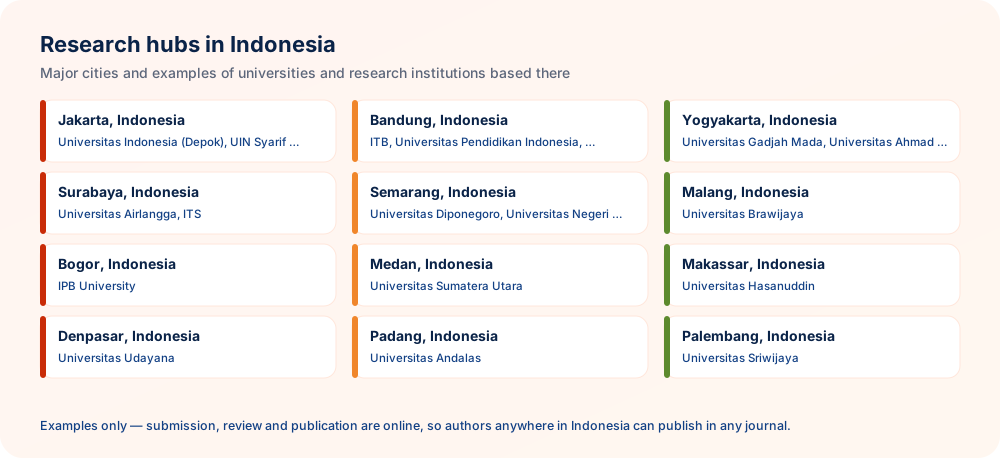
Universities across the archipelago publish Indonesian journals, with the biggest concentrations on Java. The cities below host major universities and many of the journals mentioned above.
Picking the Right Journal
Do not wait until the draft is complete to select a journal. Test its scope by reading three recent articles, note the length and reference requirements in the author guidelines, and verify what your institution will count — a national list, Scopus, Web of Science or any peer-reviewed journal. If the first choice turns the paper down, have a dependable alternative planned.
Fees and Affordable Options
Every Indonesian journal decides its own charges. Numerous university journals ask a modest publication fee in rupiah, some ask for nothing, and a few bill higher APCs, often in US dollars for international authors. The amount and what it includes ought to appear on the journal’s “Author Fees” or “Publication Charge” page.
With so many Indonesian journals around, pushy marketing is widespread. Be wary of services that promise a place in a SINTA or Scopus journal in return for payment, and never pay until the journal itself has genuinely accepted your paper. For comparison, JMVRA's fee for foreign authors is $41 USD, payable only after acceptance and covering up to five authors.
For the complete comparison method, turn to our low-cost journal publication guide, where the checks hold in any country, and to the article on how a low-fee journal covers its costs.
Checking a Journal Step by Step
- Cross-check title and ISSN with what the ISSN Portal shows.
- Look up the publisher, editorial team and contact address by yourself.
- Review the peer review policy and expect reviewer comments alongside each decision.
- Test every indexing statement against the database's own records.
- A sound journal lists its fees early and bills only after acceptance.
Checklist Before You Submit a Manuscript
- Journal verifiedScope, requirement and indexing reviewed
- Template usedLayout, reference style and length
- Similarity check passedEvery source acknowledged, including your own previous papers
- Ethics addressedApproval, consent and conflicts disclosed
- Author information accurateNames and affiliations written exactly as intended
- Covering letter writtenWhy this manuscript belongs in this particular journal
How JMVRA suits authors in Indonesia
Based in India, JMVRA (ISSN 2984-8911) is an international open access journal covering many disciplines. It is not a Indonesian journal, but it accepts papers from authors in Indonesia.
- Fee: Authors based abroad, such as those in Indonesia, pay $41 USD after acceptance only, and up to 5 authors are included.
- Review: subject experts run an open, double-blind peer review, and the similarity figure must stay under 15%.
- Access: the work is open access under CC BY 4.0, and a Crossref DOI is available if you ask for it.
- Indexing, stated plainly: you will find us in Google Scholar, but we are not in Scopus, Web of Science or DOAJ.
A 12-Month Publication Plan for Indonesia-Based Researchers
| Months | Focus |
|---|---|
| 1–3 | Settle on a narrow question and two or three journals to aim for; look at national resources such as SINTA accreditation and the Garuda portal, and at the international databases |
| 4–6 | Collect your data, analyse it, and write the draft directly in the template of the journal you have chosen |
| 7–9 | Ask a supervisor or colleague for feedback, and submit to just one journal at a time |
| 10–12 | Respond to the reviewers' remarks with a revised version; after publication, share the paper and update ORCID and Google Scholar |
Choosing a Language as an Author in Indonesia
Researchers in Indonesia work in Indonesian and English. Choose the language according to who needs to read the paper.
Write in Indonesian
Speaks to readers, practitioners and policy makers within Indonesia.
Publishing in English
Gets in front of readers, reviewers and indexes worldwide.
Abstract in two languages
Pairing a paper in Indonesian with an English title and abstract helps international readers find it.
Language editing support
Have a colleague or editor read the final version before you submit.
Practical Tips for Indonesian Lecturers Targeting Quality Journals
Indonesian academics often face institutional expectations about where and how often to publish. These tips help you meet those expectations while keeping the quality and honesty of your research first.
- Aim for quality before quantity. Resist splitting one study into several thin papers to satisfy output targets. A single well-argued article usually serves your reputation and career better than fragmented work.
- Read the performance criteria carefully. Your university and funders define what counts toward promotion. Read those rules closely and confirm with your office before choosing a journal, rather than relying on hearsay.
- Strengthen the English writing early. If you write in Indonesian first, translate with care and ask a proficient reader to review it. Poor language is a common reason that sound research is returned before review.
- Report methods with full transparency. Describe instruments, validation and analysis steps so another researcher could repeat them. This is especially important for surveys and educational studies that reviewers scrutinise closely.
- Reuse your own text with caution. Reworking a conference paper or thesis chapter is acceptable only with proper citation and substantial change. Run a similarity check yourself before submission and fix overlapping passages.
Understand your institution's expectations, but let honest, well-reported research drive your decisions rather than output targets alone.
Questions Researchers Often Ask
Summary and What to Do Next
Indonesia has a vast spread of journals, from SINTA-ranked university titles up to Scopus Q1 journals. Begin with your own requirement, confirm status through SINTA and Scopus, and pick by suitability.
- Have the publication requirement of your institution confirmed on paper.
- From the table, narrow down some journals and browse their recent articles.
- Our Scopus and Web of Science guide for Indonesia explains how to confirm indexing.
- Write up your manuscript in the template supplied by the journal and submit it at the journal’s own site.
Ready to send in your paper?
Submission to JMVRA is online and free. Review always comes first; the $41 USD publication fee applies only after your paper is accepted.
Related searches
Visitors from Indonesia who find this guide useful tend to be after affordable open access journals, high impact factor journals, Scopus and Web of Science indexed journals, paper publication fees and journal publication in Indonesia. The following guides address those subjects:
- Low-cost journal publication in Indonesia
- High impact factor journals in Indonesia
- Scopus and Web of Science journals in Indonesia
- How a low-fee journal is funded
- Locating high impact factor journals
- How to choose a journal
- Checking an indexing claim yourself
- Recognising a predatory journal
- Publishing with JMVRA from outside India
- JMVRA publication charges
References and Sources
Checked on 4 October 2026. Indexing, fees and policies can change, so check them again before submitting.
Indonesian Authors Publishing With JMVRA
- Submit onlineResearchers from any country can send work; no fee at submission
- ScreeningChecks on scope and similarity (below 15%)
- Double-blind reviewSubject experts evaluate it; you receive the decision by email
- Accepted — $41 USDA single fee, covering up to 5 authors
- PublishedOpen access under CC BY 4.0
Details: Publication charges · Peer review · Advice for authors outside India.
Ready to Publish? Submit to JMVRA
JMVRA is aligned with UGC's Suggested Parameters for Choosing Peer-Reviewed Journals.
JMVRA is a Transparent, Peer-Reviewed, Open Access Journal (Refereed Journal). Following the discontinuation of the UGC and UGC-CARE journal listing, and in alignment with the latest UGC-CARE recommendations and guidelines, JMVRA is aligned with UGC’s Suggested Parameters for Choosing Peer-Reviewed Journals.
Helpful pages on jmvra.org
Key Terms
Subjects and search phrases this article addresses.
Related Reading
Further guides for Indonesia-based researchers, plus help with choosing a journal.
Affordable Journal Publication in Indonesia
Read the guide RelatedHigh-Impact Journal Choices for Indonesian Researchers
Read the guide RelatedScopus & Web of Science Journals: Indonesia
Read the guide RelatedResearch Journals in Malaysia: MyCite & Scopus
Read the guide RelatedResearch Journals in the Philippines: A Full List for Researchers
Read the guide RelatedWhat International Authors Should Know About JMVRA
Read the guide RelatedChoosing a Journal: A 7-Step Scoring Framework
Read the guideKeep Reading on the JMVRA Blog
This guide belongs to the JMVRA journal blog, which offers practical advice on publishing, indexing, metrics and research integrity, written to be checkable instead of promotional.