
Need high impact factor journals in Indonesia? Many promotions and grants depend on impact factors, quartiles and rankings, and these are easy to misread or fake. This guide sets out what the main metrics mean, how to sidestep fake impact factors, which journals published in Indonesia report international indexing, and a stepwise method to track down the highest-impact journals in your field. It is intended for researchers in Jakarta, Indonesia; Bandung, Indonesia; Yogyakarta, Indonesia; Surabaya, Indonesia.
What a High Impact Factor Actually Tells You
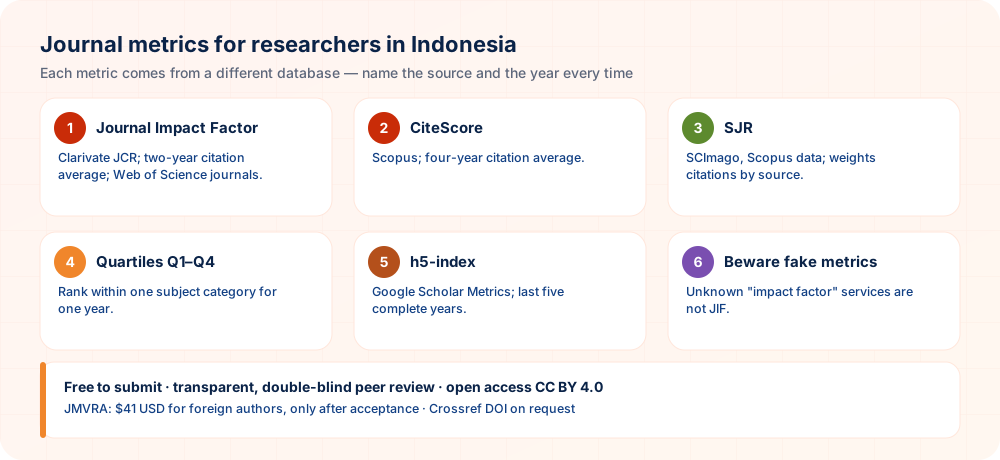
Averaging is what an impact factor does: it takes one year’s citations to the journal’s items from the previous two years and divides them by the number of citable items. Clarivate computes it only for Web of Science Core Collection journals. Different data lie behind CiteScore (Scopus, four-year window) and SJR (SCImago, prestige-weighted), which tackle similar questions.
| Metric | Data source | Window | Where to check |
|---|---|---|---|
| Journal Impact Factor | Web of Science (Clarivate) | 2 years | Journal Citation Reports |
| CiteScore | Scopus (Elsevier) | 4 years | Scopus Sources |
| SJR | Scopus data, SCImago | Prestige-weighted, covering 3 years | SCImago Journal & Country Rank |
| Quartile (Q1–Q4) | JCR or SCImago | Just one year, within one category | JCR or SCImago |
| h5-index | Google Scholar Metrics | 5 years | Google Scholar Metrics |
Invented Impact Factors and Misleading Metrics
Some websites sell or confer “impact factors” that bear no relation to Clarivate’s Journal Impact Factor. When a journal shows off a big number from an unfamiliar provider, or states a JIF but cannot be found in the Master Journal List, you are being misled. Three checks help: the database, the year, and whether you can verify it on the database’s own website.
Indexed Journals Based in Indonesia
Among Indonesia’s leading indexed titles is the Indonesian Journal of Science and Technology; its university reports it as Scopus Q1 with the top SJR in Indonesia. SINTA adds national ranks running from S1 (highest) to S6.
| Journal | Publisher | Subject | Reported coverage |
|---|---|---|---|
| Indonesian Journal of Science and Technology (IJoST) | Universitas Pendidikan Indonesia, Bandung | Science, engineering, education | Reported: Scopus (Q1); highest SJR in Indonesia per the university |
| Bulletin of Chemical Reaction Engineering & Catalysis | Universitas Diponegoro, Semarang | Chemical engineering and catalysis | Reported: Scopus and Web of Science |
| Indonesian Journal of Chemistry | Universitas Gadjah Mada, Yogyakarta | Chemistry | Reported coverage in Scopus and ESCI |
| Studia Islamika | PPIM, UIN Syarif Hidayatullah Jakarta | Islamic studies, Southeast Asia | Reported coverage in Scopus and ESCI |
| Medical Journal of Indonesia | Faculty of Medicine, Universitas Indonesia | Medicine | Reported: Scopus; SINTA |
The coverage shown reflects what each journal or publisher stated on 4 October 2026. For today's figures, look at Journal Citation Reports (Journal Impact Factor and quartile) and at Scopus Sources or SCImago (CiteScore or SJR).
Online Journals and Portals in Indonesia
E-journals are now the usual format for journals in Indonesia. The services below let you locate them, compare options and verify their reputation:
- SINTA — Science and Technology Index: the national portal of Indonesia, which lists accredited journals along with their SINTA rank (S1–S6) and offers researcher and institution profiles.
- Garuda — Garba Rujukan Digital: a nationwide portal where articles from Indonesian journals can be searched.
- University OJS portals — The majority of Indonesian journals operate on university Open Journal Systems portals, for example UGM, UI and UPI; send your submission via the journal’s own page.
- Directory of Open Access Journals — Look up open access journals that satisfy DOAJ’s criteria, narrowing by the publisher’s country (Indonesia) or by “without fees”.
- SCImago country rankings — Journal rankings drawn from Scopus, limited to titles published in Indonesia and showing quartiles and SJR.
- ISSN Portal — Look up the ISSN, exact title and country of publication to be sure a journal is genuine.
Do not read a platform or directory entry as proof of high impact or international indexing; confirm each journal in the citation databases.
Locating Top-Tier Journals in Your Field
- Decide on your subject category, using the classification of JCR and SCImago.
- Use JCR or SCImago to see all journals in the category, sorted on the metric your requirement calls for.
- Take three recent articles from each journal you have shortlisted and read them to assess fit.
- Check the current year's metric and quartile at the original source.
- Before submitting, check the fees, open access options and any waivers.
| Field | Journals based in Indonesia | Then search |
|---|---|---|
| Science & engineering | IJoST; BCREC; TELKOMNIKA (check current status) | Scopus engineering and physical sciences; SCIE |
| Chemistry | Indonesian Journal of Chemistry | Scopus chemistry; SCIE |
| Medicine & health | Medical Journal of Indonesia | JCR and Scopus subject categories in medicine |
| Religious & Islamic studies | Studia Islamika | Scopus religious studies; AHCI and ESCI |
| Language & education | IJAL (check current status) | SSCI, ESCI and Scopus social sciences |
Open Access, Costs and Impact
Open access is offered by many high-impact journals for an article processing charge; some are diamond open access, and a lot of subscription journals publish with no author fee. It widens readership, above all where libraries cannot afford subscriptions, though the citation effect differs between fields. Paying a large APC for impact alone is not advisable.
- Review costs first, before shortlisting, alongside metric and suitability.
- Raise the question of waivers: if you are from a lower- or middle-income country, several publishers may grant one.
- Try self-archiving: if journal policy allows, you may post the accepted manuscript to a repository without paying.
- Check with your library to learn whether a publisher deal pays for, or reduces, the APC for authors in Indonesia.
A Practical Path to High-Impact Publication
Set high goals, yet map out a sequence of submissions. Each paper belongs with the journal it has a real prospect of winning: early or local studies go to reputable national outlets, more solid studies to indexed regional or international outlets, and the best of your output, being carefully designed, clearly framed and relevant worldwide, goes to the top journals of your category.
- Improve the study itself: concentrate on a sharp question, a design that is sound, enough participants and thorough reporting.
- Present it globally: show what readers beyond Indonesia can take away from your work.
- Partner with colleagues whenever this contributes expertise or data.
- Deal with reviewers’ points completely — revision is the norm for high-impact papers.
Preparing to Submit to a Top-Tier Journal
- Category fitsYour paper belongs in the journal’s subject category
- Figures verifiedJIF or quartile examined in JCR or SCImago for this year
- Fit checkedThree current articles read, and yours fits among them
- Fees reviewedAPC, waiver and open access options are clear
- Alternative readyA credible second journal decided on beforehand
How JMVRA suits authors in Indonesia
Based in India, JMVRA (ISSN 2984-8911) is an international open access journal covering many disciplines. It is not a Indonesian journal, but it accepts papers from authors in Indonesia. JMVRA does not have a Clarivate impact factor; it is a good fit for papers that need an affordable, peer-reviewed open access home rather than a Scopus or WoS-indexed one.
- Fee: A foreign-author payment of $41 USD is requested only on acceptance and takes in up to 5 authors.
- Review: double-blind and transparent, handled by peers who know the subject; a similarity level below 15% is required.
- Access: free open access under the CC BY 4.0 licence; Crossref DOI offered on request.
- Indexing, honestly put: the journal is in Google Scholar and is not in Scopus, Web of Science or DOAJ.
A Step-by-Step Path to High-Impact Journals From Indonesia
| Stage | Goal |
|---|---|
| First papers | Carefully reported, solid research placed in bona fide peer-reviewed journals |
| Building | Partnerships across ASEAN, bigger samples and sturdier methods |
| Targeting | Verify in JCR or Scopus that a journal sits in Q1 or Q2 for your subject category |
| Sustaining | A steady research focus, along with data sharing and journal reviewing |
The Role of Metrics in Indonesia
- Specify the metric used — JIF, CiteScore or SJR, or a value derived from Google Scholar
- Identify the provider — and look for the journal on that site on your own
- Keep comparisons to one field — rather than crossing fields
- Document the checks you made — along with when, for evaluators
Metric Habits for Researchers Publishing from Indonesia
Impact figures are easy to quote and hard to check. These habits help scholars in Indonesia keep journal comparisons honest, whether the paper comes from a university thesis or a funded project.
- Record where each metric came from. Whenever you note a journal's impact figure, write down the source and the year it applies to. A number without a source cannot be defended to a supervisor or a promotion panel.
- Discuss targets with your supervisor early. Before drafting, agree with your supervisor which kind of venue suits the study. A shared target shapes the literature review, the length of the paper and the amount of detail needed.
- Prepare a clear English abstract. Even if your fieldwork was conducted in a local language, a precise English abstract helps international readers judge relevance. Ask a colleague outside your project to read it and flag anything vague.
- Keep a rejection log. If a journal declines the paper, note the reviewers' main concerns before moving on. Patterns across comments show what to repair, and saved notes make the next submission stronger.
- Share data and methods transparently. Describe sampling, instruments and analysis steps in enough detail for another team to repeat them. Reproducible methods impress reviewers more than any claim about where the paper will be ranked.
Choose the journal for fit and verifiable standards, document every metric you rely on, and let a transparent method carry the paper.
Questions Researchers Often Ask
Summary and What to Do Next
Achieving high-impact publication from Indonesia is realistic when you pair the right paper with the right journal and read the metrics honestly. Verify each figure at its source, select by fit within your category, and build your record gradually.
- Decide on your subject category and requirement.
- Use JCR or SCImago to shortlist journals, and read their recent articles.
- Confirm metrics and fees before submitting.
- Go on to journals in Indonesia indexed in Scopus and Web of Science and low-cost journal publication in Indonesia.
Ready to send in your paper?
Submission to JMVRA is online and free. Review always comes first; the $41 USD publication fee applies only after your paper is accepted.
Related searches
People in Indonesia who consult this guide frequently want to know about high impact factor journals, Q1 and Q2 titles, indexing in Scopus and Web of Science, and how a journal’s metrics can be verified. Answers follow in these guides:
References and Sources
Checked on 4 October 2026. Metrics are updated every year, so confirm them at the original source.
Publish From Indonesia Through JMVRA
- Submit onlineAny country is welcome; submitting costs nothing
- First reviewPaper checked for scope and similarity (below 15%)
- Double-blind reviewSpecialist reviewers; decision delivered by email
- Accepted — $41 USDSingle charge for as many as 5 authors
- PublishedCC BY 4.0 open access
Details: Publication charges · Peer review · Advice for authors outside India.
Ready to Publish? Submit to JMVRA
JMVRA is aligned with UGC's Suggested Parameters for Choosing Peer-Reviewed Journals.
JMVRA is a Transparent, Peer-Reviewed, Open Access Journal (Refereed Journal). Following the discontinuation of the UGC and UGC-CARE journal listing, and in alignment with the latest UGC-CARE recommendations and guidelines, JMVRA is aligned with UGC’s Suggested Parameters for Choosing Peer-Reviewed Journals.
Pages worth visiting on jmvra.org
Key Terms
Subjects and search phrases this article addresses.
Related Reading
Further guides for researchers in Indonesia.
Keep Reading on the JMVRA Blog
As part of the JMVRA journal blog, this guide shares practical help on publishing, indexing, metrics and research integrity, and is written to be verifiable rather than promotional.