
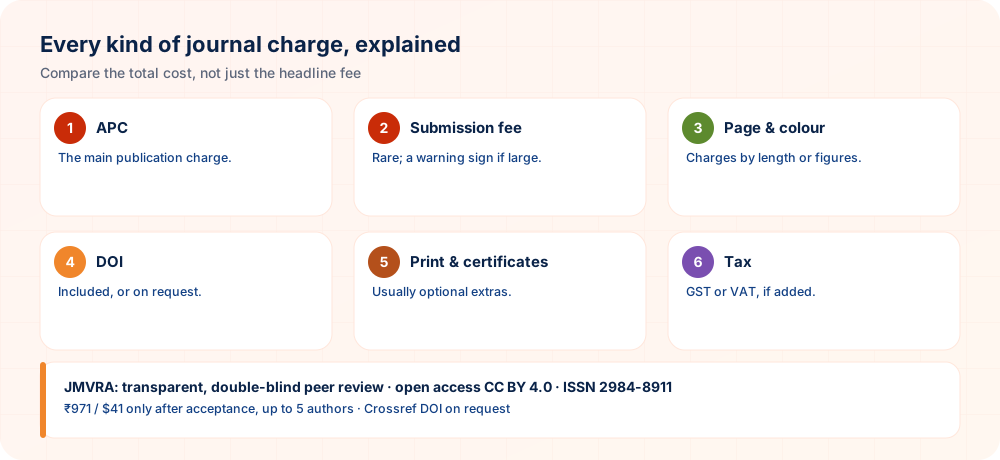
Two journals might each advertise a “low publication fee” while the real amounts differ greatly. Charges take several forms, including article processing charges, submission fees, page or colour charges and optional add-ons, and article types may be priced differently. Once you understand each, you can compare the genuine cost of publishing your article. Ask for a complete price breakdown before deciding where to submit.
Types of Charges
| Charge | When | Common in |
|---|---|---|
| Article processing charge (APC) | After acceptance | Open-access journals |
| Submission fee | At submission, non-refundable | Some journals (less common) |
| Page charges | Per printed page | Some society and subscription journals |
| Colour charges | For colour figures in print | Print journals |
| DOI add-on | At publication | Some low-cost journals |
| Certificates / hard copies | Optional | Some Indian journals |
Can the Article Type Affect the Price?
Short communications or case reports cost less at some journals, and long review articles cost more, although many apply a single flat APC. Read the fee page for your article type and see whether exceeding a length limit adds to the price.
Calculate the Overall Cost
- Begin with the advertised fee. Use the one for your author category (domestic or foreign).
- Include taxes. Add GST or other taxes where they are not already in the price.
- Include mandatory extras. Anything compulsory, for instance a DOI if you need one.
- Skip optional extras you can do without. Examples are printed copies and additional certificates.
- Compare overall totals, not advertised prices. Do this across your whole shortlist.
Low Cost and Value
Good value
Genuine review, a DOI, a lasting archive and clear terms for a modest price.
False economy
A low fee for a publication that your institution will not accept.
Hidden cost
Extras that make a low advertised fee an ordinary one.
Risky
Payment required before review, with no refund.
Waivers and Discounts
- Enquire about waivers for students or unfunded research
- Authors in lower-income countries get discounts at some journals
- APCs are sometimes paid by institutions
- Obtain any waiver in writing ahead of submission
Two Offers Compared Side by Side
| Journal X | Journal Y | |
|---|---|---|
| Headline fee | Low | Moderate |
| Submission fee | Yes, non-refundable | None |
| DOI | Extra | Included |
| Payment timing | Part before review | After acceptance |
| Verdict | Lower advertised price, greater risk | Clearer, safer total |
The 10 Most-Searched Questions on This Topic
Here are the ten questions researchers search for most on this subject, each with a direct answer.
low cost article publication international journal
Inexpensive publication of one article; compare overall cost rather than the advertised fee.
article processing charge meaning
What an open-access journal bills for publishing an accepted article.
page charges journal
Per-page charges for print, applied by certain subscription or society journals.
submission fee journal
Some journals demand a non-refundable fee at the time of submission.
colour figure charges
Charges for colour figures in print, which are normally not applied online.
total cost of journal publication
The advertised fee, taxes and any required extras added together.
APC waiver
A lowered or cancelled fee, frequently granted to students or authors in low-income countries.
review article publication fee
Can be higher because of length, so read the fee page.
DOI charges journal
A DOI comes included with some journals, while others bill it separately as an add-on.
journal fee comparison
Weigh the overall cost of every journal that satisfies your requirement.
How JMVRA Fits In
JMVRA is a Transparent, Peer-Reviewed, Open Access Journal (Refereed Journal). Following the discontinuation of the UGC and UGC-CARE journal listing, and in alignment with the latest UGC-CARE recommendations and guidelines, JMVRA is aligned with UGC’s Suggested Parameters for Choosing Peer-Reviewed Journals. UGC public notice (PDF)
JMVRA applies one published fee, ₹971 INR for Indian authors and $41 USD for foreign authors, solely after acceptance, and lists the Crossref DOI separately as an optional add-on.
- ISSN
- 2984-8911 (online) · publishing since June 2023
- Issues
- Monthly issues across many disciplines
- Review
- Two-way anonymous review by specialists
- Access
- Openly accessible under CC BY 4.0
- Fee
- ₹971 INR for Indian and $41 USD for foreign authors, due only after acceptance
- DOI
- Crossref — available as an optional extra
- Indexing
- Google Scholar yes; not Scopus, Web of Science or DOAJ
- Impact factor
- 11.25, derived from Google Scholar data
Screening begins the moment a paper arrives and each decision is sent as soon as it is reached, yet JMVRA never promises a set number of days: actual review time depends on the reviewers and on how much revision the paper needs.
At-a-Glance Checklist
- Total calculatedEvery line summed
- Timing clearFollowing acceptance
- Optional extrasNever compulsory
- Waivers requestedWhere needed
- JMVRA's fee₹971 INR / $41 USD, after acceptance
Glossary of Publication Charge Terms
| Charge | Meaning |
|---|---|
| APC (article processing charge) | A fee for publishing an accepted article open access |
| Submission fee | A fee to submit, charged even if the paper is rejected |
| Page or colour charge | Fees for length or colour figures, mostly in print journals |
| Extra author fee | An additional charge beyond an included number of authors |
| Add-ons | DOI, hard copies, certificates or reports offered separately |
Requesting an Invoice and Receipt
- Request an invoice made out correctly — personal or institutional, depending on your reimbursement
- Confirm the amount equals the published fee — prior to paying
- Use official payment channels exclusively — never a personal account
- Store the receipt alongside your acceptance letter — useful for audits and reimbursement
Reading a Journal's Charges Before You Commit
Comparing charges is easier when you ask the same questions of every journal. These habits help you understand what you will actually pay and what you receive for it.
- Ask for the complete fee list. Request a written list of every possible charge, including those that apply only after acceptance. A transparent journal will answer plainly, while vague replies are a reason to slow down.
- Separate mandatory from optional items. Mark which extras are compulsory and which you can decline, such as printed copies or expedited handling. Compare journals only after removing optional items, so the totals are genuinely comparable.
- Check the timing of payment. Find out whether payment is requested at submission, after acceptance or after proofs. Paying only once a positive editorial decision exists reduces your risk if the paper is rejected.
- Note currency and bank charges. If you pay in a foreign currency, your bank may add conversion or transfer costs. Allow a small margin in your budget so the final amount does not surprise you.
- Keep every document together. Store the invoice, receipt, acceptance email and published link in one folder. Funders and institutions often ask for this evidence when reimbursing publication costs.
Judge a journal by the full written cost and the clarity of its answers, not by the figure advertised on the front page.
Questions Researchers Often Ask
Your Paper's Journey at JMVRA, From Submission to Publication
- SubmitYou receive a paper ID
- ScreenScope & similarity
- ReviewDouble-blind
- DecideEmail & SMS
- RevisionReply to each point
- AcceptCopyright & fee
- ProduceA DOI if you ask for one
- PublishMonthly issue
How long review takes depends on the reviewers and on any revision required, so no set turnaround is promised; you are told of acceptance or rejection by email and WhatsApp.
Ready to Publish? Submit to JMVRA
JMVRA is aligned with UGC's Suggested Parameters for Choosing Peer-Reviewed Journals.
JMVRA is a Transparent, Peer-Reviewed, Open Access Journal (Refereed Journal). Following the discontinuation of the UGC and UGC-CARE journal listing, and in alignment with the latest UGC-CARE recommendations and guidelines, JMVRA is aligned with UGC’s Suggested Parameters for Choosing Peer-Reviewed Journals.
More useful pages at jmvra.org
Key Terms
Subjects and search phrases this article addresses.
Related Reading
Further reading on the same theme from the JMVRA blog.
How JMVRA's Low-Cost Model Balances the Books
Read the guide RelatedHow to Cite DOIs in APA, IEEE, Vancouver & Chicago
Read the guide Related10 Open Access Mega-Journals With DOIs
Read the guide RelatedUGC and ISSN Approved Journals: What the Claim Means
Read the guide RelatedWhy JMVRA Charges Just ₹971 INR / $41 USD Without Lowering Standards
Read the guide RelatedFree or Low-Cost Publication: Which Suits You?
Read the guide RelatedA Complete Guide to Low-Cost Journal Publication (Starting at ₹971 INR)
Read the guideKeep Reading on the JMVRA Blog
You are reading part of the JMVRA journal blog, a source of hands-on guidance about publishing, indexing, metrics and research integrity that aims to be verifiable, not promotional.