
Mega-journals with open access release thousands of peer-reviewed articles each year over wide subject areas, and they assess papers for soundness instead of perceived importance. All of them register DOIs. Studying their operation gives you a handy yardstick for evaluating any international journal that offers open access and DOIs, smaller and cheaper ones included.
Ten Familiar Examples
| Journal | Publisher | Scope |
|---|---|---|
| PLOS ONE | PLOS | All sciences and medicine |
| Scientific Reports | Springer Nature | Natural sciences, medicine, engineering |
| IEEE Access | IEEE | Engineering and computing |
| Heliyon | Cell Press (Elsevier) | Multidisciplinary |
| PeerJ | PeerJ | Life, environmental and computer sciences |
| SAGE Open | SAGE | Social sciences and humanities |
| BMJ Open | BMJ | Medicine and health |
| F1000Research | Taylor & Francis | Life sciences, with open post-publication review |
| Cureus | Springer Nature | Medicine |
| Frontiers journals | Frontiers | Many subject journals |
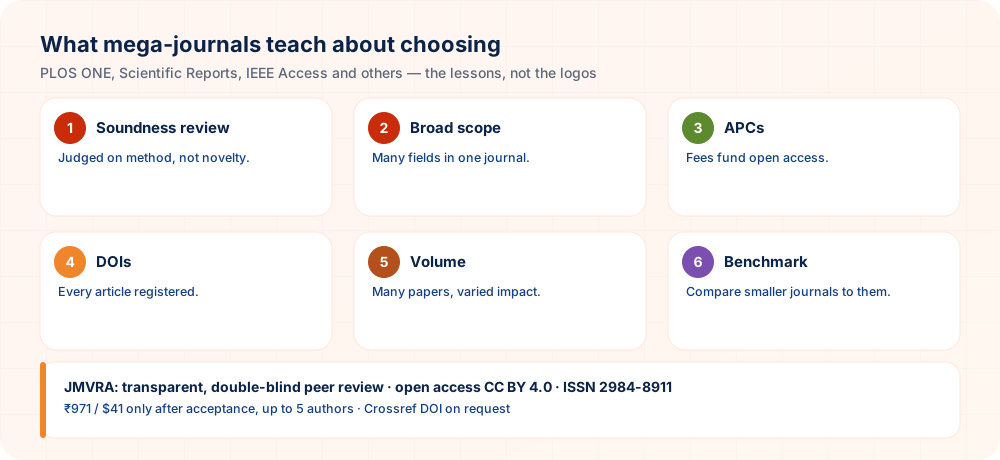
How Mega-Journals Operate
Soundness-only review
Reviewers examine the methods and conclusions rather than “importance”.
Broad scope
Big editorial boards span many disciplines.
Continuous publication
Each article goes online once it is ready.
APC-funded
The majority levy article processing charges, frequently sizeable.
What They Show You About Choosing Any Journal
- Each article carries a working Crossref DOI
- Every article displays its licence (usually CC BY)
- Fees, waivers and the review policy are publicly listed
- Editors and reviewers are identified or described
- Indexing can be confirmed at the original source
About Fees
Without funding, the APCs at most of these journals can far exceed what many Indian authors can afford, though several provide waivers. Look at each journal’s present fee page, since fees change often, and weigh them against cheaper genuine options if your requirements permit. Save a copy of the fee page you relied on, as charges may change later.
Do They Suit Your Paper?
They work well for complete, rigorous studies whose authors seek wide open-access visibility and are able to pay the APC. Early-career researchers, applied studies and unfunded projects may be better served by a smaller, affordable open-access journal that carries out genuine review.
Mega-Journals as a Yardstick
| Practice at mega-journals | Ask of any journal you consider |
|---|---|
| Crossref DOI on every article | Do its DOIs resolve? |
| Licence on every article | Is the licence stated? |
| Published APC and waivers | Are fees and waivers public? |
| Stated review criteria | What does review assess? |
| Data availability policies | Is data sharing expected? |
The 10 Most-Searched Questions on This Topic
Here are the ten questions researchers search for most on this subject, each with a direct answer.
top 10 international journals with DOI
Familiar OA mega-journals are PLOS ONE, Scientific Reports, IEEE Access and Heliyon, and each registers DOIs.
open access mega journal meaning
A big OA journal covering many subjects that judges papers on soundness, not importance.
PLOS ONE publication
A multidisciplinary OA journal that reviews for soundness and charges an APC.
Scientific Reports publication
Springer Nature’s wide-ranging OA journal for the natural sciences and engineering.
IEEE Access publication
IEEE’s OA journal spanning disciplines across engineering and computing.
soundness based peer review
Review focused on methods and conclusions instead of novelty or importance.
DOI access journal
A journal where articles can be reached via lasting DOI links.
APC waiver India
A few big OA journals grant waivers; consult each journal’s policy.
affordable alternative to mega journals
Smaller OA journals that are genuine, with modest fees and real review.
international open access journals list
Browse DOAJ by subject to find vetted OA journals.
How JMVRA Fits In
JMVRA is a Transparent, Peer-Reviewed, Open Access Journal (Refereed Journal). Following the discontinuation of the UGC and UGC-CARE journal listing, and in alignment with the latest UGC-CARE recommendations and guidelines, JMVRA is aligned with UGC’s Suggested Parameters for Choosing Peer-Reviewed Journals. UGC public notice (PDF)
JMVRA applies the same fundamentals: open access under CC BY 4.0, a published review policy and published fees, and Crossref DOIs as an optional add-on, for a fee of ₹971 INR / $41 USD charged only after acceptance.
- ISSN
- 2984-8911 (online) · publishing since June 2023
- Issues
- Monthly issues across many disciplines
- Review
- Two-way anonymous review by specialists
- Access
- Free to read, CC BY 4.0 licence
- Fee
- ₹971 INR for Indian and $41 USD for foreign authors, due only after acceptance
- DOI
- Crossref — available as an optional extra
- Indexing
- Google Scholar covers it, whereas Scopus, Web of Science and DOAJ do not
- Impact factor
- 11.25, derived from Google Scholar data
Screening begins the moment a paper arrives and each decision is sent as soon as it is reached, yet JMVRA never promises a set number of days: actual review time depends on the reviewers and on how much revision the paper needs.
At-a-Glance Checklist
- Review criteria readSoundness or novelty
- Fee comparedAPC levels
- DOIs checkedResolve correctly
- Fit decidedFor this paper
- Lessons appliedTo any journal
The Way the Mega-Journal Model Operates
Soundness, not novelty
A lot of mega-journals assess scientific soundness, not perceived importance.
Broad scope
Submissions from varied disciplines, which suits interdisciplinary research.
APC funding
Open access paid for through article charges, frequently with waivers available.
Large volume
Many thousands of articles annually, handled by editors and reviewers from different fields.
Takeaways for Choosing Any Journal
- Study the review criteria — is it soundness alone, or novelty and importance too?
- Look into the APC and waivers — ahead of submitting
- Browse recent articles in your field — to gauge fit and quality
- Confirm indexing in the databases themselves — not on the homepage
- Weigh smaller journals too — a specialist title may serve your readers better
Practical Tips for Learning From Open Access Mega-Journals
Large open access mega-journals show how broad scope, open licences and article fees can work together. Use them as teaching examples, not as automatic targets, when you plan where to send your own paper.
- Read what the review criteria actually test. Many mega-journals judge soundness rather than novelty. Check the stated criteria and write your paper to show rigorous methods, because an exciting story will not compensate for weak evidence.
- Understand who pays the fee. Find out whether your funder, institution or department covers article charges, and whether waivers exist. Ask before submission so the fee does not appear unexpectedly after acceptance.
- Compare the licence terms. Open licences allow reuse with attribution, which affects how others may share your work. Confirm that you are comfortable with these terms and that co-authors agree.
- Make your title and abstract precise. In a very broad journal your paper competes for attention across many fields. A specific title and a clear abstract help the right readers find and understand it.
- Use the DOI in every profile. Once a DOI is issued, add it to your researcher profile, repository record and curriculum vitae. A consistent identifier connects all copies and mentions of your article.
Learn the model, then judge any journal by its review standards, fee policy and licence rather than by its size or familiarity.
Questions Researchers Often Ask
Anatomy of a JMVRA DOI
Resolver → prefix 10.5555 (an example Crossref prefix) → suffix: journal, volume 14, issue 9, article identifier. A format example: doi.org/10.5555/12345678
Doubt whether a JMVRA DOI is genuine? Look it up on Crossref Search or in the Crossref journal record.
Ready to Publish? Submit to JMVRA
JMVRA is aligned with UGC's Suggested Parameters for Choosing Peer-Reviewed Journals.
JMVRA is a Transparent, Peer-Reviewed, Open Access Journal (Refereed Journal). Following the discontinuation of the UGC and UGC-CARE journal listing, and in alignment with the latest UGC-CARE recommendations and guidelines, JMVRA is aligned with UGC’s Suggested Parameters for Choosing Peer-Reviewed Journals.
Pages worth visiting on jmvra.org
Key Terms
Subjects and search phrases this article addresses.
Related Reading
Further reading on the same theme from the JMVRA blog.
UGC and ISSN Approved Journals: What the Claim Means
Read the guide RelatedWhen Is Your DOI Actually Registered?
Read the guide RelatedComparing Journal Fees Under ₹1400 With DOI
Read the guide RelatedOpen Access, Peer Review, Impact Factor & UGC Parameters Norms — A Complete Guide
Read the guide RelatedFree or Low-Cost Publication: Which Suits You?
Read the guide RelatedDOIs Explained: Crossref, DataCite, Deposit & Resolve
Read the guideKeep Reading on the JMVRA Blog
As part of the JMVRA journal blog, this guide shares practical help on publishing, indexing, metrics and research integrity, and is written to be verifiable rather than promotional.