
Everything about Digital Object Identifiers: their meaning, the difference between Crossref and DataCite, how a DOI is deposited for your research, and how DOI resolution operates behind the scenes.
What Is a DOI (Digital Object Identifier)?
A DOI is a lasting, unique string of characters given to a digital object, most often a journal article, book, dataset or piece of software, so that the object can always be found even after its web address changes.
All DOIs have this 10.prefix/suffix pattern — the "10." shows that it is a DOI, the prefix names the publisher, and the suffix names the particular item.
- Internationally standardized as ISO 26324 and overseen by the International DOI Foundation
- Stays the same once assigned, even when the article's URL, the journal platform or the publisher's website changes
- Resolves worldwide through doi.org, which redirects to the place where the content currently sits
- Holds structured metadata — such as title, authors, publication date and journal — which other systems can search
- Issued by accredited Registration Agencies such as Crossref, and not by authors themselves
- Serves citation tracking, indexing and linking between academic databases around the world
Why DOIs Matter in Research & Journal Publishing
Permanent Citation Link
A DOI, unlike an ordinary web URL, never breaks. Even years after a journal moves to a new platform, readers and citation managers can still resolve it to the right paper. This is a good reason to always cite the DOI when one exists.
Citation Tracking
With DOIs, citation databases such as Google Scholar, Semantic Scholar and Scopus can reliably connect citing papers to the papers they cite, which supports accurate citation counts and impact metrics.
Global Discoverability
After a DOI is registered, its metadata goes out to indexing services, library catalogues and reference managers across the world, so your work becomes easier to find.
Institutional & Funder Requirements
Many universities, funding bodies and UGC CARE-aligned evaluation processes look for a resolvable DOI on published research, as evidence of a formally published and trackable output.
Structured Metadata
A DOI record is more than a link. It holds machine-readable metadata (authors, ORCID iDs, funding, dates) that other systems can query and reuse programmatically.
Version & Provenance Control
DOIs can separate preprints, accepted manuscripts and versions of record, and can connect datasets or software to the paper that relied on them.
Crossref vs. DataCite — What Sets Them Apart?
Each is an official DOI Registration Agency accredited by the International DOI Foundation, but they were created for different kinds of research output.
For Scholarly Literature
Crossref is a non-profit Registration Agency, founded in 2000, designed specifically for scholarly publishing. Most journals, JMVRA among them, rely on it to register DOIs for their published articles.
- Journal articles, conference papers and proceedings
- Books, book chapters and monographs
- Preprints and working papers
- Enables reference linking between citing and cited works
- Membership is held by organizations (publishers, journals, societies)
For Research Data & Outputs
DataCite is a non-profit Registration Agency, founded in 2009, created to supply persistent identifiers to research outputs that go beyond traditional publications.
- Research datasets and supplementary data
- Research software and code repositories
- Physical samples, instruments and images
- Preprints, reports and grey literature from repositories
- Commonly used by universities, data centres and repositories
| Aspect | Crossref | DataCite |
|---|---|---|
| Founded | 2000 | 2009 |
| Primary Focus | Scholarly literature (articles, books, conferences) | Research data, software & non-traditional outputs |
| Typical Members | Journal publishers, societies, university presses | Data repositories, universities, research institutions |
| Metadata Schema | Crossref XML / Crossref REST API | DataCite Metadata Schema / REST API |
| Reference Linking | Core strength — citation graph between papers | Links datasets/software to related publications |
| Resolution | Via doi.org (Handle System) | Via doi.org (Handle System) |
Depositing a DOI Through Crossref
The publisher or journal makes the DOI deposit, not the individual author, yet knowing the process tells authors what happens once a paper is accepted.
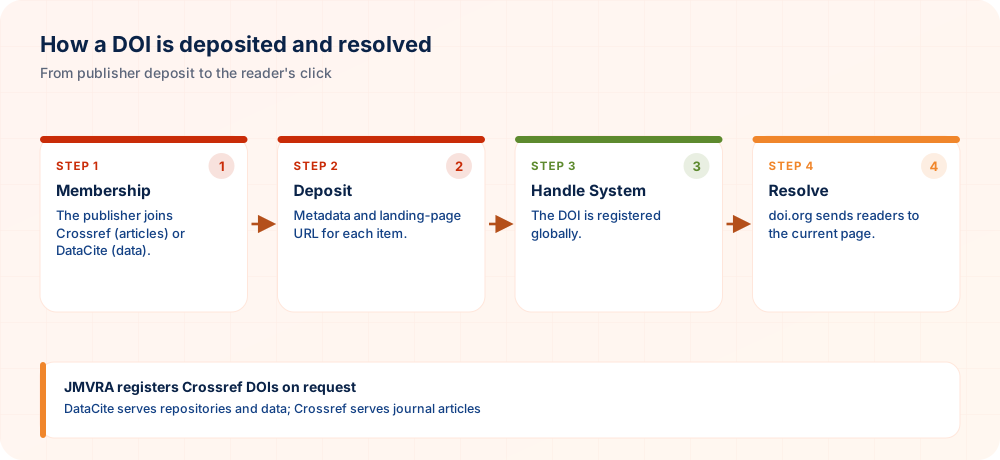
Become a Crossref Member
The journal or publisher signs up as a Crossref member organization and receives a unique DOI prefix (e.g. 10.5555) linked to its account.
Prepare Article Metadata
For every article, the bibliographic metadata is compiled: its title, authors, ORCID iDs, abstract, publication date, volume/issue, and landing-page URL.
Assign a DOI Suffix
The publisher picks a unique suffix for the article (often built from the year, volume, issue and article number) and joins it to their prefix, forming the complete DOI.
Submit the Metadata Deposit
The metadata record, with the DOI and target URL, reaches Crossref by XML upload, a web deposit form or the Crossref REST API.
Crossref Registers the DOI
Crossref validates the record and enters the DOI in the global Handle System, which makes it resolvable straight away at https://doi.org/10.5555/12345678.
Ongoing Metadata Maintenance
Should the article's URL change (for example after a site migration), the publisher updates the DOI record so the link continues to resolve; the DOI itself stays unchanged.
Depositing a DOI Through DataCite
DataCite works much like Crossref, but it is adapted to datasets, software and other research outputs that are usually held in a repository.
Register, or Use a Repository That Holds DataCite Membership
Universities, data centres and repositories become DataCite members (frequently via a national consortium) and are given a DOI prefix of their own.
Prepare the DataCite Metadata Record
Metadata follows the DataCite Metadata Schema, listing creators, title, publisher, publication year and resource type (dataset, software, etc.), plus related identifiers that connect it to a paper.
Upload or Register the Resource
The repository receives the dataset or software and produces a stable landing-page URL that describes the resource and links to it.
Mint the DOI via API or Dashboard
Through its REST API, or a management interface like Fabrica, the repository sends the metadata and landing-page URL to DataCite, and the DOI is minted.
DataCite Registers & Indexes It
DataCite enters the DOI into the Handle System and makes the metadata searchable via DataCite Search and other discovery tools.
Link Back to the Related Publication
Dataset metadata commonly has a "related identifier" field that points to the DOI of the journal article using it, and the article's metadata points back in the same way.
How DOI Resolution Really Works
A Crossref DOI and a DataCite DOI resolve in the same manner, using a shared global infrastructure known as the Handle System.
The Handle System, maintained by the DONA Foundation, is the global infrastructure into which Crossref and DataCite both register their DOIs. That is why a DOI carries on working after a publisher redesigns its site or moves to a new domain: only the metadata record needs an update, and the DOI never does. Remember this whenever you are tempted to cite a bare web address instead.
Crossref DOI at JMVRA
- DOI registration is optional and is not automatically included in the base publication fee
- A requested DOI is registered after final acceptance and confirmation of payment
- A DOI leads readers permanently to the page of your published article on jmvra.org
- For the complete fee breakdown, see JMVRA's Publication Charges policy
The Complete Guide to Digital Object Identifiers, Crossref & DataCite
Each day, millions of researchers follow links to journal articles, datasets and reports without a thought for the hidden infrastructure that keeps those links dependable years, even decades, after publication. That infrastructure is the Digital Object Identifier system, and anyone who publishes or cites academic research today needs to understand how it works, who runs it and how to use it properly. This guide covers the whole picture: what a DOI really is, why the system exists, how Crossref and DataCite differ, how deposit and resolution work technically, and what all of it means in practice for authors publishing with a journal like JMVRA.
A Short History of the DOI System
Publishers in the mid-1990s came up with the DOI system after noticing a growing problem: as scholarly content went online, links to articles kept breaking. Publishers redesigned their sites, switched content management systems, merged with other publishers or closed platforms, and each time the URLs cited in thousands of other papers stopped working. This problem is called "link rot", and by the late 1990s it seriously threatened the integrity of the scholarly citation record.
To solve this, the International DOI Foundation (IDF) was set up in 1998 with the aim of creating a permanent identifier layer above any individual website. Authors would cite a DOI, a string that never changes, rather than a URL, and the DOI system would take care of always pointing to the place where the content currently lived. Later the DOI system was formalized as an international standard, ISO 26324:2012, which made it the accepted worldwide mechanism for persistently identifying digital content.
Why Not Simply Use an Ordinary Web Link?
An ordinary URL says where something is, while a DOI says what something is and leaves the system to work out its current location. At scale, the difference is enormous. Imagine a journal that moves from one hosting platform to another after ten years, so that every article's URL may change. If ten thousand other papers had cited the old URLs directly, all of those citations would break at the same moment. With a DOI nothing breaks: the publisher updates the DOI's target URL once, in a single place, and every citation to that DOI, old or new, keeps resolving correctly.
Who Really Issues DOIs?
Authors cannot register a DOI of their own straight with the International DOI Foundation. The IDF instead accredits a small set of Registration Agencies (RAs), each of which serves a certain community or type of content. For academic research the two most relevant are Crossref and DataCite, although others serve different sectors (for example mEDRA for European multimedia content, or Airiti for content in parts of Asia). A publisher, journal, university or repository becomes a member of the suitable Registration Agency, is given a unique prefix, and then registers DOIs for its own content under that prefix.
Crossref in Depth
Crossref, whose formal name is the Publishers International Linking Association, was established in 2000 by a group of scholarly publishers seeking a common reference-linking system, so that a reader could click a citation in one paper and arrive straight at the cited work, whichever publisher hosted it. That remains its defining strength: member publishers deposit reference lists along with their own article metadata, which lets Crossref assemble a huge citation graph linking scholarly works across publishers. Many citation-counting and bibliometric tools used in academia today rely on this foundation.
Crossref membership works at the organization level: a journal, publisher, university press or professional society joins directly, pays a fee that scales with how much it publishes, and receives one or more DOI prefixes. After that, the publisher must deposit accurate metadata for all of its output, including journal articles, conference proceedings, books, book chapters and, more and more, preprints and grant records. Accurate deposits matter because every downstream service reads the same record.
DataCite in Depth
DataCite came into being in 2009 to cover something Crossref was not built for: assigning persistent identifiers to research outputs that are not conventional publications. Datasets, software repositories, physical samples, instruments and even teaching resources increasingly required a permanent, citable identity of their own, distinct from yet connected to the papers that drew on them. DataCite designed its metadata schema and membership model around that need, and today it is the leading Registration Agency for university data repositories, national data centres and research infrastructure projects around the world.
One central DataCite idea is the related identifier, a metadata field that directly connects a dataset's DOI with the DOI of the paper describing or using it, and the reverse. A reader can therefore begin with a paper, follow a link to the data behind it, and rely on that link being a verified, machine-readable relationship instead of a passing mention in the text.
How the Handle System Connects Everything
Both Crossref and DataCite rest on a common layer of global infrastructure, the Handle System, run by the DONA Foundation. Technically, any DOI, whichever Registration Agency issued it, is one kind of "handle" recorded in this system. When someone opens https://doi.org/10.5555/12345678, the request reaches a proxy server run by the DOI Foundation; it asks the Handle System which URL is currently tied to that identifier and then sends the browser there with an HTTP redirect. Because this resolution layer is shared, a DOI minted by Crossref and one minted by DataCite behave the same for the reader, and nobody needs to know which agency issued a DOI in order to resolve it.
Which Metadata Is Really Stored
People often assume a DOI is "just a link." In fact each DOI record holds a structured metadata package next to the target URL, and that is why DOIs serve discovery and citation tools so well, beyond simple redirection. For a journal article registered with Crossref, the package normally covers the article title, the complete author list (frequently with ORCID iDs), journal name and ISSN, volume and issue, page numbers, publication date, abstract, funding details and licence terms. A dataset registered with DataCite instead centres on creators, publisher, publication year, resource type and, crucially, related-identifier links back to associated papers. Since this metadata is standardized and machine-readable, indexing services, citation managers such as Zotero and Mendeley, and academic search engines can fetch accurate bibliographic details from a DOI alone, with no need to scrape or guess at what a web page contains.
Frequent Misunderstandings About DOIs
- "Having a DOI means my paper is peer-reviewed or of high quality." Incorrect. A DOI is a persistent identifier and says nothing about quality. Predatory publishers are able to register DOIs for their content, and some do.
- "As an individual author I can register a DOI myself." Not directly: DOIs are registered by member organizations such as publishers, journals and repositories, rather than by individual researchers, although your institution's repository might provide this for datasets.
- "A DOI is more or less the same as a URL." Not exactly. A URL names one specific location, whereas a DOI leads to whichever location is currently registered for it, and that can change over time while the identifier stays intact.
- "DataCite only handles scientific data." Incorrect. DataCite handles a wide variety of non-traditional outputs, including software, physical samples and audiovisual material, not merely quantitative datasets.
Research Integrity and DOIs
Apart from being convenient, DOIs increasingly support research integrity and reproducibility. Journals and funders more often expect authors to deposit the underlying datasets or code under a DOI when they publish, allowing other researchers to check or extend the work. When a paper's Crossref DOI record points to its dataset's DataCite DOI record, the result is an auditable trail from published claims to supporting evidence, something ordinary hyperlinks inside a PDF could never reliably promise in the long run. Documenting your data and code clearly helps anyone who follows that trail to reuse them.
What This Means for Authors Who Publish with JMVRA
For an author publishing a research paper with JMVRA, the practical point is simple: a Crossref DOI gives the article a lasting, citable identity that keeps resolving properly even if JMVRA's own website or platform changes later. It improves how the paper is tracked in citation databases, makes it easier to list correctly on a CV, ORCID profile or institutional repository, and meets the expectation, growing at universities and funding bodies, that a "properly published" article has a resolvable DOI. JMVRA keeps this optional and priced separately at ₹500, instead of quietly folding it into the base fee, so each author can decide whether a particular paper needs it.
A DOI Checklist Designed for Authors
- Ask for the DOI — JMVRA provides a Crossref DOI on request
- Try the link — https://doi.org/10.5555/…
- Verify the metadata — article title, author names and journal information
- Cite it wherever relevant — on your CV, ORCID profile and in repositories
DOI Myths
| Myth | Fact |
|---|---|
| Having a DOI equals being indexed | A DOI identifies; it is not indexing |
| A DOI is evidence of peer review | It gives no certification of review |
| Individual authors can purchase DOIs themselves | Member organizations like publishers do the registering of DOIs |
| DOIs expire | DOIs are persistent |
Handling Digital Object Identifiers Carefully in Your Research Workflow
A DOI is only useful when it is correct, registered and cited consistently. These practical habits help authors treat identifiers as part of the scholarly record rather than as a last-minute formality.
- Copy, never retype. Paste a DOI directly from the landing page or registration record. A single mistyped character produces a link that points nowhere or, worse, to an unrelated article.
- Check metadata before registration. Author names, affiliations, title and article type travel with the identifier. Correct them in the manuscript first, because changing registered metadata later usually needs extra requests and delays.
- Test the link after publication. Once your paper is live, open the DOI in a private browser window and confirm it reaches the right article. Report any mismatch to the journal promptly instead of assuming it will self-correct.
- Match the identifier to the output. Data sets, software and articles may be registered through different services. Decide which kind of output you are sharing, then use the registration route designed for that kind.
- Use the full link in references. Write the DOI in its resolvable link form within your reference list, so readers and automated tools can follow it with one click.
Treat the DOI as permanent infrastructure: verify details before registration, test the link afterwards and cite it in one consistent, complete format.
Questions Researchers Often Ask
What is a DOI?
A Digital Object Identifier (DOI) is a lasting alphanumeric string, written as 10.prefix/suffix, given to a digital object such as a journal article, dataset or book, so that it can still be located after its web address changes.
How do Crossref and DataCite differ?
Each is an official DOI Registration Agency. Crossref mainly registers DOIs for scholarly literature, for instance journal articles, conference papers and books, whereas DataCite mainly handles DOIs for research data, software, preprints and other non-traditional research outputs. Which one applies to you usually depends on what you are publishing and where it is deposited.
How can I obtain a DOI for my research paper?
When you publish with a journal that belongs to Crossref, the publisher registers and deposits the DOI for you once your paper is published. JMVRA registers Crossref DOIs on request for a small additional charge (check the present amount with the editorial office), on top of its regular ₹971 INR / $41 USD publication fee.
How does a DOI get resolved?
Opening https://doi.org/ followed by a DOI sends a request to the worldwide Handle System, which finds the URL currently registered for that DOI and redirects the browser to it, even when the web address of the page has changed since the DOI was issued.
Does obtaining a DOI cost nothing?
Individual authors do not pay Crossref directly. Registration Agencies bill publishers and repositories for membership and per-DOI fees, and publishers may pass these on within a publication fee, as JMVRA does through its optional DOI add-on, which carries a small optional charge (ask the editorial office).
Is it possible for a DOI to stop working?
A DOI never expires by itself, but it only resolves if the publisher keeps the metadata record updated with a working URL. Respected Registration Agencies such as Crossref oblige members to keep their links accurate and current. If a link fails, reporting it to the publisher is the quickest way to get it repaired.
Is Crossref used by JMVRA?
JMVRA supports Crossref DOI registration for published articles. It is provided on request at ₹500 (Indian) / $20 USD (international), added to the standard ₹971 INR (Indian) / $41 USD (international) publication fee.
Is it possible to add a DOI to an earlier JMVRA article?
Contact the editorial office; Crossref DOIs can be had on request.
Will a DOI increase my citations?
It simplifies citing and tracking, but the usefulness of the work is what earns citations.
Want a Crossref DOI for Your Paper?
Affordable publication charges Publication · Crossref DOI ₹500 On Request · UGC Status & Parameters · ISSN 2984-8911
+91 91063 65667 · See also: Publication Charges Policy
What This Guide Covers
At-a-Glance Checklist
- Agency identifiedCrossref or DataCite
- Full metadataTitle, authors and references
- Stable landing pageOne for each article
- DOI verifiedAt doi.org
- Kept current if URLs changeThrough the agency
Anatomy of a JMVRA DOI
Resolver → prefix 10.5555 (an example Crossref prefix) → suffix: journal, volume 14, issue 9, article identifier. A format example: doi.org/10.5555/12345678
Authenticating a JMVRA DOI is simple with Crossref Search or the Crossref journal record.
Ready to Publish? Submit to JMVRA
JMVRA is aligned with UGC's Suggested Parameters for Choosing Peer-Reviewed Journals.
JMVRA is a Transparent, Peer-Reviewed, Open Access Journal (Refereed Journal). Following the discontinuation of the UGC and UGC-CARE journal listing, and in alignment with the latest UGC-CARE recommendations and guidelines, JMVRA is aligned with UGC’s Suggested Parameters for Choosing Peer-Reviewed Journals.
Where to go next on jmvra.org
Key Terms
Subjects and search phrases this article addresses.
Related Reading
Further reading on the same theme from the JMVRA blog.
Publishing an Academic Book: ISBN, DOIs & Process
Read the guide RelatedCrossref DOI: How Registration and Metadata Work
Read the guide RelatedMaking Your Paper Easier to Find Online
Read the guide RelatedFree Zenodo DOIs: Uses and Limits
Read the guide RelatedGetting a Crossref DOI for Your Published Paper
Read the guide RelatedISBN, ISSN and DOI: Three Identifiers Compared
Read the guideKeep Reading on the JMVRA Blog
Find this guide on the JMVRA journal blog, a collection of practical guidance on publishing, indexing, metrics and research integrity that favours verifiable content over promotion.