
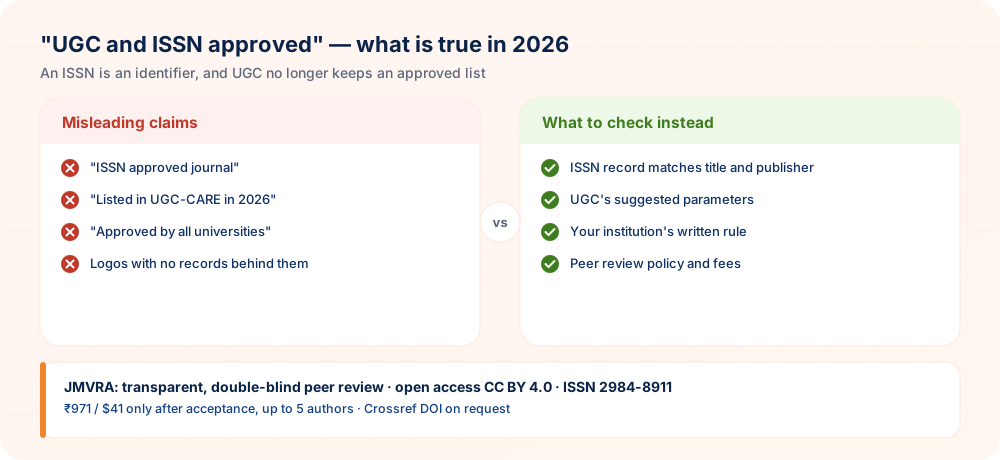
Journal websites frequently display a pair of badges: “UGC approved” and “ISSN approved”. In 2026 both phrases are misleading, because an ISSN is an identifier rather than an approval, and UGC has discontinued its approved and CARE lists. Understanding what each term truly means lets you read journal claims correctly and shows what evidence to look for in their place.
What an ISSN Is and What It Is Not
The International Standard Serial Number identifies a serial publication such as a journal, magazine or series. The ISSN network assigns it (in India, through the ISSN National Centre at CSIR-NIScPR) after a publisher applies with the necessary details. It says nothing certifying quality, peer review or recognition, and there is no such thing as an “ISSN approval”.
The Meaning of UGC Status in 2026
UGC first maintained the UGC-Approved List of Journals (2017–2019) and later UGC-CARE. The CARE listing has been discontinued, as decided in October 2024 and announced in UGC’s public notice of February 2025, and UGC now refers people to suggested parameters for choosing peer-reviewed journals. In 2026, then, no journal can be “UGC approved” in the sense of appearing on a current list. Read our guide to the CARE list’s status for details.
Common Claims and Their Real Meaning
| Claim | Its real meaning |
|---|---|
| “ISSN approved” | The journal holds an ISSN, which is just an identifier |
| “UGC approved 2026” | Cannot be verified, since no current list exists |
| “Was UGC approved” | Might have been true in the past; look at the dates |
| “Aligned with UGC’s suggested parameters” | A statement you can test one point at a time against the parameters |
What You Should Verify Instead
- An ISSN Portal record whose title and website agree with the journal
- A peer review policy together with evidence that review takes place
- Indexing confirmed directly at the source
- Open fees and clear ownership
- The rule your institution follows today
Open Access Is a Different Question
The phrase “international open access journal” tells you about access and readership, not about approval. Evaluate it like any open-access journal, by its licence, fees, review and permanence.
Print ISSN, e-ISSN and ISSN-L
| Identifier | Meaning |
|---|---|
| Print ISSN (p-ISSN) | Marks the printed edition |
| Online ISSN (e-ISSN) | Marks the online edition |
| ISSN-L | Connects the different editions of one journal |
A journal that appears solely online requires only an e-ISSN. Make sure the ISSN displayed corresponds to the edition in which you are publishing.
The 10 Most-Searched Questions on This Topic
Here are the ten questions researchers search for most on this subject, each with a direct answer.
UGC and ISSN approved journal
This wording misleads, as an ISSN is merely an identifier and UGC maintains no current approved list.
what is ISSN
A code that identifies a serial publication, for example a journal.
ISSN approved meaning
ISSN approval does not exist; an ISSN simply identifies the journal.
how to get ISSN in India
Publishers send their applications to CSIR-NIScPR, which hosts the ISSN National Centre for India.
UGC approved journal 2026
UGC does not keep an approved list or a CARE list any more.
UGC CARE discontinued
UGC ended the CARE listing and now points to suggested parameters.
UGC suggested parameters journals
Guidance from UGC on the features of credible peer-reviewed journals.
ISSN check portal
Look up the ISSN on portal.issn.org.
international open access journal
A journal anyone can read, with readers worldwide — assess it on evidence.
journal approval myths
An ISSN or an old UGC badge cannot prove present quality or recognition.
How JMVRA Fits In
JMVRA is a Transparent, Peer-Reviewed, Open Access Journal (Refereed Journal). Following the discontinuation of the UGC and UGC-CARE journal listing, and in alignment with the latest UGC-CARE recommendations and guidelines, JMVRA is aligned with UGC’s Suggested Parameters for Choosing Peer-Reviewed Journals. UGC public notice (PDF)
JMVRA describes its status accurately: ISSN 2984-8911, and — following the discontinuation of UGC and UGC-CARE listing — aligned with UGC’s Suggested Parameters for Choosing Peer-Reviewed Journals.
- ISSN
- 2984-8911 (online) · publishing since June 2023
- Issues
- Monthly issues across many disciplines
- Review
- Two-way anonymous review by specialists
- Access
- CC BY 4.0 open access
- Fee
- ₹971 INR for Indian and $41 USD for foreign authors, due only after acceptance
- DOI
- Crossref — available as an optional extra
- Indexing
- Google Scholar has it, whereas Scopus, Web of Science and DOAJ do not
- Impact factor
- 11.25, derived from Google Scholar data
Screening begins the moment a paper arrives and each decision is sent as soon as it is reached, yet JMVRA never promises a set number of days: actual review time depends on the reviewers and on how much revision the paper needs.
At-a-Glance Checklist
- ISSN clarifiedNothing more than an identifier
- UGC stance up to dateParameters
- Claims confirmedAt the source
- Institution consultedIn writing
- OA licence examinedA question of its own
How to Verify an ISSN
- Open the ISSN Portal — then search for the number
- Match the exact title — subtitle and language included
- Look at the medium — a print ISSN, an online ISSN or both
- Verify the publisher and country — they must agree with the journal’s own information
Phrases That Call for Caution
| Claim | Reality |
|---|---|
| “ISSN approved” | That kind of approval does not exist; an ISSN is only an identifier |
| “UGC approved journal” (2026) | UGC has stopped keeping an approved list |
| “Indexed in ISSN” | The ISSN Portal works as a register and not as an index |
| “Government recognised” | Ask which organisation and which document |
Practical Tips for Judging Approval Claims on Journals
Journal websites often use approval language that sounds official but proves little. These habits help you read such claims calmly and decide whether a journal deserves your manuscript before you send anything.
- Screenshot claims with the date. When a journal states an approval or listing, save a dated screenshot of the page. Wording changes quietly, and your own record helps if you later need to explain why you chose that journal.
- Ask who issued the claim. Every genuine approval has an issuing body that you can name and contact. If the page only says approved without naming anyone, treat the statement as marketing rather than evidence.
- Check the registry directly. Instead of trusting a badge, open the official registry yourself and search by title. Compare the journal name, publisher and country shown there with what the journal's own website declares.
- Separate access from legitimacy. An open access label describes who can read the paper, not whether review was rigorous. Judge peer review practice, editorial transparency and ethics statements as independent questions before you decide.
- Consult your librarian. University librarians handle these questions regularly and often know which sources your institution accepts for promotion or degree requirements. A short email can save you from a costly mistake.
Verify every approval claim at its original source, and keep a dated record of what you found before you submit.
Questions Researchers Often Ask
How JMVRA Measures Up to UGC’s 35 Suggested Parameters
Annexure-I, the final version issued with UGC’s 16 July 2025 notice, divides 35 parameters among 8 categories (36 appeared in the February 2025 draft). On JMVRA's own assessment, 28 are met, 2 are partly met, 3 are not published and 2 do not apply, each one explained.
Taken from the UGC public notice on CARE journals (PDF) · further detail appears on JMVRA & UGC parameters.
Ready to Publish? Submit to JMVRA
JMVRA is aligned with UGC's Suggested Parameters for Choosing Peer-Reviewed Journals.
JMVRA is a Transparent, Peer-Reviewed, Open Access Journal (Refereed Journal). Following the discontinuation of the UGC and UGC-CARE journal listing, and in alignment with the latest UGC-CARE recommendations and guidelines, JMVRA is aligned with UGC’s Suggested Parameters for Choosing Peer-Reviewed Journals.
Handy links within jmvra.org
Key Terms
Subjects and search phrases this article addresses.
Related Reading
Further reading on the same theme from the JMVRA blog.
When Is Your DOI Actually Registered?
Read the guide RelatedComparing Journal Fees Under ₹1400 With DOI
Read the guide RelatedVerifying a Low-Cost Journal's Crossref DOIs
Read the guide RelatedDOI vs ISSN: Two Identifiers, Two Jobs
Read the guide RelatedWhat the Discontinuation of UGC-CARE Means for Researchers
Read the guide RelatedUGC’s Suggested Parameters for Choosing Peer-Reviewed Journals
Read the guideKeep Reading on the JMVRA Blog
The JMVRA journal blog includes this guide, one of many practical pieces on publishing, indexing, metrics and research integrity, prepared so readers can verify them without any sales pitch.