
When publication is rapid, authors frequently get a DOI number by email before the article is even online, only to discover that the link fails. Knowing when and how DOIs are registered accounts for most of these cases and shows which of them are red flags.
The Point at Which a DOI Gets Registered
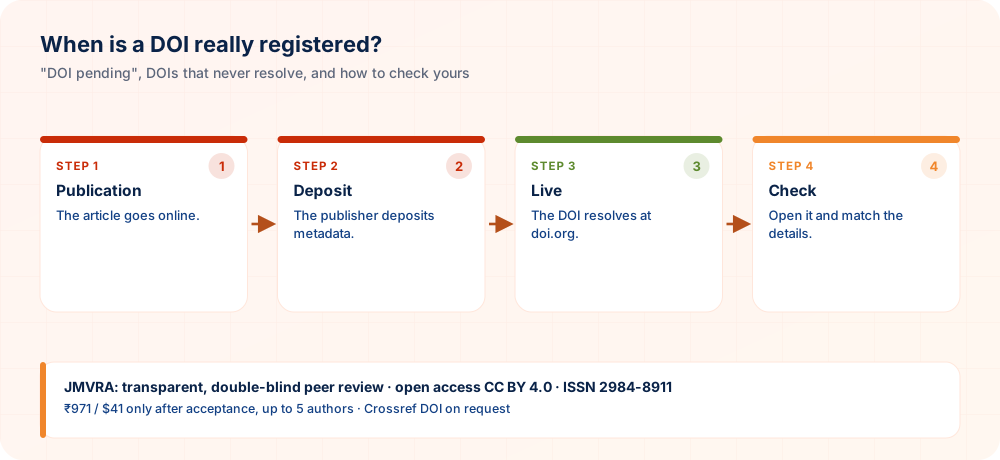
- The article is accepted and finalised. The journal readies the final version along with its metadata.
- The article page goes live. It receives a permanent URL.
- The journal submits metadata to Crossref. This covers the title, authors, journal, date and URL.
- The DOI starts to resolve. Typically soon after the deposit.
The Meaning of “DOI Pending”
A DOI may be announced ahead of its deposit, for instance on an accepted-manuscript page, and the link will not resolve until the journal deposits it. A brief delay is normal, but a DOI that still fails weeks after publication is something to take up with the journal.
Reasons Some DOIs Never Work
| Cause | What it means |
|---|---|
| Deposit not made | Registration by the journal has not happened yet |
| Typo in the DOI | Check characters carefully |
| An invented “DOI-like” number | Certain journals display numbers that are not registered DOIs |
| Wrong prefix | The prefix is not one owned by the journal’s publisher |
Check Your DOI
- Go to https://doi.org/ followed by your DOI — it ought to lead to your article
- Enter your title on search.crossref.org and check that the record shows your details
- Make sure the prefix is the same as on other articles in the journal
- Tell the journal about any problem, quoting your paper ID
DOIs and Low Charges
A journal pays a Crossref membership fee and a small registration fee for each article in order to register DOIs, which is why low-cost journals sometimes sell DOIs as an add-on. That is fair when stated openly. Charging for a “DOI” that is never registered is not.
Anatomy of a DOI
| Part | Example | Meaning |
|---|---|---|
| Resolver | https://doi.org/ | The service which forwards you to the article |
| Prefix | 10.5555 | The registrant (publisher) |
| Suffix | jmvra.xxxxxxx | The individual article |
If what follows the resolver address does not start with “10.”, it is not a DOI.
The 10 Most-Searched Questions on This Topic
Here are the ten questions researchers search for most on this subject, each with a direct answer.
international journals with rapid publication and DOI
Journals that publish efficiently and register Crossref DOIs which actually resolve.
when is DOI registered
Once the journal sends the article’s metadata to Crossref, which normally happens when it is published.
DOI pending meaning
The DOI has been allotted but not yet registered, which is why it does not resolve.
DOI not working
Commonly it is not yet deposited, was typed wrongly, or is not a real registered DOI.
how to check DOI registered
Visit it through doi.org or search on search.crossref.org.
fake DOI journal
A number resembling a DOI that has never been registered with an agency.
DOI prefix check
Check the prefix against other articles from the same journal.
low charges journal DOI add-on
A few low-cost journals bill DOI registration as a separate item.
Crossref metadata search
Registered DOI records can be seen at search.crossref.org.
DOI resolution time
Typically a short time after the journal has deposited the metadata.
How JMVRA Fits In
JMVRA is a Transparent, Peer-Reviewed, Open Access Journal (Refereed Journal). Following the discontinuation of the UGC and UGC-CARE journal listing, and in alignment with the latest UGC-CARE recommendations and guidelines, JMVRA is aligned with UGC’s Suggested Parameters for Choosing Peer-Reviewed Journals. UGC public notice (PDF)
On request, JMVRA registers DOIs with Crossref (the Crossref DOI option) once the article is published in an issue, which is an optional add-on, and it checks the deposit whenever an author reports a DOI that does not resolve.
- ISSN
- 2984-8911 (online) · publishing since June 2023
- Issues
- Monthly issues across many disciplines
- Review
- Two-way anonymous review by specialists
- Access
- Free to read, CC BY 4.0 licence
- Fee
- ₹971 INR for Indian and $41 USD for foreign authors, due only after acceptance
- DOI
- Crossref — available as an optional extra
- Indexing
- Google Scholar covers it, but not Scopus, Web of Science or DOAJ
- Impact factor
- 11.25, derived from Google Scholar data
Screening begins the moment a paper arrives and each decision is sent as soon as it is reached, yet JMVRA never promises a set number of days: actual review time depends on the reviewers and on how much revision the paper needs.
At-a-Glance Checklist
- DOI tried outThrough doi.org
- Metadata comparedTitle plus authors
- Prefix holderLooked up in Crossref
- "Pending" status pursuedThrough the journal
- JMVRA DOIOn request
A Usual DOI Timeline
| Stage | What happens |
|---|---|
| Acceptance | The paper passes review and is accepted |
| Production | The final file, metadata and article page are made ready |
| Publication | The article page is published online |
| Registration | The journal submits the DOI and metadata to the registration agency |
| Resolution | After registration, the DOI leads to the article page |
Before Adding a DOI to Your CV
- Test the DOI on your own — through https://doi.org/
- Confirm it opens your article — rather than a homepage or another paper
- Inspect the metadata — the title and author names must agree
- Write it uniformly — as a complete https://doi.org/ link
Checking and Using Your DOI After Publication
A DOI is only useful if it resolves correctly and appears consistently wherever your paper is listed. These habits help you confirm it works and avoid sharing broken links.
- Click the link yourself. After publication, paste the DOI link into a browser and confirm it opens your article. Do this before adding it to your CV, repository or social profiles.
- Copy the DOI exactly. Take the identifier directly from the published page rather than retyping it. A single wrong character produces a dead link and may send readers to someone else's work.
- Be patient with newly issued identifiers. A freshly assigned identifier can take a short while before it resolves. If it still fails after a sensible wait, write to the journal and keep the correspondence.
- Keep the same DOI everywhere. Use the identical link in your institutional repository, profiles and later citations. Consistency helps tracking tools connect all mentions to one record.
- Report errors without delay. If the DOI leads to the wrong page or an error message, tell the publisher promptly with a screenshot. Early reporting makes correction easier.
Test your DOI personally, copy it exactly, and report problems quickly so that readers can always reach your paper.
Questions Researchers Often Ask
Anatomy of a JMVRA DOI
Resolver → prefix 10.5555 (an example Crossref prefix) → suffix: journal, volume 14, issue 9, article identifier. A format example: doi.org/10.5555/12345678
Want to confirm that a JMVRA DOI is genuine? Look it up in Crossref Search or the Crossref journal record.
Ready to Publish? Submit to JMVRA
JMVRA is aligned with UGC's Suggested Parameters for Choosing Peer-Reviewed Journals.
JMVRA is a Transparent, Peer-Reviewed, Open Access Journal (Refereed Journal). Following the discontinuation of the UGC and UGC-CARE journal listing, and in alignment with the latest UGC-CARE recommendations and guidelines, JMVRA is aligned with UGC’s Suggested Parameters for Choosing Peer-Reviewed Journals.
Pages worth visiting on jmvra.org
Key Terms
Subjects and search phrases this article addresses.
Related Reading
Further reading on the same theme from the JMVRA blog.
Comparing Journal Fees Under ₹1400 With DOI
Read the guide RelatedVerifying a Low-Cost Journal's Crossref DOIs
Read the guide RelatedFinding International Journals With Low Charges
Read the guide RelatedTesting a Journal DOI: A Checklist for DOI Resolution and Metadata
Read the guide RelatedA Crossref DOI for Your Published Paper: Its Purpose and How to Obtain It
Read the guide RelatedHow Journals Obtain Crossref DOIs
Read the guideKeep Reading on the JMVRA Blog
As part of the JMVRA journal blog, this guide shares practical help on publishing, indexing, metrics and research integrity, and is written to be verifiable rather than promotional.