
Publication charges can run from zero to several thousand US dollars, and a journal's position on that scale reflects its business model, publisher and funding rather than just its quality. So instead of trusting a ready-made “list of low-charge journals”, first understand the landscape, then assemble your own list from sources that display fees openly. Always compare what each fee actually covers before judging whether a price is good.
The Fee Landscape
| Tier | Typical author cost | Examples of who is here |
|---|---|---|
| Diamond open access | None | Society, university and government-funded journals |
| Subscription (non-OA route) | Often none | Many traditional journals |
| Low-cost open access | Modest APCs | Many independent and regional journals |
| Major publisher open access | Often $1,500 USD–3,000 or more | Large commercial and society OA journals |
Locating No-Fee Journals Through DOAJ
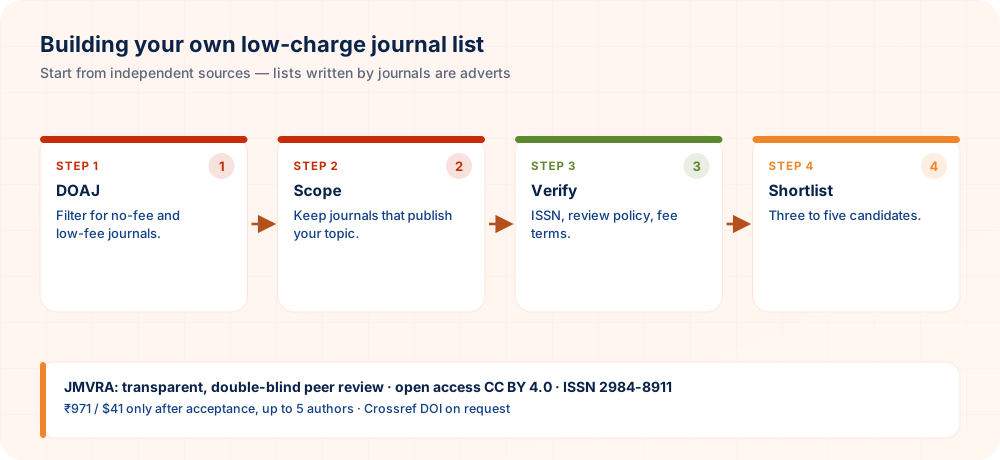
- Open DOAJ. doaj.org
- Look up your field. Try keywords or browse by subject.
- Filter “Without article processing charges”. In DOAJ you can restrict results to journals with no APC.
- Vet every journal. Look at its scope, review process and latest issues.
Create a Low-Charge List of Your Own
- Begin with journals matching your subject and needs
- Log each journal’s APC, taxes and extras
- Make a note of when payment is due and whether waivers exist
- Confirm the review and indexing claims
- Write down the date you checked, since fees change
What Explains Such Big Fee Gaps
- Whether authors, institutions or readers pay for the journal
- Publisher overheads and brand name
- How many articles are published
- Included services: editing, DOIs, marketing, indexing
Be Careful With Lists Journals Write Themselves
A lot of web-based “lists of low-charge journals” come from a journal that places itself at the top. Treat them purely as leads and check each entry on your own.
How to Read a DOAJ Journal Record
| DOAJ field | What it tells you |
|---|---|
| APC | Whether there is a charge, and its amount |
| Waiver policy | Whether the fee can be reduced |
| Licence | Which Creative Commons licence applies |
| Review process | What kind of peer review is used |
| Time to publication | The average the journal itself reports |
The 10 Most-Searched Questions on This Topic
Here are the ten questions researchers search for most on this subject, each with a direct answer.
list of international journals with low publication charges
Assemble your own list using DOAJ and further sources, noting the full fees and confirming every journal.
no publication fee journals
Authors pay nothing in diamond OA and in numerous subscription journals.
diamond open access journals
Readers and authors both pay nothing; institutions or societies cover the costs.
DOAJ without APC filter
In DOAJ you can narrow results to journals that carry no article processing charges.
APC range journals
Anything from nothing up to several thousand US dollars.
why are APCs so high
Fees differ a lot because of publisher overheads, brand and services.
low publication charges journal India
Numerous Indian journals ask for modest fees; confirm their review and permanence.
free international journal publication
Diamond OA journals; confirm suitability and review.
journal fee transparency
Clear statements of fees, taxes, add-ons and when payment falls due.
journal APC comparison
Set the totals side by side for the journals that satisfy your requirement.
How JMVRA Fits In
JMVRA is a Transparent, Peer-Reviewed, Open Access Journal (Refereed Journal). Following the discontinuation of the UGC and UGC-CARE journal listing, and in alignment with the latest UGC-CARE recommendations and guidelines, JMVRA is aligned with UGC’s Suggested Parameters for Choosing Peer-Reviewed Journals. UGC public notice (PDF)
JMVRA belongs to the low-cost open-access group, with ₹971 INR for Indian authors and $41 USD for foreign authors, openly published and billed only once a paper is accepted.
- ISSN
- 2984-8911 (online) · publishing since June 2023
- Issues
- Monthly issues across many disciplines
- Review
- Two-way anonymous review by specialists
- Access
- CC BY 4.0, open to all readers
- Fee
- ₹971 INR for Indian and $41 USD for foreign authors, due only after acceptance
- DOI
- Crossref — available as an optional extra
- Indexing
- Google Scholar covers it; Scopus, Web of Science and DOAJ do not
- Impact factor
- 11.25, derived from Google Scholar data
Screening begins the moment a paper arrives and each decision is sent as soon as it is reached, yet JMVRA never promises a set number of days: actual review time depends on the reviewers and on how much revision the paper needs.
At-a-Glance Checklist
- Independent sourceDOAJ or databases
- Fee read on journal siteCurrent and complete
- Review policy checkedNamed model
- Waivers askedWhere available
- List kept currentFees change
A Fair Way to Compare Low-Fee Journals
| Factor | Question |
|---|---|
| Peer review | Does the journal name its model and give genuine reviewer feedback? |
| Scope fit | Are the latest articles similar to yours? |
| Indexing | Can any claimed indexing be confirmed in the database itself? |
| Licence | Is the article open access with a clear licence, for example CC BY? |
| Total cost | Do DOI, certificates or additional authors cost extra? |
| Timing of payment | Is payment requested solely after acceptance? |
Fee Waivers, Discounts and Support From Institutions
Publisher waivers
Authors from lower-income countries often qualify for waived or reduced APCs at many publishers, so read each policy.
Institutional agreements
Certain universities hold agreements with particular publishers that pay APCs on authors' behalf.
Grant budgets
Add publication costs to your budget when requesting funding.
Diamond OA
Many fields have journals that charge authors nothing, and DOAJ can filter for them.
Evaluating International Low-Charge Journals Beyond the Price Tag
An international journal with modest charges can serve you well, provided it is honest about its processes. Use these checks to separate sustainable, ethical venues from risky ones.
- Read the open access licence. Confirm which licence applies to your article and what readers may do with it. Licence terms affect reuse, and they should be stated clearly before you submit.
- Prefer independent directories. Use neutral directories and library guides to find options, rather than rankings written by the journals themselves. Self-published lists often favour their authors' interests.
- Ask about archiving arrangements. Find out how the journal preserves articles in the long term. Preservation plans protect your work if the website changes or the publisher closes.
- Consider currency and payment methods. International payments may involve bank charges or conversion differences. Ask for the exact payable amount and keep the receipt for your records.
Look past the charge to licences, archiving and payment clarity, using neutral sources to build your shortlist.
Questions Researchers Often Ask
Your Paper's Journey at JMVRA, From Submission to Publication
- SubmissionPaper ID is issued
- ScreenScope & similarity
- ReviewDouble-blind
- DecideEmail & SMS
- ReworkEach point answered
- AcceptCopyright & fee
- ProduceYou can request a DOI
- PublishMonthly issue
How long review takes depends on the reviewers and on any revision required, so no set turnaround is promised; you are told of acceptance or rejection by email and WhatsApp.
Ready to Publish? Submit to JMVRA
JMVRA is aligned with UGC's Suggested Parameters for Choosing Peer-Reviewed Journals.
JMVRA is a Transparent, Peer-Reviewed, Open Access Journal (Refereed Journal). Following the discontinuation of the UGC and UGC-CARE journal listing, and in alignment with the latest UGC-CARE recommendations and guidelines, JMVRA is aligned with UGC’s Suggested Parameters for Choosing Peer-Reviewed Journals.
Where to go next on jmvra.org
Key Terms
Subjects and search phrases this article addresses.
Related Reading
Further reading on the same theme from the JMVRA blog.
"UGC Approved Journal for ₹1400" Offers Explained
Read the guide RelatedFree Publication With a DOI: What Free Really Means
Read the guide RelatedWhat a ₹1200 Publication Fee Can Realistically Cover
Read the guide RelatedFree or Low-Cost Publication: Which Suits You?
Read the guide RelatedWhy JMVRA Charges Just ₹971 INR / $41 USD Without Lowering Standards
Read the guide RelatedJournal Finder — Build a Shortlist of Affordable, Quality, UGC CARE-Aligned Journals in Minutes
Read the guideKeep Reading on the JMVRA Blog
Find this guide on the JMVRA journal blog, a collection of practical guidance on publishing, indexing, metrics and research integrity that favours verifiable content over promotion.