
Publication fees around ₹1000–₹1200 look very appealing, particularly to students. It is reasonable to wonder what a fee that small can actually cover. A genuine journal has real expenses: software, similarity-check licences, staff, DOI registration and hosting. Knowing those costs lets you tell whether a very low fee reflects efficiency or signals that something important is absent. Compare what each journal lists in writing rather than relying on the headline price.
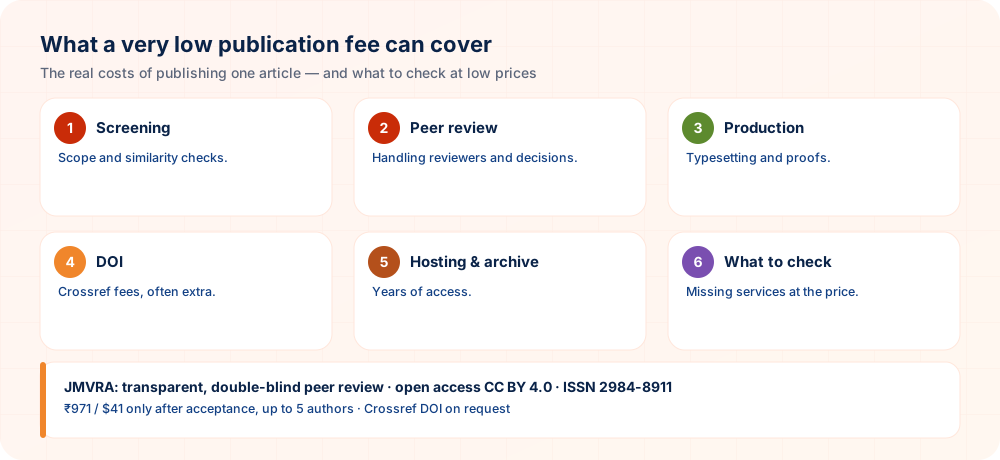
The Cost of Publishing a Single Article
| Cost | What it involves |
|---|---|
| Screening plus a similarity check | Software licences and editorial time |
| Peer review management | Locating reviewers, following up on reports and relaying decisions |
| Editing and typesetting | Preparing the layout of text, tables, figures and references |
| DOI registration | A Crossref membership together with a fee for each article |
| Hosting and archiving | Server space, backups and long-term preservation |
| Administration | Handling payments and invoices, and supporting authors |
Why a Low Fee Can Still Be Legitimate
- A large volume of papers shares out fixed costs
- Staff time falls when screening and formatting are automated
- Volunteer academic reviewers
- A slim, fully online operation
- DOIs sold as an optional extra
What Could Be Lacking at Very Low Prices
- Does genuine peer review happen, with reports?
- Is it a real DOI, or merely a “DOI-like” number?
- Are earlier issues online and complete?
- Does the journal run a similarity check?
- Can you expect the journal to survive another five years?
Weigh the Overall Cost, Not the Advertised Price
Before comparing, add taxes, DOI charges and any compulsory extras to the advertised fee, as our fee-comparison guide shows. A ₹1200 headline price can easily pass ₹1500 once everything is included.
Advice for Students
Students on a tight budget should ask about waivers, make use of their institution’s free tools, and pick a journal that bills only after acceptance. A saving of a few hundred rupees is not worth ending up with a publication your college will not accept. Ask your supervisor early which journals your department will actually count.
Five Indicators That a Low-Cost Journal Will Endure
- Regular issues spread across several years
- A publisher and editorial team identified by name
- DOIs that are registered with Crossref
- Articles archived somewhere other than the journal’s own server
- Clear, steady fees instead of constant “offers”
The 10 Most-Searched Questions on This Topic
Here are the ten questions researchers search for most on this subject, each with a direct answer.
low cost journal publishing site under 1200 with DOI
Fees can be very low, but verify the review, DOI registration, archive and overall cost.
journal publication fee under 1200
Compare the full amount, with taxes and DOI added.
cost of running a journal
Administration, hosting, DOIs, editing, review management and screening.
why journals charge publication fees
To pay for publishing when readers pay nothing.
cheap journal with DOI India
Make sure the DOI resolves and that the journal truly reviews papers.
DOI-like number fake
A number resembling a DOI that has not been registered.
journal sustainability
If the journal will keep your article available online over the long run.
student low cost publication
Enquire about waivers, and pay only once accepted.
journal fee GST included
Find out if the fee quoted already includes tax.
very low APC risks
Absent review, counterfeit DOIs or journals that vanish.
How JMVRA Fits In
JMVRA is a Transparent, Peer-Reviewed, Open Access Journal (Refereed Journal). Following the discontinuation of the UGC and UGC-CARE journal listing, and in alignment with the latest UGC-CARE recommendations and guidelines, JMVRA is aligned with UGC’s Suggested Parameters for Choosing Peer-Reviewed Journals. UGC public notice (PDF)
At ₹971 INR for Indian authors, JMVRA sits slightly above this range; the fee covers screening, double-blind review, editing and open-access hosting, while the Crossref DOI is a stated optional add-on.
- ISSN
- 2984-8911 (online) · publishing since June 2023
- Issues
- Monthly issues across many disciplines
- Review
- Two-way anonymous review by specialists
- Access
- Free to read, CC BY 4.0 licence
- Fee
- ₹971 INR for Indian and $41 USD for foreign authors, due only after acceptance
- DOI
- Crossref — available as an optional extra
- Indexing
- Google Scholar covers it; not Scopus, Web of Science or DOAJ
- Impact factor
- 11.25, derived from Google Scholar data
Screening begins the moment a paper arrives and each decision is sent as soon as it is reached, yet JMVRA never promises a set number of days: actual review time depends on the reviewers and on how much revision the paper needs.
At-a-Glance Checklist
- Services listedAt the quoted price
- DOI cost knownIncluded or extra
- Archive planLong-term access
- Review realComments with decisions
- Total comparedNot the headline
How a Small Fee Is Spent
| Area | Examples |
|---|---|
| People | Typesetting, support, coordinators and editorial staff |
| Technology | Servers, backups, the website and the submission system |
| Integrity tools | Identity verification and similarity checks |
| Identifiers and metadata | Metadata deposit and DOI registration |
| Preservation | Archiving and hosting for the long term |
A low fee can be sustained when costs are spread over many articles and the journal operates efficiently. Read how a low-cost journal covers its costs.
Clues That a Low-Cost Journal Will Still Exist Later
Long, regular archive
Issues that appear steadily year after year.
Stable identifiers
A registered ISSN and DOIs that resolve.
Clear ownership
An identified publisher with contact details.
Published policies
Open statements on review, ethics, corrections and preservation.
Practical Tips for Students Working With a Small Publication Budget
A small fee leaves little room for error, so careful preparation matters more than usual. These suggestions help students and early-career authors make a modest budget stretch sensibly.
- Ask what the fee includes. Request a plain list of services covered, such as screening, review, typesetting and archiving. Knowing what is included prevents unexpected add-on charges after acceptance.
- Share costs with co-authors. When several people have contributed, agree in advance who pays and in what proportion. Settling this early avoids tension and keeps authorship decisions separate from money.
- Proofread before paying. Check grammar, references and figure quality before submission, since late corrections may be limited. A clean file also helps reviewers concentrate on your ideas.
- Watch for sudden changes. Be cautious if a journal asks for extra payment that was never mentioned, or hurries you to pay before review. Calm questions in writing usually reveal whether the request is reasonable.
A small budget goes furthest when you clarify inclusions, agree shared costs early and submit a carefully checked manuscript.
Questions Researchers Often Ask
Anatomy of a JMVRA DOI
Resolver → prefix 10.5555 (an example Crossref prefix) → suffix: journal, volume 14, issue 9, article identifier. A format example: doi.org/10.5555/12345678
Want to check that a JMVRA DOI is genuine? Look it up in Crossref Search or the Crossref journal record.
Ready to Publish? Submit to JMVRA
JMVRA is aligned with UGC's Suggested Parameters for Choosing Peer-Reviewed Journals.
JMVRA is a Transparent, Peer-Reviewed, Open Access Journal (Refereed Journal). Following the discontinuation of the UGC and UGC-CARE journal listing, and in alignment with the latest UGC-CARE recommendations and guidelines, JMVRA is aligned with UGC’s Suggested Parameters for Choosing Peer-Reviewed Journals.
Pages worth visiting on jmvra.org
Key Terms
Subjects and search phrases this article addresses.
Related Reading
Further reading on the same theme from the JMVRA blog.
How JMVRA's Low-Cost Model Balances the Books
Read the guide RelatedHow DOIs and Google Scholar Work Together
Read the guide RelatedLow Fees vs Recognition After the UGC List
Read the guide Related10 Major Research Publishers That Register DOIs
Read the guide RelatedWhy JMVRA Charges Just ₹971 INR / $41 USD Without Lowering Standards
Read the guide RelatedUnderstanding JMVRA's 11.25 Impact Factor
Read the guide RelatedAffordable Journal Publication in India, Done Safely
Read the guideKeep Reading on the JMVRA Blog
As part of the JMVRA journal blog, this guide shares practical help on publishing, indexing, metrics and research integrity, and is written to be verifiable rather than promotional.