
All leading scholarly publishers assign a DOI to every article they publish, so “with DOI” on its own cannot separate a strong publisher from a weak one. The list below covers ten of the biggest and most familiar research publishers, what each is known for, and the questions worth asking about any publisher, large or small, prior to submitting. Treat the DOI as a starting point for checking, never as the final verdict.
Ten Leading Publishers Registering DOIs
| Publisher | Known for | Model |
|---|---|---|
| Elsevier | ScienceDirect; Cell, The Lancet and thousands of journals | Subscription and open access |
| Springer Nature | Nature portfolio, Springer journals and books, BMC | Subscription and open access |
| Wiley | Society journals across science, health, humanities | Subscription and open access |
| Taylor & Francis | Humanities, social sciences, engineering | Subscription and open access |
| SAGE Publishing | Social sciences, health, management | Subscription and open access |
| IEEE | Engineering, electronics and computing journals and conferences | Subscription and open access |
| MDPI | Large fully open-access portfolio | Open access (APC) |
| Frontiers | Open-access journals in science and health | Open access (APC) |
| PLOS | PLOS ONE and other non-profit OA journals | Open access (APC) |
| Oxford University Press | University press journals across disciplines | Subscription and open access |
Why “With DOI” Does Not Measure Quality
Publishers obtain DOIs through a registration agency such as Crossref. Any publisher able to join Crossref and cover the membership and registration fees can issue them, even very small or very new ones. What a DOI shows is that an article is registered and citable; it tells you nothing about peer review or indexing.
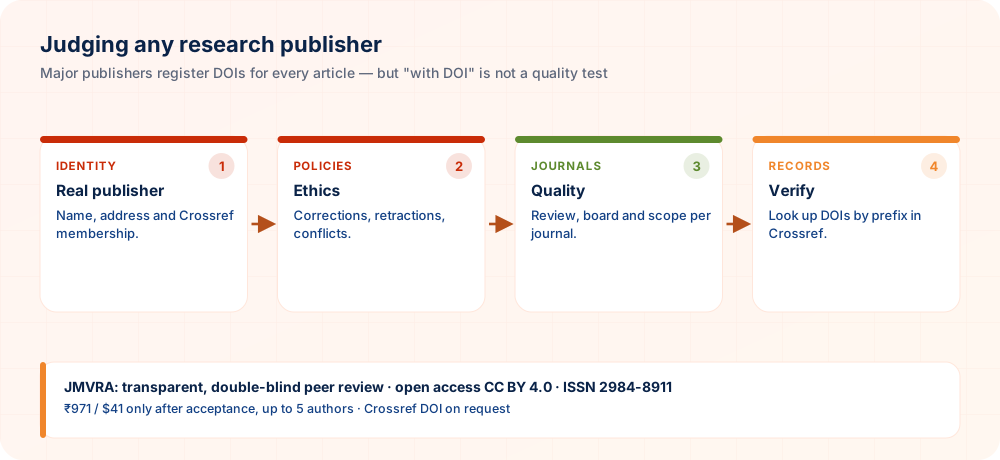
How to Evaluate Any Publisher
- Does it belong to Crossref? Look its name up in Crossref’s member list or test whether its article DOIs resolve.
- If it says it belongs to COPE (Committee on Publication Ethics) or OASPA, is that true?
- Do its journals appear in the databases it names? Confirm at the database itself.
- Does it spell out its fees, peer review and ownership?
- Can you find a street address and named leaders?
Large Publisher or Smaller Journal?
Large publishers
Strong infrastructure and indexing; often higher APCs for open access and longer timelines.
Society and university presses
Deep subject expertise; costs and speed vary widely.
Independent journals
Can offer affordable, focused, faster publication — but need careful checking.
Your requirement decides
Indexing rules for your PhD, promotion or grant usually settle the choice.
How to Check a Publisher’s DOIs
- Locate a DOI for one of its articles. Take it from an article page or a reference list.
- Look it up on Crossref. Enter it at search.crossref.org.
- Examine the record. It lists the member (publisher) that registered the DOI, plus the journal and metadata.
- Match it against the website. The title, journal name and publisher must agree with what the site states.
The check takes less than a minute and suits publishers of every size. A DOI that cannot be found at Crossref (or at another registration agency like DataCite) is not registered.
The 10 Most-Searched Questions on This Topic
Here are the ten questions researchers search for most on this subject, each with a direct answer.
top 10 research paper publishers
Big publishers of note: Oxford University Press, PLOS, Frontiers and MDPI, together with IEEE, SAGE, Taylor & Francis, Wiley, Springer Nature and Elsevier.
research paper publishers with DOI
Nearly every established publisher assigns a Crossref DOI to each article.
what is Crossref
The leading DOI registration agency in scholarly publishing, relied on by thousands of publishers around the world.
how to check publisher is genuine
Confirm Crossref membership, COPE membership where claimed, indexing, the address and how openly fees are shown.
open access publishers list
MDPI, Frontiers and PLOS publish entirely in OA, and most large publishers operate OA journals too.
publisher vs journal difference
One publisher may run a single journal or many; assess each journal on its own as well as the publisher.
COPE member publisher
A publisher that has become a member of the Committee on Publication Ethics and agreed to abide by its guidance.
Elsevier Springer journal publication cost
Publishing in subscription journals is often free, whereas their open-access routes usually involve sizeable APCs.
DOI registration cost for publisher
Members pay Crossref a yearly fee together with a small content registration fee for each DOI.
best publisher for research paper India
The publisher whose journal satisfies your requirement, suits your paper and can be shown to be peer reviewed.
How JMVRA Fits In
JMVRA is a Transparent, Peer-Reviewed, Open Access Journal (Refereed Journal). Following the discontinuation of the UGC and UGC-CARE journal listing, and in alignment with the latest UGC-CARE recommendations and guidelines, JMVRA is aligned with UGC’s Suggested Parameters for Choosing Peer-Reviewed Journals. UGC public notice (PDF)
JMVRA is published by JMVRA Publication and registers article DOIs with Crossref under the Crossref DOI on request (an optional add-on at publication).
- ISSN
- 2984-8911 (online) · publishing since June 2023
- Issues
- Monthly issues across many disciplines
- Review
- Two-way anonymous review by specialists
- Access
- Openly accessible under CC BY 4.0
- Fee
- ₹971 INR for Indian and $41 USD for foreign authors, due only after acceptance
- DOI
- Crossref — available as an optional extra
- Indexing
- Google Scholar yes; not Scopus, Web of Science or DOAJ
- Impact factor
- 11.25, derived from Google Scholar data
Screening begins the moment a paper arrives and each decision is sent as soon as it is reached, yet JMVRA never promises a set number of days: actual review time depends on the reviewers and on how much revision the paper needs.
At-a-Glance Checklist
- Publisher foundAddress and contacts
- DOI prefix checkedOwner in Crossref
- Policies readEthics and corrections
- Journal judgedNot only the brand
- COPE claims checkedOn the COPE site, if claimed
Looking Up Any DOI
- Append the DOI to https://doi.org/ — it ought to lead to the article
- Query Crossref — to view the registered metadata
- Cross-check the details — the title, authors and journal must agree
- Look at the prefix — it points to the registrant
Alternative DOI Registration Agencies
| Agency | Typical content |
|---|---|
| Crossref | Journal articles, books, conference papers |
| DataCite | Datasets, software and other research outputs |
| mEDRA | Publications, mainly in Europe |
| JaLC | Japanese content |
Practical Tips for Evaluating Research Publishers and Their DOIs
A DOI shows that a persistent identifier exists, not that the work was carefully reviewed. These tips help you assess a publisher in an orderly way, whether it is large and famous or small and new.
- Test the DOI yourself. Paste a sample DOI into the official resolver and confirm it leads to the article's landing page. A working link with matching title and authors is a minimal sign of tidy record keeping.
- Read the editorial board properly. Search a few board members independently and confirm that they exist, work in the stated field and agree to be listed. Fabricated boards are a recognised warning sign.
- Look for named policies. A trustworthy publisher states policies on peer review, corrections, retractions, complaints and archiving in plain view. Missing or vague policies deserve further questions before you submit.
- Ask colleagues about direct experience. Speak with researchers who have published there. Their account of communication, review quality and handling of problems adds detail no website can offer.
- Compare scale with service. A large publisher may offer reach and infrastructure, while a smaller one may give closer editorial attention. Decide which matters more for your particular paper and career stage.
Treat a DOI as a starting point, then judge the publisher on policies, people and your own direct checks.
Questions Researchers Often Ask
Anatomy of a JMVRA DOI
Resolver → prefix 10.5555 (an example Crossref prefix) → suffix: journal, volume 14, issue 9, article identifier. A format example: doi.org/10.5555/12345678
To check a JMVRA DOI yourself, enter it in Crossref Search or open the Crossref journal record.
Ready to Publish? Submit to JMVRA
JMVRA is aligned with UGC's Suggested Parameters for Choosing Peer-Reviewed Journals.
JMVRA is a Transparent, Peer-Reviewed, Open Access Journal (Refereed Journal). Following the discontinuation of the UGC and UGC-CARE journal listing, and in alignment with the latest UGC-CARE recommendations and guidelines, JMVRA is aligned with UGC’s Suggested Parameters for Choosing Peer-Reviewed Journals.
More useful pages at jmvra.org
Key Terms
Subjects and search phrases this article addresses.
Related Reading
Further reading on the same theme from the JMVRA blog.
Fast Review & DOI Claims: A 20-Point Journal Scorecard
Read the guide RelatedHow Journal Charges Work: APCs to Add-Ons
Read the guide RelatedHow to Cite DOIs in APA, IEEE, Vancouver & Chicago
Read the guide RelatedCrossref & DataCite DOIs: What a DOI Is and How to Deposit and Resolve It
Read the guide RelatedCrossref DOI or Repository DOI: Which Fits Your Paper?
Read the guide RelatedHow Journals Obtain Crossref DOIs
Read the guideKeep Reading on the JMVRA Blog
You are reading part of the JMVRA journal blog, a source of hands-on guidance about publishing, indexing, metrics and research integrity that aims to be verifiable, not promotional.