
Some authors fear that a DOI registered by a repository instead of Crossref is a warning sign. It is not, because both are legitimate, official DOI Registration Agencies, and what separates them is their origin and usual purpose rather than their credibility. What matters is that the identifier resolves and points to the correct record.
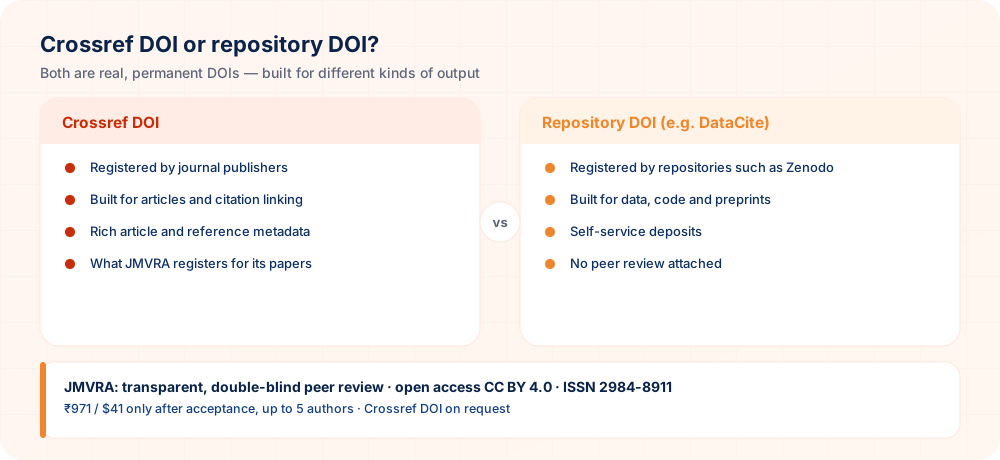
Two Genuine, Accredited DOI Registries
No matter which agency issued it, each DOI belongs to the system of the International DOI Foundation and resolves for good through doi.org. A DOI from a repository is just as real, lasting and citable as one from Crossref.
CrossRef
Crossref grew up around journal articles and the system that links their citations: when a click on a reference takes you directly to the cited paper, CrossRef's citation-linking infrastructure is doing the work. It is the DOI registrar most often tied to traditional journal publishing.
DOI Registration Agencies: Who Issues Which DOIs
Its origins lie in datasets, software and other, wider research outputs beyond the conventional journal article, although it registers article DOIs as well. A good number of repositories and data archives use a different registration agency that has its own metadata schema and infrastructure.
Is It Important Which Agency Your Journal Chooses?
Finding Out Which Agency Issued a DOI
- Visit doi.org and enter the DOI itself; it leads to the paper whichever agency registered it
- Use the DOI prefix registration lookup to see the agency under which it is registered
- Look at the paper's metadata page, which frequently names the registration agency directly
DOI Registration at JMVRA
At-a-Glance Checklist
- Agency identifiedCheck the DOI prefix owner
- Right DOI for the itemArticle vs data
- Both resolveTest at doi.org
- Versions linkedRepository to article
- Not mislabelledCall each by its agency
Crossref, DataCite and Other Agencies Compared
| Agency | Typical content | Example users |
|---|---|---|
| Crossref | Journal articles, books, conference proceedings | Publishers and journals |
| DataCite | Datasets, software, repository items | Repositories such as Zenodo and institutional data archives |
| mEDRA, JaLC and others | Regional or specialist content | Publishers in particular regions |
All agencies issue genuine, persistent DOIs within the DOI system. They differ in the services and metadata they offer; Crossref, for instance, supports reference linking and citation matching among journal articles.
Practical Tips for Authors
- Prefer the DOI the journal assigned to the article — where a Crossref DOI exists, cite it for the version of record
- Rely on repository DOIs for data and code — place datasets in a repository and cite their DOIs within the paper
- Confirm that a DOI resolves — add it after https://doi.org/ and verify that it opens the correct page
- Avoid making a second DOI for one article — two DOIs for a single work divide its citations
Choosing and Citing the Right Kind of DOI
Different DOI services suit different kinds of output, and mixing them up leads to confusing records. These tips help you decide what to cite and how to describe it honestly.
- Label the type of output. In your CV, say whether a DOI points to a peer-reviewed article, a dataset or a preprint. Honest labels help evaluators judge each item fairly.
- Check where the DOI resolves. Click the link and read the page it opens. The landing page should clearly identify the publisher or repository responsible for the record.
- Ask the journal about its approach. Before submitting, write to the editorial office and ask which registration service the journal uses and whether identifiers are assigned to all articles.
- Do not buy standalone identifiers. An identifier detached from a real publication adds little value. Be cautious of anyone selling DOIs separately from a genuine article or dataset.
- Keep deposits and articles linked. If you deposit data in a repository with its own DOI, cite it in your article and cross-reference both, so readers can move between them.
Know which service created each identifier, label it truthfully, and be sceptical of any DOI offered without a real publication behind it.
Questions Researchers Often Ask
Anatomy of a JMVRA DOI
Resolver → prefix 10.5555 (an example Crossref prefix) → suffix: journal, volume 14, issue 9, article identifier. A format example: doi.org/10.5555/12345678
To confirm a JMVRA DOI yourself, look it up in Crossref Search or open the Crossref journal record.
Ready to Publish? Submit to JMVRA
JMVRA is aligned with UGC's Suggested Parameters for Choosing Peer-Reviewed Journals.
JMVRA is a Transparent, Peer-Reviewed, Open Access Journal (Refereed Journal). Following the discontinuation of the UGC and UGC-CARE journal listing, and in alignment with the latest UGC-CARE recommendations and guidelines, JMVRA is aligned with UGC’s Suggested Parameters for Choosing Peer-Reviewed Journals.
More useful pages at jmvra.org
Key Terms
Subjects and search phrases this article addresses.
Related Reading
Further reading on the same theme from the JMVRA blog.
Zenodo DOI or Journal Crossref DOI? Choosing Right
Read the guide RelatedDOIs Explained: Crossref, DataCite, Deposit & Resolve
Read the guide RelatedMaking Your Paper Easier to Find Online
Read the guide RelatedGetting a Crossref DOI for Your Published Paper
Read the guide RelatedFree Zenodo DOIs: Uses and Limits
Read the guide RelatedDoes This DOI Work? Resolution & Metadata Checks
Read the guideKeep Reading on the JMVRA Blog
You are reading part of the JMVRA journal blog, a source of hands-on guidance about publishing, indexing, metrics and research integrity that aims to be verifiable, not promotional.