
Why Parameters Took the Place of a List
A list says which journals made the grade. Parameters explain what making the grade involves, and that is more practical, since you can apply them to any journal, anywhere, at any moment, including titles that no list has looked at yet.
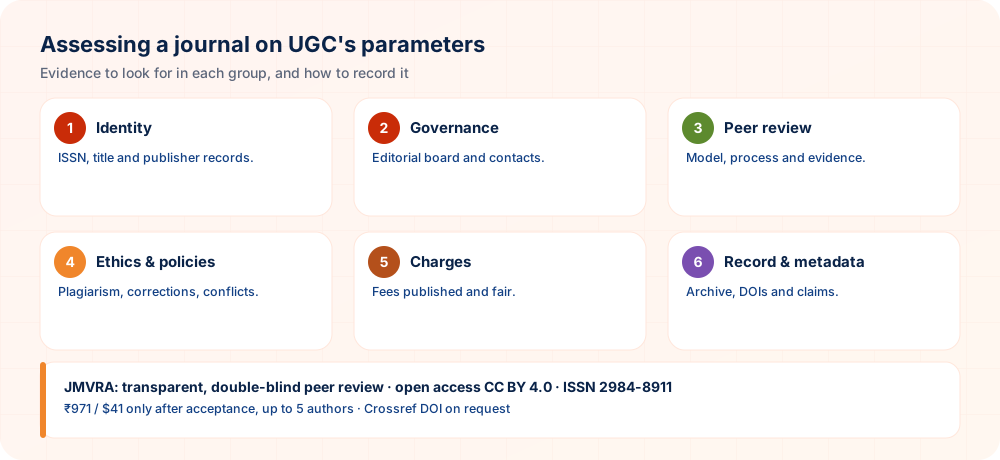
This page lays out the features such assessments examine, the evidence that counts for each, and the way to write down your findings. After going through it once, you will be able to assess any journal in around fifteen minutes. Keeping the same routine for every journal makes your comparisons fairer.
Journal Identity
To begin, confirm that the journal really is what it claims to be.
| Parameter | Evidence that meets the test |
|---|---|
| Registered ISSN | The ISSN leads, at the official register, to this very title and this publisher |
| Stable website | A functioning domain that the journal has used steadily and that opens when typed in directly |
| Named publisher | A named organisation with a contact address, and more than a web form |
| Clear scope | A precisely stated field of study, not a blanket claim covering every science, medicine, law and arts discipline |
| Stated frequency | A publication schedule that the archive itself bears out |
Editorial Governance
- An editor-in-chief who is named and whose affiliation can be verified
- An editorial board of real people whose institutions you are able to check
- Board members whose expertise fits the scope the journal states
- A written policy on how editors treat their own submissions
- An editorial contact that works and answers messages
Try this test: choose two board members by chance and look them up. If you cannot find them, or the institution they list has no trace of them, that settles it. Some predatory journals name academics who never agreed to it.
Peer Review
The parameter is not a statement that the journal "claims to be peer reviewed", because every journal says so. It asks whether the process is described in enough detail for someone to assess it.
- Model stated — single-blind, double-blind or open, spelled out clearly
- Stages described — screening, reviewer assignment, assessment, decision and revision
- Criteria published — the points reviewers are asked to judge
- Decision categories — accept, minor revision, major revision and reject, each explained
- No guaranteed outcome — and no promised turnaround, since that would mean review does not decide anything
A journal that boasts of finishing review within a fixed short period is describing something other than peer review. Read how a documented review process reads for a comparison.
Ethics and Policies
| Policy | What to look for |
|---|---|
| Plagiarism | A similarity threshold that is stated, and what follows when it is passed |
| Authorship | Rules on who qualifies, and how changes are dealt with |
| Conflict of interest | Declarations required of authors, reviewers and editors |
| Corrections and retractions | A defined procedure, plus proof that it has been put to use |
| Complaints and appeals | A way for authors who think a decision was mistaken to appeal |
| AI use | A rule requiring disclosure, and a statement that AI cannot be listed as an author |
A journal that records what occurs when something goes wrong gives the strongest signal of all. Describing the smooth path is easy for any journal. Look for complaints and corrections sections.
Charges and Transparency
- The amount is published ahead of submission and not revealed once the paper is accepted
- It falls due only after an independent editorial decision has been made
- The fee is broken down to show what it pays for
- Where waivers are offered, they are described together with the way to ask for one
- The position on refunds is set down in writing
- The same figure appears on the site, in the portal and in the acceptance email
At-a-Glance Checklist
- Evidence per groupLinks or screenshots
- Score recordedMet, partly met, not met
- Claims testedNot taken on trust
- Assessment datedAnd saved
- Institution's viewFinal say
A Template for Recording Your Assessment
| Area | Evidence | Checked on |
|---|---|---|
| Identity (title, ISSN, publisher) | ||
| Peer review | ||
| Editorial board | ||
| Ethics and policies | ||
| Charges and transparency |
JMVRA’s Statement
Documenting Your Journal Assessment for Institutional Review
Institutions increasingly ask scholars to show how they judged a journal. A tidy assessment file turns your own research into evidence that is easy for a committee to accept.
- Use a consistent assessment template. Create a simple table with the parameter, your finding, the evidence source and the date. Reusing it for each journal saves time and keeps your reasoning comparable.
- Store links and saved copies. Webpages disappear or change, so keep both the address and a saved copy of key policy pages. Label each file clearly with the journal name and the day saved.
- Be honest about gaps. If a parameter is not clearly met, record that plainly instead of stretching the evidence. Reviewers respect candour, and it protects you from later challenge.
- Ask a colleague to review. Have a peer or librarian read your assessment and question anything unclear. A fresh reader often notices missing evidence that you overlooked after repeated checking.
Record each parameter with a source and honest notes, so your assessment can stand up to any institutional question.
Questions Researchers Often Ask
Why did UGC swap the CARE list for parameters?
A fixed list could not keep pace with cloned and unsuitable journals. Suggested parameters allow researchers and institutions to assess any journal for themselves.
In what form should I record my assessment?
Log every parameter together with the links to your evidence, mark it met, partly met or not met, and add the date.
If a journal meets the parameters, is recognition assured?
No. Institutions follow their own rules, and the parameters only guide the assessment.
Does every parameter have to be satisfied?
They are suggestions, and each institution decides how strictly to apply them.
Is it worth keeping my assessment?
Yes. A dated record is useful when your work comes up for evaluation.
How JMVRA Measures Up to UGC’s 35 Suggested Parameters
Annexure-I, as finalised in UGC’s 16 July 2025 notice, comprises 35 parameters across 8 categories, one fewer than the February 2025 draft's 36. JMVRA's own audit finds 28 met, 2 partly met, 3 not published and 2 not applicable, and a reason is recorded for each.
Primary source: UGC public notice on CARE journals (PDF) · all details are on JMVRA & UGC parameters.
Publication Record
Open the archive and read it properly.
- Do issues come out on the schedule the journal states, with no gaps left unexplained?
- Do the articles seem copy-edited, or do you see clear mistakes in language and formatting?
- Is the number of articles in each issue believable given the review capacity described?
- Does the subject matter of the published work agree with the stated scope?
- Do author affiliations vary, or do they cluster in a suspicious way?
An issue holding two hundred articles from unrelated disciplines cannot have been reviewed in any real sense, whatever the policy page claims.
Metadata and Identifiers
- Articles have a DOI that resolves when clicked — try one yourself
- Article pages display full metadata: authors, affiliations, abstract, dates and licence
- Reference lists are complete, with links wherever identifiers exist
- The licence is stated outright and not left to inference
A DOI that resolves is the easiest piece of evidence for a journal to supply and for you to check. Read DOI explained.
Claims and Marketing
How a journal describes itself is evidence as well, and at times the most telling kind.
| Warning sign | What it indicates |
|---|---|
| A crowd of logos without any link for verifying them | Coverage claims you have no means of checking |
| An impact factor with no named source | A metric that was made up or bought |
| Phrases such as "international publishing practice" | Suggesting coverage without actually claiming it |
| Sharing platforms presented as "indexing" | Filling out a list with items that are not indexes |
| Promised acceptance or a set turnaround time | Review does not decide the outcome |
| Unsolicited flattering invitations | Volume-driven solicitation |
Scoring a Journal
A straightforward method for using everything above: grade each of the eight areas listed as pass, partial or fail.
- All pass — go ahead, and hold on to your evidence.
- One or two partial — write to the editorial office; a good journal replies.
- Any fail on identity, review or ethics — walk away without submitting. No exceptions apply to these three areas.
- Several fails — the overall pattern gives you the answer.
Documenting Your Assessment
Write a brief record for each journal you submit to. Should a panel later query the venue, evidence gathered at the time carries far more weight than memory. Store the files somewhere you can find them again.
- Date of your check
- ISSN, as confirmed at the official register
- Screenshots of the peer review description, the charges page and the indexing statement
- What happened when you resolved a sample DOI
- Your institution's written reply about what it requires
Five minutes of record-keeping safeguards years of work.
Ready to Publish? Submit to JMVRA
JMVRA is aligned with UGC's Suggested Parameters for Choosing Peer-Reviewed Journals.
JMVRA is a Transparent, Peer-Reviewed, Open Access Journal (Refereed Journal). Following the discontinuation of the UGC and UGC-CARE journal listing, and in alignment with the latest UGC-CARE recommendations and guidelines, JMVRA is aligned with UGC’s Suggested Parameters for Choosing Peer-Reviewed Journals.
More useful pages at jmvra.org
Key Terms
Subjects and search phrases this article addresses.
Keep Reading on the JMVRA Blog
You are reading part of the JMVRA journal blog, a source of hands-on guidance about publishing, indexing, metrics and research integrity that aims to be verifiable, not promotional.
Related Reading
Further reading on the same theme from the JMVRA blog.