
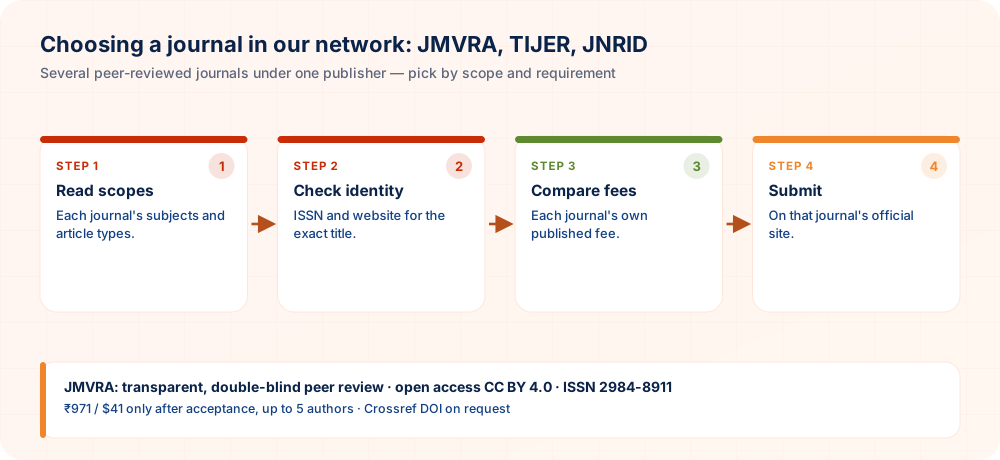
Three journals share our publishing network, and each one has its own ISSN, founding year and fee. This page is a directory and a selection guide in one: it sets JMVRA, TIJER and JNRID side by side, explains how to read each entry, and walks you through picking one title and checking its identity before you send a manuscript. If you would rather browse the same journals as large showcase cards, open Our Journal Network; this page is the compact, comparison-first version.
What This Directory Covers
Our publishing network has exactly three journals: the Journal of Modern and Versatile Research Approach (JMVRA), which is the journal behind this website; TIJER – International Research Journal; and the Journal of Novel Research and Innovative Development (JNRID). All three are multidisciplinary, open access, peer-reviewed and published monthly, so the decision between them seldom turns on subject fit. It turns on smaller, practical points: the fee in your currency, how long the title has been running, how its impact is described, and where you send the manuscript.
Every entry below gives the same facts in the same order — full name, ISSN, year established, publication fee, impact factor wording and official website — so you can read across the three quickly. A directory is a starting point, not a substitute for the journal itself: confirm the details on the official site before you pay anything, and keep a note of what you checked and when.
Three Journals, One Network
Directory Cards: JMVRA, TIJER and JNRID
One card per journal, in network order. Buttons on the JMVRA card stay on this site; buttons on the TIJER and JNRID cards open the shared Research Wave gateway in a new tab.
JMVRA — Journal of Modern and Versatile Research Approach
- ISSN (online): 2984-8911
- Established: June 2023
- Fee: ₹971 INR Indian authors · $41 USD international authors
- Impact factor: 11.25 (calculated by Google Scholar)
- Website: jmvra.org
- Profile: Multidisciplinary · Monthly · Open access · Peer-reviewed
JMVRA is aligned with UGC's Suggested Parameters for Choosing Peer-Reviewed Journals. Submission is free; the fee is due only after acceptance.
TIJER – International Research Journal
- ISSN: 2349-9249
- Established: 2014
- Fee: Low cost — ₹970 Indian authors · $50 USD international authors
- Impact factor: High Impact Factor
- Website: tijer.org
- Profile: Multidisciplinary · Monthly · Open access · Peer-reviewed
In the journal's own words: “UGC CARE Approved, Transparent Peer-Reviewed (Refereed) Journal as per new UGC Notification” and “Multidisciplinary, Monthly, Crossref DOI, Indexing in all major database & Metadata”.
JNRID — Journal of Novel Research and Innovative Development
- ISSN: 2984-8687
- Established: 2023
- Fee: Low cost — ₹970 Indian authors · $50 USD international authors
- Impact factor: High Impact Factor
- Website: jnrid.org
- Profile: Multidisciplinary · Monthly · Open access · Peer-reviewed
In the journal's own words: “UGC CARE Approved, Transparent Peer-Reviewed (Refereed) Journal as per new UGC Notification” and “Multidisciplinary, Monthly, Crossref DOI, Indexing in all major database & Metadata”.
The same facts in one table
| Journal | ISSN | ESTD | Impact factor | Fee (Indian · International) | Website |
|---|---|---|---|---|---|
| JMVRA — Journal of Modern and Versatile Research Approach | 2984-8911 | June 2023 | 11.25 (calculated by Google Scholar) | ₹971 INR · $41 USD | jmvra.org |
| TIJER – International Research Journal | 2349-9249 | 2014 | High Impact Factor | ₹970 · $50 | tijer.org |
| JNRID — Journal of Novel Research and Innovative Development | 2984-8687 | 2023 | High Impact Factor | ₹970 · $50 | jnrid.org |
The fees above are the published per-paper charges. JMVRA's full breakdown, including the optional Crossref DOI add-on, is on the publication charges page; for TIJER and JNRID, confirm the current charge on the Research Wave gateway before you submit. Read across a row to judge one journal, and down a column to compare one detail across all three.
Reading the Impact Factor Wording
What the Three Journals Share
Because the three titles belong to one network, much of the author experience is the same whichever one you choose:
- Multidisciplinary scope — none of the three is limited to a single subject, so a paper from almost any field can be considered by any of them
- Open access — published papers are free for anyone to read online
- Peer review — every manuscript is reviewed before an acceptance decision is made
- Monthly issues — each journal publishes a new issue every month, so there is always a next issue to aim for
- A separate ISSN for each title — your citation, certificate and CV entry must name the journal you actually published in, not the network
Where they differ is just as useful to know: the fee in your currency (₹970 or ₹971 INR; $50 or $41 USD), the founding year (2014 for TIJER, 2023 for JMVRA and JNRID), the way impact is described, and the submission route (this site for JMVRA, the Research Wave gateway for TIJER and JNRID). Those four points are what the selection guide further down is built on.
Submission, Review and Fees at JMVRA
JMVRA's workflow is documented on this site, so here it is from first upload to final paper:
- Submit free of charge — upload your manuscript on the JMVRA submission page; nothing is payable at this stage
- Double-blind peer review — reviewers do not see the authors' names, and authors do not see the reviewers' names
- Editorial decision — you are told whether the paper is accepted, needs revision, or cannot be taken forward
- Fee only after acceptance — ₹971 INR for Indian authors or $41 USD for international authors is requested once the paper has been accepted, never before
- Publication under CC BY 4.0 — the paper appears in the monthly issue, free to read and reuse with credit to the authors
- Optional Crossref DOI — available on request as a separate add-on (₹500 Indian · $20 international), never folded silently into the base fee
UGC Wording, Journal by Journal
In a public notice dated 3rd October 2024 (584th UGC meeting), UGC formally ended the static UGC-CARE Journal List and put in its place a 2025 Peer-Reviewed Journal Policy based on suggestive parameters — open editorial practices, real peer review and disclosed publisher details — instead of a fixed numbered list. The full notice is here: UGC Public Notice, 16 July 2025.
- JMVRA: JMVRA is a Transparent, Peer-Reviewed, Open Access Journal (Refereed Journal). Following the discontinuation of the UGC and UGC-CARE journal listing, and in alignment with the latest UGC-CARE recommendations and guidelines, JMVRA is aligned with UGC’s Suggested Parameters for Choosing Peer-Reviewed Journals. JMVRA carries no UGC journal number, because no numbered list exists any more.
- TIJER and JNRID: both describe themselves as “UGC CARE Approved, Transparent Peer-Reviewed (Refereed) Journal as per new UGC Notification”. That is each journal's own statement; check it against your institution's rules in the same way you would for any title.
Because of this shift, hunting for an old pre-2024 "UGC Parameters Journal Number" from the discontinued listing system makes little sense; test current alignment against the suggestive parameters of the 2025 policy, the self-audit approach that JMVRA applies to itself, described in Why JMVRA Fits the New UGC Parameters Peer-Reviewed Journal Policy.
Selection Guide: Which Journal Fits You?
Scope does not separate the three, so start from your own situation. The table pairs common author profiles with the title that tends to suit them and the reason, using only the facts in the directory above.
| If you are… | Worth considering | Why |
|---|---|---|
| An international author paying in US dollars | JMVRA | $41 USD, against $50 at TIJER and JNRID |
| An Indian author comparing rupee fees | Any of the three | ₹971 INR against ₹970 is a one-rupee gap, so decide on the other factors |
| A researcher who wants a stated impact factor figure | JMVRA | 11.25 is printed on its entry; TIJER and JNRID show “High Impact Factor” without a number here |
| An author who prefers a longer-running title | TIJER | Established 2014, the oldest of the three |
| An author who wants Crossref DOI in the journal's standard description | TIJER or JNRID | Their own description lists Crossref DOI; at JMVRA a DOI is an optional add-on |
| A student who wants submission, charges and back issues on one site | JMVRA | Submission, publication charges, current issue and archive all sit on jmvra.org |
Extra checks for PhD scholars and faculty
- Ask your department or research committee which evidence it accepts for a journal's standing, and gather that evidence before you submit rather than after publication
- Record the ISSN of the journal you pick and verify it (see the next section) — appointment and promotion files are checked against the ISSN, not the short name
- Read the UGC wording above and match it to your university's own rules; a journal's description never replaces your institution's guidance
- Decide early whether you need a DOI. At JMVRA it costs ₹500 / $20 on top of the fee, so build it into your budget if your institution expects one
Verify Each ISSN on portal.issn.org
The ISSN International Centre runs the ISSN Portal, the public register of assigned ISSNs. A check there takes a minute and protects you from look-alike websites and mixed-up titles.
- Open the record for the journal you chose: JMVRA 2984-8911, TIJER 2349-9249 or JNRID 2984-8687
- Compare the title on the record with the title on the journal's website, word for word
- Check that any web address shown on the record matches the site you plan to submit through
- Save a dated screenshot or PDF of the record; it is useful evidence for a thesis file or promotion dossier
- If anything does not match, pause and write to [email protected] before you pay anything
Why it matters: an ISSN identifies exactly one serial title. If a website shows an ISSN that the portal attaches to a different title, you are not dealing with the journal you think you are.
At-a-Glance Checklist
- Journal pickedJMVRA, TIJER or JNRID
- ISSN verifiedOn portal.issn.org
- Fee understood₹970–₹971 INR · $41 USD–$50 USD
- Official route onlyjmvra.org or Research Wave
- One journal at a timeNo parallel submissions
- DOI decidedAdd-on at JMVRA
Deciding Between JMVRA, TIJER and JNRID
- Start with your currency — $41 USD at JMVRA against $50 at TIJER and JNRID; in rupees the gap is only ₹1
- Note the ISSN — 2984-8911, 2349-9249 or 2984-8687, and check it on the ISSN Portal
- Follow the right route — the JMVRA submission page for JMVRA, the Research Wave gateway for the other two
- Send to one journal only — withdraw formally before offering the paper to a sister title
Shared and Separate Details
| Shared by all three | Separate for each journal |
|---|---|
| Multidisciplinary scope | Title and ISSN |
| Open access and peer review | Fee amounts in rupees and dollars |
| Monthly publication | Founding year and impact factor wording |
| One publishing network | Submission route: jmvra.org or Research Wave |
Choosing Between Journals in a Publisher's Network Wisely
When one publisher runs several journals, the choices can look similar. Taking time to compare scope and policies helps you place your paper where its readers will actually find it.
- Match scope to your topic. Read each journal's aims and recent contents and pick the one whose published papers resemble yours in subject and approach, not merely the one with an attractive name.
- Compare charges and terms separately. Do not assume that policies, fees or timelines are identical across sister journals. Read each journal's own author page and note any difference before deciding.
- Verify every claim yourself. For any statement about approval, indexing or metrics, locate the original source and check it directly. Do not rely on a summary written by the publisher alone.
- Ask your supervisor or librarian. A senior colleague or librarian may know how a journal is regarded in your field and whether your institution has particular expectations.
- Keep a comparison table. List the candidates in a simple grid with scope, audience, policies and contact details. Seeing the facts side by side makes the decision more rational.
Compare scope, terms and independent evidence for each journal in a network, then submit to the one that genuinely suits your paper.
Questions Researchers Often Ask
How JMVRA Measures Up to UGC’s 35 Suggested Parameters
35 parameters in 8 categories make up the final Annexure-I of UGC’s 16 July 2025 notice, down from 36 in the February 2025 draft. JMVRA's own count gives 28 met, 2 partly met, 3 not published and 2 not applicable, with the reasoning shown for each.
Source: UGC public notice on CARE journals (PDF) · for the whole picture, go to JMVRA & UGC parameters.
Ready to Publish? Submit to JMVRA
JMVRA is aligned with UGC's Suggested Parameters for Choosing Peer-Reviewed Journals.
JMVRA is a Transparent, Peer-Reviewed, Open Access Journal (Refereed Journal). Following the discontinuation of the UGC and UGC-CARE journal listing, and in alignment with the latest UGC-CARE recommendations and guidelines, JMVRA is aligned with UGC’s Suggested Parameters for Choosing Peer-Reviewed Journals.
Pages worth visiting on jmvra.org
Key Terms
Subjects and search phrases this article addresses.
Related Reading
Further reading on the same theme from the JMVRA blog.
UGC-CARE Criteria and How JMVRA Addresses Them
Read the guide RelatedUGC Status & Parameters Journal in 2026: Is the UGC CARE List Still Active?
Read the guide RelatedUGC Status & Parameters Journal Standards
Read the guide RelatedUGC Parameters vs Scopus vs Web of Science vs DOAJ: What Is the Difference?
Read the guide RelatedUGC Parameters API Score Explained: How Research Papers Count Toward Faculty Promotion
Read the guide RelatedUGC Parameters Policy Isn't Static — How to Re-Verify Any Journal's Status, Not Just Check It Once
Read the guideKeep Reading on the JMVRA Blog
As part of the JMVRA journal blog, this guide shares practical help on publishing, indexing, metrics and research integrity, and is written to be verifiable rather than promotional.