
Much of the advice on verifying journals presents UGC CARE compliance as something you confirm once and then forget. That approach is flawed, since the framework has already been revised once and nothing suggests it is finished changing. The better question is not whether a journal carries a fixed "UGC CARE compliant" label, but how it demonstrates that it keeps up with whatever the framework says right now. Treat any status you noted earlier as a snapshot, not a permanent fact.
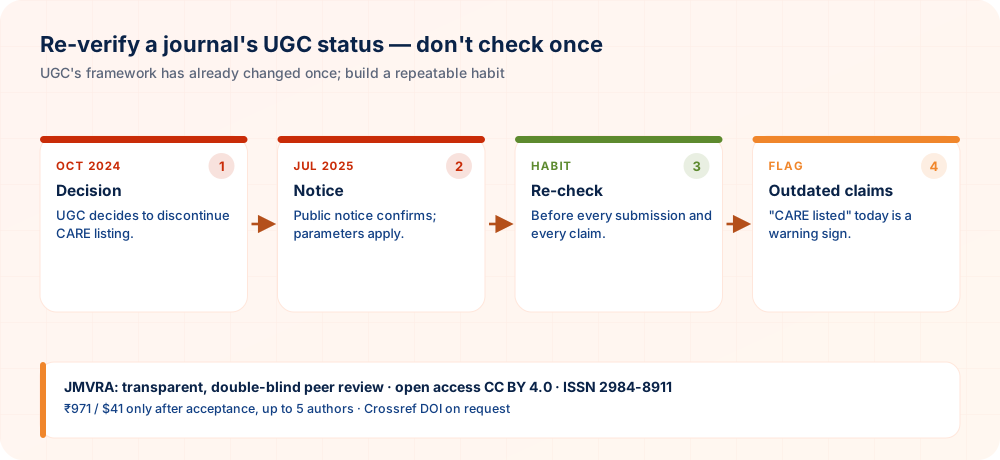
The Framework Has Already Been Revised Once
This one shift shows that the underlying framework is not permanent. Any guidance, this article included, that handles it as a single fixed checkbox is already behind the way UGC itself has acted.
Why Checking Once Is Not Enough
An author who confirmed a journal's UGC Parameters status two years ago, ahead of the 2024–25 change, and never looked again may well be relying on information that no longer describes how the framework works. The same danger holds for the future: a journal's disclosed practices, its editorial board and even its indexing status can all move over time, whether or not UGC announces anything. A fresh look at the evidence before each submission is the simplest protection.
A Verification Habit You Repeat, Not a One-Off Check
- Ahead of every submission — not merely when you first consider a journal — check how it measures up against UGC's Suggested Parameters and your institution's current rules (the UGC-CARE list has been discontinued), using the journal's published evidence and official sources such as the ISSN Portal and UGC's public notice, never a saved screenshot or the journal's own badge.
- Look for a date on the journal's disclosure page — a trustworthy journal says when its compliance details were last reviewed; an undated page, or one that still cites the pre-2024 UGC-CARE List without noting the change, suggests it has not been maintained.
- Compare against cloned and discontinued journal lists — journals are renamed, cloned or dropped, and a title that matched a genuine listing last year may not be the same journal now. The full Cloned Journal Alert guide explains how to run this check.
The Quickest Way to Detect an Out-of-Date Claim
When a journal's compliance page still presents the "UGC-CARE List" as the working mechanism, with no word on the 2024–25 discontinuation or the 2025 policy that took its place, that is a strong and quick sign the page, and perhaps the journal's real practices too, has not been refreshed for some time. A journal that has truly kept up will name the current framework, not the discontinued one. Always compare the wording against the latest official notice.
How JMVRA Keeps Its Own Disclosure Up to Date
Rather than a single static "UGC Status & Parameters" badge and nothing else, JMVRA maintains:
- A dated, point-by-point self-audit against the current UGC Parameters framework — Why JMVRA Fits the New UGC Parameters Peer-Reviewed Journal Policy
- For a candid account of where the journal stands on indexing, read The Honest Answer: Does JMVRA Follow Scopus & Web of Science Standards?, which spells out the details.
- A safety guide to cloned and discontinued journals — Cloned Journal Alert
- Formal, numbered policy documents — All 23 Policies
No single page is meant to last forever; what matters is that each is specific, dated and open to re-checking, rather than a vague claim that is left to go stale.
At-a-Glance Checklist
- Notice read16 July 2025
- Re-checkedBefore each submission
- Outdated claims spottedAnd avoided
- Evidence datedScreenshots with dates
- JMVRA's disclosureCurrent on jmvra.org
Where to Look for Policy Updates
- UGC’s official website — its notices and public notices pages
- Your university’s research office — how national guidance is applied locally
- Funding body guidelines — relevant for funded projects
- Recruitment or promotion notifications — these may set criteria of their own
Keeping a Record of Which Rules Applied and When
JMVRA’s statement: JMVRA is a Transparent, Peer-Reviewed, Open Access Journal (Refereed Journal). Following the discontinuation of the UGC and UGC-CARE journal listing, and in alignment with the latest UGC-CARE recommendations and guidelines, JMVRA is aligned with UGC’s Suggested Parameters for Choosing Peer-Reviewed Journals.
Building a Habit of Rechecking Journal Policy Status
Regulations and institutional expectations can shift, so a check you made long ago may no longer apply. A small, regular routine keeps your publishing decisions current and well documented.
- Set a recurring reminder. Add a calendar note to review the rules that matter to you before every submission and again before using a paper in a formal report.
- Use primary sources first. Go to the official notice or your institution's circular rather than a blog summary. Secondary articles can be outdated or can paraphrase a rule imprecisely.
- Note the rule that applied then. When you record a publication, add a line describing the expectations in force at the time. This protects you if requirements change after your paper appears.
- Share updates with your group. If you find a new notice, pass it to fellow scholars and your supervisor. Collective awareness reduces the chance that someone acts on stale advice.
Recheck official sources before each submission and record which rules applied at the time, so later changes never catch you unprepared.
Questions Researchers Often Ask
How JMVRA Measures Up to UGC’s 35 Suggested Parameters
The 16 July 2025 UGC notice includes a final Annexure-I, which arranges 35 parameters in 8 categories (the February 2025 draft counted 36). JMVRA's own review records 28 as met, 2 as partly met, 3 as not published and 2 as not applicable, and states why in every case.
Source: UGC public notice on CARE journals (PDF) · read the complete details under JMVRA & UGC parameters.
Ready to Publish? Submit to JMVRA
JMVRA is aligned with UGC's Suggested Parameters for Choosing Peer-Reviewed Journals.
JMVRA is a Transparent, Peer-Reviewed, Open Access Journal (Refereed Journal). Following the discontinuation of the UGC and UGC-CARE journal listing, and in alignment with the latest UGC-CARE recommendations and guidelines, JMVRA is aligned with UGC’s Suggested Parameters for Choosing Peer-Reviewed Journals.
Further reading on jmvra.org
Key Terms
Subjects and search phrases this article addresses.
Related Reading
Further reading on the same theme from the JMVRA blog.
UGC Status & Parameters Journal Standards
Read the guide RelatedJournal Finder — Find a Dependable, Low-Cost, UGC CARE-Aligned Journal Without Waiting
Read the guide RelatedOpen Access, Peer Review, Impact Factor & UGC Parameters Norms — A Complete Guide
Read the guide RelatedUGC Status & Parameters Journal Publication — Everything on Affordable publication charges and Peer Review Publication
Read the guide RelatedUGC Parameters Under the New Peer-Reviewed Journal Policy, Explained
Read the guide RelatedUGC Parameters, Scopus, Web of Science and DOAJ: Where Do They Differ?
Read the guideKeep Reading on the JMVRA Blog
This article sits on the JMVRA journal blog, where practical guidance covering publishing, indexing, metrics and research integrity is written to be verifiable, not promotional.