
UGC's Move Toward a Peer-Reviewed Journal Policy
UGC no longer treats one fixed "approved list" as the last word on journal credibility. Under its Peer-Reviewed Journal Policy it now issues suggestive parameters for spotting journals that are genuinely transparent and ethically run. The focus has moved to verifiable transparency, research integrity and real Open-Process Peer Review journal publication, and away from a name merely being on a list.
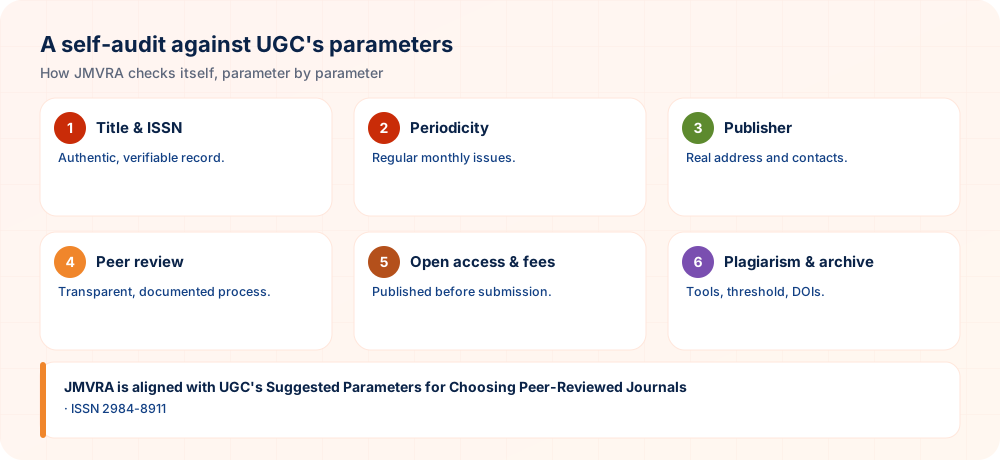
Authors should consult UGC's own official public notice for the current framework instead of trusting any journal's paraphrase of it, this article included. The article goes through the main parameters commonly used to judge journal credibility and checks each one against JMVRA directly.
Using This Self-Audit
All sections below share one format: what the parameter examines, then JMVRA's actual and verifiable status against it, with a link or method for confirming it yourself. You can use this as a template for any journal you are considering, not only JMVRA.
Authenticity of Journal Title & ISSN
What to check: A journal's name ought to be distinctive, never confusingly close to a well-known title, and identical on its site, its ISSN record and any indexing databases. The ISSN must be checkable on the official ISSN Portal and correspond exactly to that title. A quick side-by-side comparison of the spellings usually exposes any mismatch.
| Parameter | JMVRA's Status |
|---|---|
| Journal Title | Journal of Modern and Versatile Research Approach (JMVRA) |
| ISSN | 2984-8911 — can be confirmed on the official ISSN Portal |
| Official Website | jmvra.org |
Periodicity & Issue Frequency
What to check: Look for a steady, openly stated publication schedule with past issues you can open, and stay wary of journals that claim an implausibly high output frequency without genuine review behind it.
Since 2023, JMVRA has released an issue monthly with no break — a decade of uninterrupted, archived issues that span many disciplines and take papers in English as well as regional Indian languages.
Genuine Publisher and Contact Information
What to check: Publisher name, address and contact information should be verifiable, and the email should come from a professional domain instead of a generic free mail provider.
| Detail | JMVRA's Status |
|---|---|
| Publisher | JMVRA Publication |
| Address | India |
| [email protected] (an email on the journal's own domain, not a free public mail service) | |
| Phone/WhatsApp | +91 91063 65667 |
Open and Clear Peer Review Policy
What to check: A public, clearly written peer review policy that names the review type, how reviewers are chosen and the evaluation timeline. Treat journals that keep their review process undisclosed with caution. Policies describing real steps, rather than vague assurances, are the ones worth trusting.
JMVRA runs a double-blind peer review system backed by a panel of 3,000+ expert reviewers. Authors and reviewers stay anonymous to each other, and anonymised reviewer comments reach the author together with the editorial decision, at no separate charge since it is part of the standard review process. The complete breakdown is in JMVRA's Transparent Peer Review Policy.
Certified Official Domain
What to check: The journal ought to run on a professionally managed custom domain rather than a free subdomain, protected by SSL (HTTPS), and its ownership should be traceable through a WHOIS lookup. Checking the browser's security indicator takes only moments.
JMVRA runs on its own official domain with SSL protection: jmvra.org. Before you submit a paper or pay any fee, make sure you are on exactly this domain.
Open Access and Clear Fee Disclosure
What to check: A journal should state its access model (open access or subscription) and all charges clearly in advance, and should not ask for unexpected payments once a paper is accepted.
| Detail | JMVRA's Status |
|---|---|
| Access model | Entirely open access under a CC BY 4.0 licence |
| Base fee (India) | ₹971 INR, disclosed upfront |
| Base fee (International) | $41 USD, stated in advance |
| Optional add-ons | Crossref DOI (on request), hard copy (₹500) — disclosed separately, not hidden |
Plagiarism Checking & Tools
What to check: Recognised plagiarism-detection software should be used, with a defined acceptable similarity threshold, and the report should be shared with authors for transparency.
Every submission at JMVRA is screened with Turnitin and iThenticate; a 15% similarity threshold serves as the benchmark for acceptance, and the check covers self-plagiarism and duplicate submissions as well as copying from others. Authors can keep their similarity low by quoting properly and paraphrasing in their own words.
Editorial Board and Reviewer Openness
What to check: Editors and reviewers need institutional affiliations that can be verified and credentials that are disclosed; sparse or hidden board details are a warning sign for any journal.
JMVRA lists its editorial board openly on the website, with names and institutional affiliations that anyone can check independently. The complete criterion-by-criterion breakdown is in UGC CARE Criteria Explained.
Indexing & Repository Integration
What to check: Look for real, verifiable indexing in recognised platforms, and be careful with journals that claim indexing but give no valid, checkable links. A genuine listing can always be found by searching the platform itself.
Rather than trusting a badge, verify any of these yourself — look up JMVRA (ISSN 2984-8911) directly on each platform's own website.
Archiving Practice and DOI Preservation
What to check: Earlier issues should stay systematically archived and reachable, and published articles ought to carry valid DOIs that resolve, issued by a recognised registration agency.
JMVRA keeps a complete, accessible archive of issues dating from June 2023, and provides Crossref DOI registration for published articles on request (₹500 India / $20 USD international), resolvable through doi.org. The full mechanics are in What is a DOI? Crossref & DataCite Explained. Keep the DOI link with your records so that citations always point to the right article.
Impact Factor Verification
What to check: If a journal advertises an impact factor, it has to be authentic and traceable to a genuine source, never a self-awarded or made-up figure from an unrecognised service.
Ethical Publishing Standards
What to check: Written policies on who qualifies as an author, conflicts of interest, handling of plagiarism and research misconduct, preferably in line with recognised bodies such as COPE.
JMVRA's ethics policy is based on the guidelines of COPE (Committee on Publication Ethics) and covers authorship disputes, conflict-of-interest declarations and misconduct handling. Like any responsible journal, it expects authors to disclose meaningful use of AI writing tools in their submissions, as part of sound research-integrity practice.
Journal Layout and Presentation Standards
What to check: Citation formatting that is consistent, a professional layout, a well-kept website and, where relevant, support for regional languages.
JMVRA uses standardised referencing formats and a structured article layout, and its website is professionally maintained, SSL-secured and updated regularly. Papers may be submitted in English or regional Indian languages, though abstracts must be in English. Institutions that need physical archives can request a printed hard copy of the published issue.
Quick Checklist Summary
| Parameter | Status |
|---|---|
| Authentic Title & ISSN | ISSN 2984-8911 |
| Consistent Periodicity | Monthly since June 2023 |
| Verified Publisher Contact | JMVRA Publication |
| Open-Process Peer Review | Double-blind, 3,000+ reviewers |
| Certified Domain | jmvra.org, SSL-secured |
| Fee Transparency | ₹971 INR / $41 USD, add-ons disclosed separately |
| Plagiarism Screening | Turnitin/iThenticate, 15% threshold |
| Disclosed Editorial Board | Published with affiliations |
| Genuine Indexing | Google Scholar, CrossRef and more — not Scopus/WoS/DOAJ |
| Valid DOI | Crossref, on request |
| Verifiable Impact Factor | Details, Google Scholar-based |
| COPE Ethics Compliance | Documented policy |
At-a-Glance Checklist
- Parameter list readAnnexure-I
- Evidence linkedFor each one
- Gaps admittedHonestly
- Institution consultedFinal say is theirs
- Self-audit repeatedPolicies change
How to Use This Self-Audit for Your Records
- Print or save this page — together with the date
- Add your article details — the title, link and DOI
- Add your review evidence — your comments and the decision
- Present it with your application — if requested
The Complete Statement
Practical Tips for Auditing Any Journal You Consider
A self-audit is only useful if you carry it out with your own evidence. These suggestions help you test any journal against published parameters, rather than accepting its own summary of itself.
- Use a written checklist. Convert each parameter into a yes or no line on a sheet and record where you found the proof. Memory-based judgements tend to favour whatever you already hoped.
- Trace the identifier. Look up the journal's serial number on the official registry and compare title, publisher and country with what the website says. Differences need explanation.
- Check the people involved. Search editorial board members independently and confirm they exist, work where stated and know of their role. Fabricated boards are a well-known warning sign.
- Read the fee statement carefully. Look for a clear, public explanation of charges and when they apply. Unexplained costs or sudden requests after acceptance deserve questions before you proceed.
- Revisit the audit periodically. Journals and rules change, so repeat your checks before each new submission. A conclusion reached long ago may no longer describe the present situation.
Convert parameters into a written checklist, collect your own proof for each line, and repeat the exercise before every submission.
Questions Researchers Often Ask
How JMVRA Measures Up to UGC’s 35 Suggested Parameters
UGC’s 16 July 2025 notice includes a final Annexure-I, which sets out 35 parameters across 8 categories where the February 2025 draft had 36. Taking its own measure, JMVRA finds 28 met, 2 partly met, 3 not published and 2 not applicable, and states why for each.
Source: UGC public notice on CARE journals (PDF) · the wider picture is on JMVRA & UGC parameters.
Ready to Publish? Submit to JMVRA
JMVRA is aligned with UGC's Suggested Parameters for Choosing Peer-Reviewed Journals.
JMVRA is a Transparent, Peer-Reviewed, Open Access Journal (Refereed Journal). Following the discontinuation of the UGC and UGC-CARE journal listing, and in alignment with the latest UGC-CARE recommendations and guidelines, JMVRA is aligned with UGC’s Suggested Parameters for Choosing Peer-Reviewed Journals.
Pages worth visiting on jmvra.org
Key Terms
Subjects and search phrases this article addresses.
Related Reading
Further reading on the same theme from the JMVRA blog.
Verifying UGC-CARE, Scopus & Web of Science Claims
Read the guide RelatedUGC Status & Parameters Journal Publication — Complete Guide to Affordable publication charges Peer Review Publication
Read the guide RelatedLow-Cost Journals in India: Checking UGC Claims
Read the guide RelatedThe UGC-CARE List of Journals: A Full Guide
Read the guide RelatedJournal Finder — Speedy Search for a Sound, Budget-Friendly, UGC CARE-Aligned Journal
Read the guide RelatedUGC Parameters API Score Explained: How Research Papers Count Toward Faculty Promotion
Read the guideKeep Reading on the JMVRA Blog
As part of the JMVRA journal blog, this guide shares practical help on publishing, indexing, metrics and research integrity, and is written to be verifiable rather than promotional.