
JMVRA (ISSN 2984-8911) publishes in line with the complete set of UGC’s Suggested Parameters that were once used to define a "peer-reviewed journal" — transparent peer review, a verified editorial board, plagiarism screening, ethics compliance and open indexing — at a low cost of only ₹971 INR for Indian authors.
Reviewed by peers, and working to UGC's 2025 suggestive parameters.
The UGC-CARE Listing Has Ended — and This Is What Took Its Place
A Public Notice from UGC dated 16 July 2025 (F.No. 1-1/2018(CARE/JOURNAL)), which reaffirms its previous notice of 11 February 2025, states that the Commission has formally discontinued the UGC-CARE listing of journals. No official "UGC Status & Parameters" certification can now be granted to any journal.
UGC's successor to the list is "Suggestive Parameters for Choosing Peer-Reviewed Journals" (Annexure-I): quality benchmarks which faculty members, students and institutions should use whenever they judge a journal for academic and research publication.
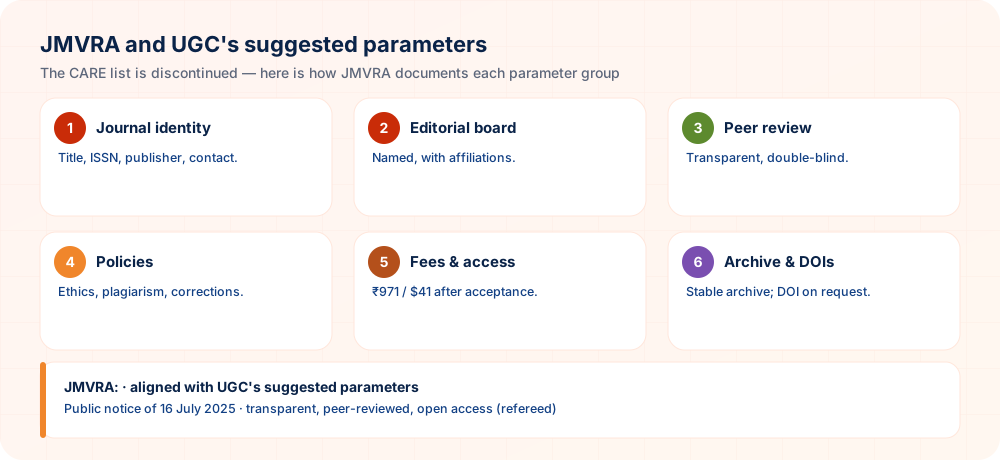
Because no formal "peer-reviewed" badge exists any longer, JMVRA treats full, demonstrable compliance with these UGC’s Suggested Parameters against the parameters such assessments apply — and each parameter is ticked off below, one at a time, against the actual notice. The original notification is available here: UGC Public Notice, 16 July 2025 (PDF).
JMVRA's Compliance With Every UGC Parameters Suggestive Parameter (Annexure-I)
What follows is the full list of parameters in UGC's 16 July 2025 notice, arranged in the same eight categories as the official Annexure, together with how JMVRA meets each one.
Journal Preliminary Criteria
The title Journal of Modern and Versatile Research Approach (JMVRA) is registered, unambiguous and applied uniformly on the website, in ISSN records and in each published issue.
JMVRA has a valid Online ISSN, 2984-8911, which is registered, can be verified and appears on every published paper and certificate.
JMVRA has published monthly, without a break, since June 2023 — a consistent, verifiable issue archive spanning nearly a decade.
Publisher contact details, the editorial email and WhatsApp support appear in the footer of every page and on the Contact Us page, together with the editorial office details.
A published Peer Review Policy sets out the precise double-blind review workflow, timelines and decision categories applied to every submission.
JMVRA's site runs on a domain of its own (jmvra.org) secured with HTTPS, and its professional design receives ongoing upkeep.
Under a Creative Commons CC BY 4.0 licence, JMVRA is fully Open Access: readers may read, download and share articles freely, while the fees are laid out transparently beforehand (₹971 INR Indian / $41 USD International).
Articles can be found through Google Scholar, ResearchGate, Academia.edu, Semantic Scholar and other leading indexing and repository partners.
All earlier issues stay permanently available in the online archive; nothing is removed or placed behind a paywall after publication.
Editorial Board Criteria
The editorial board's names, affiliations and subject expertise are listed publicly on the About & Editorial Board pages.
Board members are academicians and researchers from engineering, science, management and humanities, in keeping with JMVRA's multidisciplinary scope.
A panel of 3,000+ expert reviewers underpins a structured review workflow, and decisions on acceptance or rejection are communicated by email and WhatsApp.
Journal Editorial Policy
The scope is clearly published: JMVRA is a multidisciplinary journal that takes research in science, engineering, technology and management, as detailed on the About page.
Every subject is welcome — engineering, computer science, management, humanities and interdisciplinary research — with no narrow restrictions on field.
A fully transparent, published fee: ₹971 INR for Indian authors and $41 USD for foreign authors, with no hidden charges and full disclosure ahead of submission.
Each stage from submission to publication is documented and tracked online, and acceptance or rejection notices are sent through email and WhatsApp.
Acceptance depends strictly on the outcome of review and is never guaranteed; papers that fail plagiarism or quality screening are rejected or returned for revision.
Criteria for Journal Quality — Content
Before any paper is accepted, reviewers specifically evaluate its originality, motivation and contribution to existing knowledge.
Editorial screening confirms that each submission fits JMVRA's stated multidisciplinary aims before it moves on to peer review.
Journal Standards
Authors must use a standardised referencing format, which is checked during editorial review.
Published papers share a consistent, professional layout template in every issue to aid readability.
The submission and publication template natively supports figures, tables and diagrams.
A permanent Crossref DOI can be obtained on request for any article, and papers can be tracked through Google Scholar and Semantic Scholar citation records.
Consistent monthly issue numbering has been maintained since June 2023 with no gaps in the archive.
The website is kept active, works well on mobile devices and is refreshed regularly with new issues, policies and author resources.
Authors in India can get support in English and Hindi by email and WhatsApp.
Research Ethics
A published Author Documentation & Ethics guide explains the authorship, originality and conduct requirements ahead of submission.
Each submission goes through Turnitin / iThenticate similarity checking, and papers above the acceptable similarity threshold are rejected or sent back for revision.
Reviewers and editors must declare any conflicts of interest, and JMVRA follows the guidelines of COPE (Committee on Publication Ethics) on governance and impartiality.
Authors must disclose any AI assistance used while preparing a manuscript; AI cannot be named as an author, and AI-generated content that is not disclosed counts as an ethics violation.
Journal Visibility
JMVRA reports an Impact Factor of 11.25, shown openly together with the basis of its calculation on the journal's key-metrics page.
Content from the journal can be reached via Semantic Scholar, Google Scholar, ResearchGate, Academia.edu, ORCID-linked profiles and further large academic databases, where it is indexed.
Journal Impact Criteria
JMVRA neither requires, encourages nor rewards authors for citing earlier JMVRA articles; self-citation is left wholly to genuine relevance and stays within normal disciplinary norms.
Citation activity can be followed openly through each article's Google Scholar listing and, if requested, its Crossref DOI, rather than a closed internal count that nobody can verify.
JMVRA is open access and its articles are DOI-linked, so anyone can check its citation impact independently, whenever they like, in public scholarly databases.
What "UGC Status & Parameters Journal" Really Means in 2025
1. What UGC-CARE Was and Why It Mattered to Researchers
For many years, "peer-reviewed journal" ranked among the most searched phrases for Indian PhD scholars, assistant professors and research students. UGC-CARE (Consortium for Academic and Research Ethics) kept two lists, Group I and Group II, of journals regarded as acceptable for academic credit: PhD submission, API scoring for promotions and UGC/AICTE-linked appraisals. Being on the list marked a journal as a safe, credible option; being absent did not automatically rule it out but brought closer scrutiny.
The system was important because India produces a huge amount of academic research each year, and institutions needed a baseline signal to tell genuine peer-reviewed publishing apart from predatory, pay-to-publish outlets that skip review altogether. Authors still need that kind of signal today, which they must now gather for themselves.
2. The Notice of July 2025: A "List" Becomes "Suggestive Parameters"
A public notice from the UGC Secretary, issued on 16 July 2025 (F.No. 1-1/2018(CARE/JOURNAL)), confirmed what an earlier one from 11 February 2025 had hinted at: the UGC-CARE journal listing itself was being discontinued. The Commission approved a fresh Annexure to take over — "Suggestive Parameters for Choosing Peer-Reviewed Journals" — organised into eight categories, namely preliminary journal details, editorial board quality, editorial policy, content quality, journal standards, research ethics, visibility and citation impact.
Importantly, the notice also posted a historical reference list of 1,474 journals that had been UGC-CARE listed as of 10 February 2025, stating explicitly that "the inclusion or exclusion of a journal in this list does not imply validation or endorsement by the Commission." Put simply, there is no badge left to pursue. Institutions and researchers are now responsible for evaluating journals themselves, with UGC's suggestive parameters as the yardstick.
3. The Reasons the Core Standards Still Count (Even With No List)
Without the list, the quality bar has not vanished; if anything, authors must work harder at their own due diligence. A journal able to show a valid ISSN, a transparent and documented peer-review process, a named editorial board, a clear ethics and plagiarism policy, open-access licensing and verifiable indexing displays exactly the qualities described in UGC's Annexure-I. One that cannot, or will not, reveal these details is a red flag, list or no list.
For this reason JMVRA shaped its editorial workflow around these parameters from day one. The aim was never to chase a badge; transparent peer review, plagiarism screening and openly disclosed editorial governance are simply what make a journal a worthwhile place to publish.
4. Affordable but Not Lax: What the ₹971 INR JMVRA Publication Fee Involves
Alongside "is this peer-reviewed", we are often asked "why is it so cheap?" It is a reasonable question, since predatory journals also advertise low fees. The difference lies in what the fee does and does not pay for:
- The amount of ₹971 INR (Indian authors) / $41 USD (foreign authors) includes editorial handling, plagiarism checks with Turnitin/iThenticate, DOI registration, typesetting, hosting and a publication certificate, and nothing further is billed afterwards.
- The fee does not purchase acceptance. Papers are still screened for plagiarism and reviewed for quality; the low fee supports an efficient, digital-first workflow without printing costs, not a rubber-stamp process.
- JMVRA operates entirely online with an established network of 3,000+ expert reviewers, so its costs are naturally lower than those of a print-heavy legacy journal, and the savings go to students and early-career researchers instead of being taken as profit-maximising APCs.
5. Judging Any Journal Today (Not Only JMVRA)
Whether or not you pick JMVRA, apply this checklist, taken straight from UGC's own Annexure-I, to every journal you are weighing:
- Is its ISSN valid and verifiable?
- Does it explicitly document its peer review process (single-blind, double-blind or open)?
- Are board members named, with genuine institutional affiliations that you can check?
- Are fees stated before you submit, with no unexpected charges once a paper is accepted?
- Is there a published plagiarism/ethics policy, and are submissions really screened?
- Are all issues archived and open to read, with no back-issues that disappear?
- Do its articles show up in indexes beyond its own website (Google Scholar, Crossref, etc.)?
A journal that fails most of these points may not be fraudulent, yet it expects you to trust it blindly, which no researcher should have to do with their own published work. Walk away if the answers stay vague after you ask the editorial office directly.
The Position in Three Lines
The list has been withdrawn
UGC-CARE no longer grants approval today.
Parameters guide choices
The suggested parameters UGC has set for peer-reviewed journals.
Institutions decide
What is recognised for appointments and promotion.
Evidence matters
Maintain records for every paper.
JMVRA’s Statement
Practical Tips for Evaluating Journal Quality After Listings Ended
With the old approved-list model gone, authors must judge quality for themselves. These suggestions give you a calm, evidence-based way to assess any journal and to record why you trusted it.
- Rely on documented practice. Favour journals that publish clear policies on review, ethics, correction and archiving. Policies that you can read and test are worth more than reassuring slogans.
- Compare low cost with transparency. A modest charge is not a defect, but it should come with a clear explanation of what it covers. Hidden extras are the real concern, not the amount.
- Check your institution's present stance. Ask your research office what guidance it now follows for choosing outlets. Local policy may differ from what a journal's website describes.
- Look for consistent contact details. Verify that the publisher's name, address and email appear identically across the site, the registry entry and published articles. Inconsistencies suggest carelessness or worse.
- Keep your reasoning on file. Save the pages you reviewed, with the dates, in a folder. If a committee ever asks why you selected a journal, you can answer with evidence.
Judge journals by documented practice and your institution's current guidance, and keep a dated record of how you reached your decision.
6. Common Questions Answered
Does JMVRA operate as a peer-reviewed journal?
In 2025 UGC brought its UGC-CARE journal listing to an end, which means no journal, JMVRA among them, can carry that certification any more because it has ceased to exist. What JMVRA does is comply fully with UGC's present "Suggestive Parameters for Choosing Peer-Reviewed Journals," as documented parameter-by-parameter above.
Does the UGC CARE list still hold in 2025?
In its 16 July 2025 notice, UGC posted the old list (as of 10 Feb 2025) solely as a historical reference and states plainly that inclusion or exclusion "does not imply validation or endorsement." It should not be used as an active approval list.
What can I examine in place of a UGC CARE badge?
Rely on UGC's own suggestive parameters: a valid ISSN, transparent peer review, a disclosed editorial board, an ethics/plagiarism policy, open-access licensing and independent indexing, all covered by the checklist on this page.
What is the cost of publishing in JMVRA?
The fee is ₹971 INR for Indian authors and $41 USD for foreign authors, which covers the whole publication process without hidden fees.
How much time does publication need?
Specialist reviewers assess your paper, and you receive the acceptance or rejection decision by email and WhatsApp. Review time depends on reviewer availability, so no fixed turnaround is promised.
Does JMVRA hold UGC approval in 2026?
Yes. Since UGC stopped publishing an approved list, recognition rests on its Suggested Parameters for Choosing Peer-Reviewed Journals, and JMVRA is aligned with them.
What evidence shows that a journal is suitable?
Proof measured against the parameters: identity, peer review, ethics and clear fees.
Publish Under Clear, Documented Standards — Affordably
ISSN 2984-8911 · Impact Factor Details · Open Access · ₹971 INR Indian / $41 USD International
What This Guide Covers
At-a-Glance Checklist
- Parameters readAnnexure-I
- Evidence foundOn jmvra.org
- Institution askedWhat it accepts
- Wording correctNo current CARE listing exists
- Assessment datedPolicies change
How JMVRA Measures Up to UGC’s 35 Suggested Parameters
In the final Annexure-I attached to UGC’s 16 July 2025 notice, 35 parameters fall under 8 categories; the February 2025 draft contained 36. JMVRA's own tally shows 28 parameters met, 2 partly met, 3 not published and 2 not applicable, and a reason accompanies every one.
Source document: UGC public notice on CARE journals (PDF) · see JMVRA & UGC parameters for every detail.
Ready to Publish? Submit to JMVRA
JMVRA is aligned with UGC's Suggested Parameters for Choosing Peer-Reviewed Journals.
JMVRA is a Transparent, Peer-Reviewed, Open Access Journal (Refereed Journal). Following the discontinuation of the UGC and UGC-CARE journal listing, and in alignment with the latest UGC-CARE recommendations and guidelines, JMVRA is aligned with UGC’s Suggested Parameters for Choosing Peer-Reviewed Journals.
More useful pages at jmvra.org
Key Terms
Subjects and search phrases this article addresses.
Related Reading
Further reading on the same theme from the JMVRA blog.
Why JMVRA Is Considered UGC Status & Parameters Journal Publication
Read the guide RelatedThe UGC-CARE List of Journals: A Full Guide
Read the guide RelatedUGC Parameters New Policy for Peer-Reviewed Journals: Parameters Explained
Read the guide RelatedWhy JMVRA Fits the New UGC Parameters Peer-Reviewed Journal Policy — A Point-by-Point Self-Audit
Read the guide RelatedVerifying UGC-CARE, Scopus & Web of Science Claims
Read the guide RelatedNetwork Journal Directory: JMVRA, TIJER & JNRID
Read the guideKeep Reading on the JMVRA Blog
You are reading part of the JMVRA journal blog, a source of hands-on guidance about publishing, indexing, metrics and research integrity that aims to be verifiable, not promotional.