
Quick answer: The parameters UGC suggests for selecting peer-reviewed journals span basic journal details, the authenticity of the editorial board and publisher, transparent peer review, content quality and ethics, journal standards and presentation, indexing and visibility, and citation impact. Authors and institutions apply them straight to a journal, since no list exists to look up. Treat any single criterion as one piece of evidence rather than a verdict.
The Reason UGC Shifted Its Approach
Fixed lists have a built-in weakness: a journal may stay listed long after the standards that earned its place have slipped, while a journal that improves may stay excluded for a while. Suggestive parameters place the evaluation at the moment of use — authors or institutions test a journal against present criteria when they need to, instead of relying on an outdated snapshot.
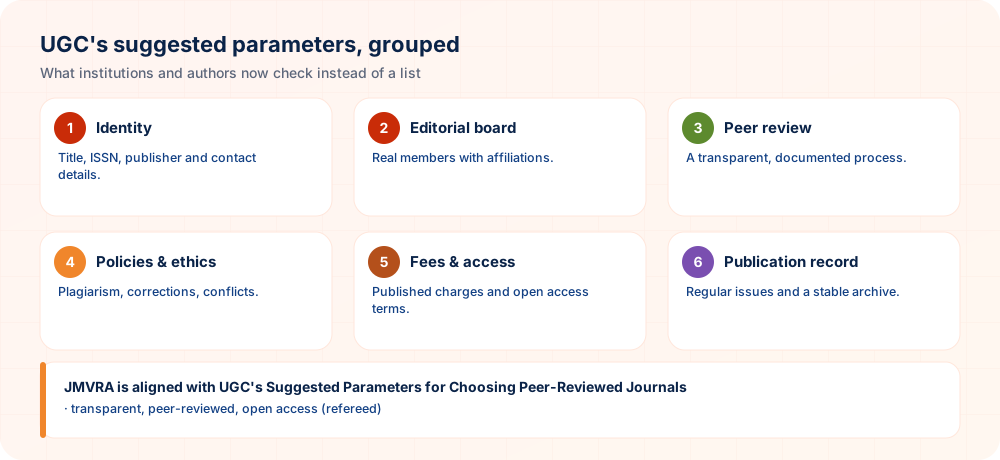
The Evaluation Areas
| Area | What to verify | Where to check |
|---|---|---|
| Preliminary details | Title, ISSN, periodicity | The ISSN Portal plus the journal's archive |
| Publisher & editorial board | Verifiable identity and named editors | Independent institutional pages |
| Peer review | Documented, transparent process | The policy the journal itself publishes |
| Content & ethics | Scholarly contribution and plagiarism screening | Sample articles and the ethics policy page |
| Journal standards | Professional look and a functioning archive | The site itself and earlier issues |
| Indexing & visibility | Honest, verifiable claims | The source list from each database itself |
| Citation impact | Real citation activity that can be attributed | Look directly in Google Scholar, Scopus or WoS |
Putting Together an Institutional Checklist
- Merge the seven UGC areas listed above with what your own institution requires in writing
- Run every candidate journal through the identical checklist, with no exceptions
- Record the date and outcome of each check for every publication
- Review the checklist from time to time, since both criteria and journal practices shift
A Self-Check for Authors
Before you submit or pay: confirm the ISSN, independently verify the editorial board, read the peer-review and ethics policies, trace any indexing claim back to its source, and obtain your institution's present requirement in writing.
Read the Complete UGC CARE Status Guide
The whole timeline, plus JMVRA's position relative to these very parameters.
UGC CARE 2026 Guide Submit PaperCommon Search Terms
Applying UGC's Journal Parameters as an Author
Guidance on choosing peer-reviewed journals is most useful when you turn it into a short routine. These steps help authors and research offices apply the parameters sensibly and consistently.
- Turn parameters into questions. Rewrite each suggested parameter as a plain question about the journal, then answer it from visible evidence. Questions are easier to discuss with co-authors than abstract criteria.
- Look for evidence, not assertions. A claim of rigorous review should be supported by a described process, named editors and realistic handling practice. Give more weight to what you can see than to what is stated.
- Score journals on the same sheet. When comparing candidates, use one consistent checklist for all of them. Using the same sheet prevents favourite journals from receiving easier treatment than unfamiliar ones.
- Share results with your supervisor. Show your completed checklist to a supervisor or senior colleague before submitting. A second pair of eyes often notices inconsistencies you have become used to.
- Revisit the check periodically. Journals change editors, policies and practices over time. Repeat the quick check if your submission is delayed or your plans change, instead of relying on an old assessment.
Convert the guidance into a written, evidence-based checklist, use it for every candidate journal, and have someone experienced review your conclusions.
Evidence Authors Are Able to Gather
| Parameter area | Evidence |
|---|---|
| Peer review | The decision letter with reviewers' comments |
| Transparency | Dated policy pages |
| Identity | ISSN record |
| Ethics | Ethics and malpractice statement |
JMVRA’s Statement
Questions Researchers Often Ask
What led UGC to alter its approach to selecting journals?
A static list could not keep up with publishing and could be taken as a lasting endorsement even once practices changed. Suggestive parameters move the evaluation to where the journal is actually used.
Which basic journal details should I check first?
The precise title, an ISSN that can be verified against it, and a plainly stated publication frequency.
How should I put together an institutional journal checklist?
Combine the UGC’s Suggested Parameters with your institution's own written requirements, applied consistently.
In what way can authors check a journal against the current framework themselves?
Confirm the ISSN and editorial board, read the peer-review and ethics policies, trace indexing claims to their source, and secure institutional confirmation before you pay.
Does JMVRA document compliance with the current UGC’s Suggested Parameters?
Yes. Openly published are the ISSN, the editorial board, and the peer-review, ethics and fee details. Refer to our UGC CARE 2026 status guide.
Do the UGC parameters take the place of the CARE list?
They serve as guidance for picking peer-reviewed journals now that the list has been discontinued.
Who is meant to apply the parameters?
Institutions and researchers, at the point of choosing journals.
Key References
At-a-Glance Checklist
- Parameters studiedUGC notice, Annexure-I
- Evidence locatedFor every parameter
- Gaps notedHonestly
- Institutional checklistDerived from the parameters
- Assessment storedWith date and links
How JMVRA Measures Up to UGC’s 35 Suggested Parameters
Grouped into 8 categories, the 35 parameters of the final Annexure-I to UGC’s 16 July 2025 notice replace the 36 of the February 2025 draft. As JMVRA counts them, 28 are met, 2 are partly met, 3 are not published and 2 are not applicable, with a reason beside each.
Source: UGC public notice on CARE journals (PDF) · a full explanation can be found in JMVRA & UGC parameters.
Ready to Publish? Submit to JMVRA
JMVRA is aligned with UGC's Suggested Parameters for Choosing Peer-Reviewed Journals.
JMVRA is a Transparent, Peer-Reviewed, Open Access Journal (Refereed Journal). Following the discontinuation of the UGC and UGC-CARE journal listing, and in alignment with the latest UGC-CARE recommendations and guidelines, JMVRA is aligned with UGC’s Suggested Parameters for Choosing Peer-Reviewed Journals.
Where to go next on jmvra.org
Key Terms
Subjects and search phrases this article addresses.
Related Reading
Further reading on the same theme from the JMVRA blog.
Low-Cost Journals in India: Checking UGC Claims
Read the guide RelatedOpen Access, Peer Review, Impact Factor & UGC Parameters Norms — A Complete Guide
Read the guide RelatedThe UGC-CARE List of Journals: A Full Guide
Read the guide RelatedThe UGC Parameters Policy Keeps Changing — Re-Verify a Journal’s Status Instead of Checking It Once
Read the guide RelatedLow Cost Journal Publication ₹971 INR — UGC Status & Parameters, Peer Review, Crossref DOI, International publishing practice
Read the guide RelatedWhy JMVRA Is Regarded as a UGC Status & Parameters Journal Publication
Read the guideKeep Reading on the JMVRA Blog
Find this guide on the JMVRA journal blog, a collection of practical guidance on publishing, indexing, metrics and research integrity that favours verifiable content over promotion.