
According to a public notice from UGC dated 16 July 2025, the UGC-CARE journal listing mechanism has been discontinued. A historical list of 1,474 journals (as of 10 February 2025) remains uploaded purely for reference; being on it, or off it, does not signal present UGC Parameters validation or endorsement. The framework UGC now offers consists of suggestive parameters for choosing peer-reviewed journals. Authors and institutions ought to assess a journal against what their institution currently requires, together with these parameters, and not against a dated "peer-reviewed" label.
Quick answer: No, the UGC-CARE list is not active in 2026; an official UGC notice discontinued it. What remains is a set of suggestive parameters that authors and institutions use to assess a journal directly — there is no list to search, and no current certification that any journal can hold.
What UGC-CARE Was
UGC established the Consortium for Academic and Research Ethics (UGC-CARE) to encourage quality research, academic integrity and publication ethics, and to deter publishing in dubious, predatory or sub-standard journals. For years its list, grouped initially into four groups (A, B, C, D) and afterwards into Group I and Group II, served as the standard reference Indian universities used to judge whether a journal counted towards a PhD, a promotion or a grant.
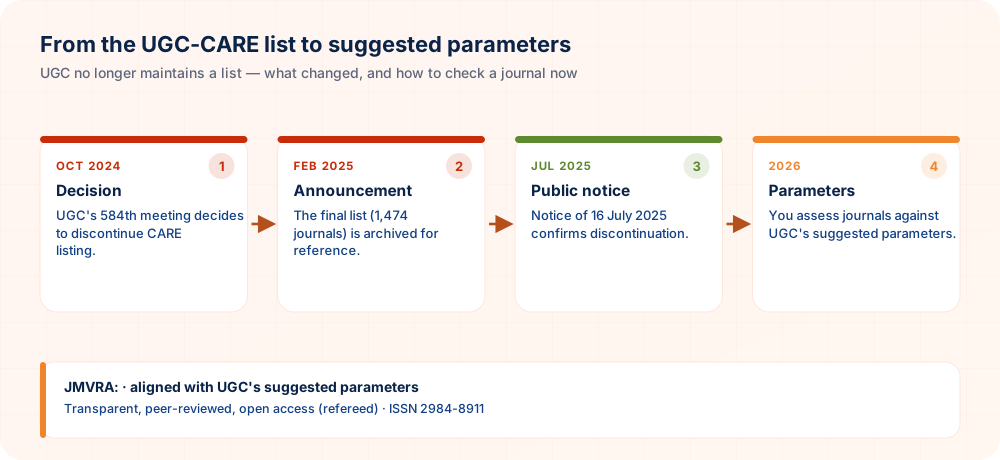
That arrangement functioned as a curated directory: a journal was either listed or not, and authors searched by title or ISSN through an official portal. Most searches for a "peer-reviewed journal" still assume this model, which is precisely why the update above is important. Always check the date of any list you rely on.
Timeline
Suggestive Parameters from UGC
Preliminary details
A unique journal title, a valid ISSN, clear periodicity and a stated scope.
Publisher & editorial board
Publisher identity and contact details that can be verified; editors who are named and checkable.
Peer review
A peer-review process that is transparent and documented, not merely a claimed label.
Content & ethics
A real academic contribution, plagiarism screening and published ethics policies.
Journal standards
Professional presentation, accurate citations, and a working website with an archive.
Indexing & impact
Indexing and citation claims that are honest and independently verifiable — never a self-reported figure on its own.
How to Check a Journal Today — No List Needed
| Step | What to do |
|---|---|
| 1 | Enter the ISSN into the ISSN Portal and check that the title returned agrees |
| 2 | Find the editors' affiliations independently rather than on the journal's own page |
| 3 | Read the peer-review and ethics policies the journal has published |
| 4 | Verify any indexing claim (Scopus, WoS, DOAJ) in the source list of that database itself |
| 5 | Obtain your institution's current requirement in writing before you pay |
Where JMVRA Stands
No journal can claim a current UGC-CARE listing, and JMVRA (ISSN 2984-8911, established 2023) makes no such claim. Our documentation instead shows how the journal addresses the present suggestive parameters, through an ISSN anyone can verify, a named editorial board, a published peer-review policy, open ethics practices and a publication fee stated in full. You should confirm each item independently instead of trusting our word; the full method is in our journal authenticity checklist.
Assess JMVRA Against the Same Parameters
Then, if your manuscript suits our scope, submit it — charges are payable only after acceptance.
Submit Paper Online Call for PapersCommon Search Terms
Judging Journals After the UGC-CARE List Ended
With the old list no longer maintained, researchers must assess journals through their own evidence. These habits help you decide calmly and keep a record that your department or supervisor can read later.
- Keep a journal evaluation file. Save screenshots, dates and links for every claim you check about a journal. A tidy file lets you justify your choice to a supervisor, promotion panel or auditor without searching again.
- Treat archived lists as history. An archived list shows what was recorded at some earlier moment, not what is true today. Use it for background only, and never as the sole proof that a journal is trustworthy.
- Read the editorial policies yourself. Open the aims, peer review statement, ethics policy and author guidelines and read them fully. Vague, copied or missing policies tell you more about a journal than any badge on its homepage.
- Ask your institution early. Your university or funder may publish its own guidance on acceptable journals for appointments and evaluation. Confirm that guidance before you submit, because rules differ between institutions and can change.
- Check editors and past articles. Look up the editors independently and read several published papers in your field. Real expertise, sensible review comments and careful copyediting are signs of a journal that takes quality seriously.
Build your own evidence file for each journal rather than trusting a single list, badge or recommendation from someone else.
Using the Archived List Properly
Historical evidence
A journal’s earlier listing can account for older papers.
Not current approval
It does not confirm the current status.
Date matters
Record when your paper was published.
Institution decides
How earlier listings are treated.
Where JMVRA Stands Today
Questions Researchers Often Ask
Is the UGC CARE list still in operation in 2026?
No. Through its public notice of 16 July 2025, UGC ended the UGC-CARE journal listing mechanism. A last list covering 1,474 journals, current to 10 February 2025, was posted for reference only, and a journal's presence or absence there carries no implication of present UGC Parameters validation or endorsement.
What took the place of the UGC CARE list?
UGC's suggestive parameters for choosing peer-reviewed journals — criteria that authors and institutions apply directly to a journal, in place of a fixed list on which a journal either appears or does not.
What are the UGC’s Suggested Parameters for peer-reviewed journals?
Broad areas of evaluation: basic journal details, the authenticity of the publisher and editorial board, a transparent peer-review process, quality and ethics of content, presentation and standards, visibility through indexing, and citation impact. Treat them as a checklist you can apply yourself to any journal before submitting.
Can new journals still obtain UGC CARE approval?
No. Because the listing framework itself has ended, there is no present application or approval route for being added to a UGC-CARE list.
After the list ended, can a journal still describe itself as peer-reviewed?
Not as a claim of current listing. A journal may truthfully explain how it meets the present suggestive parameters, which is a different and more honest statement than asserting a certification that no longer exists.
How do I check if a journal suits my university?
Request the current written requirement from your university, department, research cell or funder, because institutional rules have shifted since the list was discontinued.
Does ISSN mean a journal is UGC Parameters?
No. All an ISSN does is label a continuing publication; it is not evidence about the quality of peer review, about UGC Status & Parameters, or about what any database decided on indexing.
Is Scopus the same as UGC CARE?
No. They are different systems, run by different organisations with different selection criteria.
Is JMVRA a journal with peer review?
No journal, JMVRA included, can hold a current UGC-CARE listing, since UGC ended the mechanism on 16 July 2025. Instead, JMVRA documents how it meets the current suggestive parameters.
Do papers published while the journal was in UGC-CARE remain valid?
Institutions generally weigh the status at that time; confirm with yours.
Is there a list that replaces it?
UGC has put out suggested parameters instead of a new list.
Key References
At-a-Glance Checklist
- Notice reviewedUGC public notice, 16 July 2025
- Past list clarifiedFor reference only, not a current listing
- Parameters usedIdentity, review, ethics and fees
- Institution consultedWhat it accepts today
- Evidence savedFor your records
How JMVRA Measures Up to UGC’s 35 Suggested Parameters
UGC’s 16 July 2025 notice carries a final Annexure-I that sorts 35 parameters into 8 categories, whereas the February 2025 draft listed 36. Counting for itself, JMVRA meets 28 parameters, meets 2 in part, has 3 not published and finds 2 not applicable, giving a reason for each.
Source: UGC public notice on CARE journals (PDF) · the complete breakdown is on JMVRA & UGC parameters.
Ready to Publish? Submit to JMVRA
JMVRA is aligned with UGC's Suggested Parameters for Choosing Peer-Reviewed Journals.
JMVRA is a Transparent, Peer-Reviewed, Open Access Journal (Refereed Journal). Following the discontinuation of the UGC and UGC-CARE journal listing, and in alignment with the latest UGC-CARE recommendations and guidelines, JMVRA is aligned with UGC’s Suggested Parameters for Choosing Peer-Reviewed Journals.
Helpful pages on jmvra.org
Key Terms
Subjects and search phrases this article addresses.
Related Reading
Further reading on the same theme from the JMVRA blog.
Why JMVRA Is Considered UGC Status & Parameters Journal Publication
Read the guide RelatedWhy JMVRA Fits the New UGC Parameters Peer-Reviewed Journal Policy — A Point-by-Point Self-Audit
Read the guide RelatedUGC Parameters Policy Isn't Static — How to Re-Verify Any Journal's Status, Not Just Check It Once
Read the guide RelatedAPI Score Under the UGC Parameters: How Research Papers Count Towards Faculty Promotion
Read the guide RelatedUGC Status & Parameters Journal Standards
Read the guide RelatedUGC Parameters New Policy for Peer-Reviewed Journals: Parameters Explained
Read the guideKeep Reading on the JMVRA Blog
This guide belongs to the JMVRA journal blog, which offers practical advice on publishing, indexing, metrics and research integrity, written to be checkable instead of promotional.