
Wanting speed and low cost together is sensible for students, early-career researchers and anybody publishing without grant support. What matters is planning each one carefully: a budget covering all genuine costs and a schedule that allows for review and revision. Once you have those two figures, picking suitable journals becomes nearly automatic. Write both down before you open any journal website.
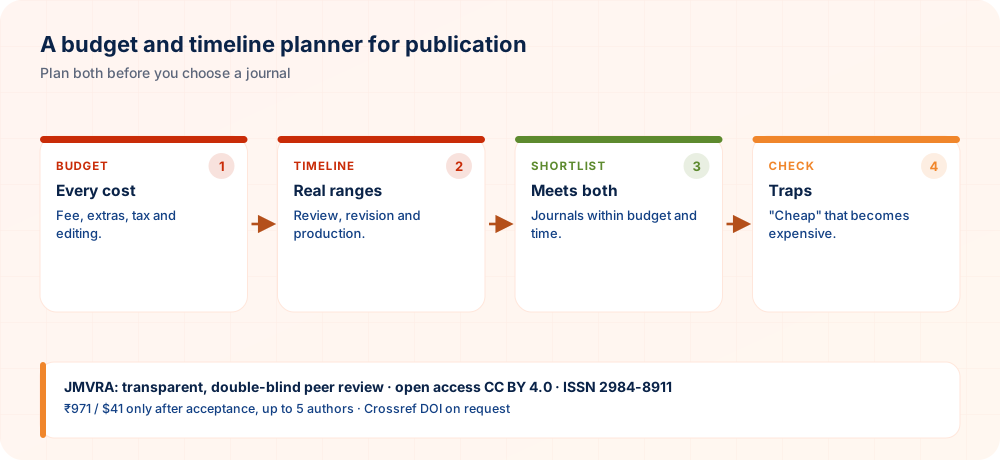
Step 1: Prepare a Realistic Budget
| Cost item | Notes |
|---|---|
| Article processing charge (APC) | The main fee; check whether GST or taxes are extra |
| DOI | Included in some journals, an add-on in others |
| Language editing support | Optional; only if needed |
| Similarity check | Often free through your institution |
| Hard copy or certificate courier | Usually optional |
| Conference registration | Only for conference routes |
Step 2: Draw Up a Realistic Timeline
- Final checks: 1 week. Go over the template, references, similarity report and declarations.
- Screening and review: varies. Rely on the journal’s actual turnaround rather than its advertising.
- Revision: 1–2 weeks. Set aside time for a thorough response.
- Production: varies. Covers proofs, placement in an issue and DOI registration.
Step 3: Compare Candidates Against Both
Retain only the journals that satisfy your requirement and stay within both limits. When nothing qualifies, adjust a single factor: stretch the budget a little, give yourself longer, or look at another kind of journal. Change one factor at a time so you can see what really helps.
Pitfalls That Turn “Cheap” Into Costly
- A small advertised fee followed by added charges for a DOI, certificates or “processing”.
- Money requested ahead of review, with nothing returned if the paper is rejected.
- A journal your institution fails to recognise, forcing you to publish the paper again somewhere else.
- With no archive or DOI, the paper is difficult to cite or may vanish.
Waivers and Discounts
Students, authors in lower-income countries and unfunded projects are often eligible for waivers or reduced fees at many journals. Make the request in writing before submitting and hold on to the answer. Certain institutions also cover APCs from library or research funds.
A Sample Budget Worked Through
| Item | Amount (illustrative) |
|---|---|
| Publication fee (after acceptance) | ₹971 INR |
| DOI add-on (optional) | As stated by the journal |
| Language editing support | ₹0 — done with guide’s help |
| Similarity check | ₹0 — institutional access |
| Printed copy | ₹0 — not needed |
| Planned total | Fee + DOI, confirmed in writing |
The figures are only examples. What counts is settling beforehand what you are willing to pay for and obtaining the confirmed total in writing prior to submission.
The 10 Most-Searched Questions on This Topic
Here are the ten questions researchers search for most on this subject, each with a direct answer.
publish research paper fast and affordable
Draw up a complete budget and a believable schedule, then choose verified journals that satisfy both.
affordable journal publication
Publishing for a small, openly stated fee; look at what it includes and when it falls due.
journal publication cost India
Spans free diamond OA to very high APCs at large publishers; look into GST and add-ons.
APC meaning
Article processing charge: what certain open-access journals bill authors for publishing.
is GST charged on journal fees
Frequently so for Indian authors; confirm if the stated fee already contains it.
publication fee after acceptance
The more secure arrangement: payment is due solely after review ends in acceptance.
APC waiver request
Write to the journal ahead of submitting, describe your circumstances and save its reply.
hidden charges in journal publication
Added costs for DOI, certificates or processing that the advertised price leaves out.
publication timeline planning
Leave room for last checks, review, revision and production.
cheap journal publication risk
What matters is not the price but the absence of review, recognition or permanence.
How JMVRA Fits In
JMVRA is a Transparent, Peer-Reviewed, Open Access Journal (Refereed Journal). Following the discontinuation of the UGC and UGC-CARE journal listing, and in alignment with the latest UGC-CARE recommendations and guidelines, JMVRA is aligned with UGC’s Suggested Parameters for Choosing Peer-Reviewed Journals. UGC public notice (PDF)
JMVRA lists its fee openly in advance: ₹971 INR for Indian authors and $41 USD for foreign authors, due only after acceptance. Registering a Crossref DOI is an optional add-on that is stated separately.
- ISSN
- 2984-8911 (online) · publishing since June 2023
- Issues
- Monthly issues across many disciplines
- Review
- Two-way anonymous review by specialists
- Access
- Open access published under CC BY 4.0
- Fee
- ₹971 INR for Indian and $41 USD for foreign authors, due only after acceptance
- DOI
- Crossref — available as an optional extra
- Indexing
- Found in Google Scholar, absent from Scopus, Web of Science and DOAJ
- Impact factor
- 11.25, derived from Google Scholar data
Screening begins the moment a paper arrives and each decision is sent as soon as it is reached, yet JMVRA never promises a set number of days: actual review time depends on the reviewers and on how much revision the paper needs.
At-a-Glance Checklist
- Budget on paperEvery cost counted
- Realistic scheduleReview needs time
- Verified shortlistISSN and policies
- Waivers looked intoAsk the journal directly
- Pay after acceptanceNot before review
An Easy Planning Template
| Item | Your entry |
|---|---|
| Target journal and backup | |
| Budget (fee, extras, payment costs) | |
| Deadline you need to meet | |
| Institutional requirement | |
| Co-authors and roles |
Complete it prior to submitting, so the trade-offs among speed, cost and recognition are clear.
What Speed to Realistically Expect
Building a Realistic Plan for Fast and Affordable Publishing
Speed and savings are reasonable goals, but they must coexist with quality. This planning advice helps you set expectations that fit your circumstances and keep your paper credible.
- Build slack into every stage. Allow extra time for reviewer comments, revision and proof checking. Plans that assume everything goes smoothly usually collapse at the first request for changes.
- Prepare your files before submitting. Have figures, references and declarations ready in the required format. Complete submissions avoid the delays caused by repeated technical returns.
- Respond to reviewers quickly but carefully. Prompt replies speed the process, yet each answer should address the comment fully. A hurried response can lead to another round and lose more time.
- Keep an emergency budget margin. Set aside a little extra for unexpected costs such as language editing or additional figures. A margin keeps small surprises from derailing your plan.
Plan with generous time and budget margins, prepare your files early and answer reviewers thoroughly rather than hastily.
Questions Researchers Often Ask
Your Paper's Journey at JMVRA, From Submission to Publication
- SubmitReceive your paper ID
- ScreenScope & similarity
- ReviewDouble-blind
- DecideEmail & SMS
- RevisionComment by comment
- AcceptCopyright & fee
- ProduceDOI at the author's request
- PublishMonthly issue
How long review takes depends on the reviewers and on any revision required, so no set turnaround is promised; you are told of acceptance or rejection by email and WhatsApp.
Ready to Publish? Submit to JMVRA
JMVRA is aligned with UGC's Suggested Parameters for Choosing Peer-Reviewed Journals.
JMVRA is a Transparent, Peer-Reviewed, Open Access Journal (Refereed Journal). Following the discontinuation of the UGC and UGC-CARE journal listing, and in alignment with the latest UGC-CARE recommendations and guidelines, JMVRA is aligned with UGC’s Suggested Parameters for Choosing Peer-Reviewed Journals.
Quick links across jmvra.org
Key Terms
Subjects and search phrases this article addresses.
Related Reading
Further reading on the same theme from the JMVRA blog.
What Makes a Journal Truly International?
Read the guide RelatedWhat an Affordable Publication Fee Buys in India
Read the guide RelatedPublishing Quickly in India Without Taking Risks
Read the guide RelatedWhy JMVRA Charges Just ₹971 INR / $41 USD Without Lowering Standards
Read the guide RelatedFree or Low-Cost Publication: Which Suits You?
Read the guide RelatedThe Complete Guide to Low-Cost Journal Publication (From ₹971 INR)
Read the guideKeep Reading on the JMVRA Blog
Our JMVRA journal blog carries this guide along with other practical advice on publishing, indexing, metrics and research integrity, all written so that claims can be verified and nothing is promotional.