
Being asked to revise is encouraging: the editor finds enough merit in your paper to allow another round. Your reply frequently determines the result. This guide explains how to interpret the decision, plan your changes, write a clear point-by-point response letter, disagree with a reviewer courteously and with evidence, and resubmit a stronger paper.
Understanding the Decision
| Decision | What it means | What to do |
|---|---|---|
| Accept | The paper is taken as it stands, or after very minor edits | Carry out the closing steps the journal requests |
| Minor revision | The paper is nearly there; some clarifications or minor changes are required | Apply every change and give a brief explanation of each |
| Major revision | The paper has merit but requires major work on its analysis, structure or argument | Plan with care and deal with each point thoroughly |
| Reject and resubmit | The idea could be publishable, but the paper must be rebuilt | Revise in depth and, if invited, send it in as a new manuscript |
| Reject | This paper will not be published by the journal | Draw on the comments to strengthen it for a different journal |
JMVRA sends decisions and reviewer comments by email and WhatsApp to the contact details you supplied when submitting. Begin with the editor’s letter, since it frequently shows which reviewer comments carry the most weight.
Planning Your Revisions
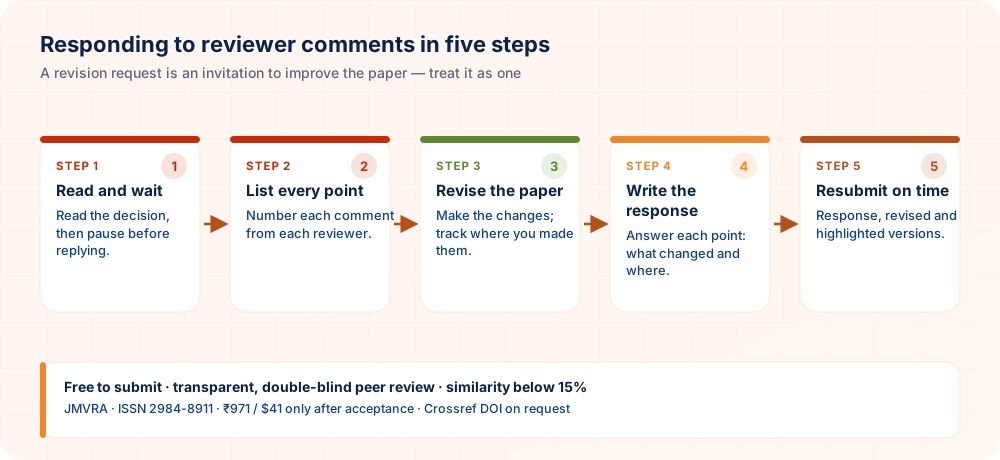
- Read it all through once, then take a break. Harsh comments can feel personal at first, but they look different a day later.
- Paste every comment into one document and label each in turn, such as Reviewer 1, Comment 1; Reviewer 1, Comment 2; and so forth.
- Sort the comments into easy corrections (wording, references), major revisions (analysis, structure) and issues you might have to debate.
- Settle the plan with your co-authors and share out the tasks.
- Record the deadline stated in the decision. Should you need longer, ask the editor before it expires.
Drafting the Response Letter
Your response letter is sent to the editor and, in most cases, on to the reviewers. Its purpose is to make their second read straightforward.
- Begin with a brief thank-you to the editor and reviewers, followed by a summary of the main changes in two or three sentences.
- Respond to each comment in sequence. Quote the comment and put your reply right below it.
- Spell out what you altered and its location — cite the section, page and line numbers of the revised manuscript.
- Include the new wording for significant changes, saving the reviewer a hunt through the paper.
- Be precise when a change could not be made — for instance, data that cannot be gathered — and describe how you dealt with the concern in another way, perhaps as a limitation.
An Example Response
Reviewer 1, Comment 3: “The sample size seems small for the regression analysis. Please justify it.”
Response: Thank you for raising this. We have added a justification of the sample size based on the number of predictors in the model and acknowledged the remaining limitation in the Discussion. See Section 3.2, page 6, lines 112–120, and the new limitation on page 14, lines 301–306.
For lengthy revisions, a three-column table works well — Comment, Response, Change and location.
If You Disagree With a Reviewer
Accepting every suggestion is not required, yet each one needs a reply. If you disagree with a point:
- Recognise the reviewer’s concern and the thinking that lies behind it.
- Back up your position with evidence — data, citations or the reasoning of the study design.
- Wherever you can, make a partial change, for example rewording the text so that later readers will not raise the same worry.
- Stay neutral in tone, since the editor will judge between you and the reviewer.
When two reviewers request contradictory changes, pick one approach, give your reasons, and let the editor know the reviewers were at odds.
Tone and Language
Stay courteous, brief and factual, and steer clear of sarcasm, defensiveness and heavy flattery. Wording like “We agree and have revised…”, “We have clarified this point…” and “We respectfully disagree, because…” keeps attention on the research itself. Reading the draft aloud once helps you catch anything that sounds irritated, so you can soften it before sending.
Sending Back the Revised Paper
- Submit the response letter and a clean copy of the revised manuscript, plus a version showing highlighted or tracked changes if the journal requests one.
- Where the journal runs double-blind review, as JMVRA does, keep the manuscript anonymised.
- Make sure references, figure numbers and cross-references still line up once your edits are in.
- If the revision brings in a lot of new text, run one more similarity check; JMVRA requires similarity below 15%.
Mistakes to Avoid
- Disregarding a comment, or covering several comments with a single vague sentence.
- Claiming a change was made without indicating its location.
- Describing changes in the response letter that are never carried into the manuscript.
- Questioning the reviewer’s competence rather than addressing the substance of the point.
- Letting the resubmission deadline pass without requesting an extension.
Revision Checklist
- All comments listedNumbered per reviewer and per comment
- All comments answeredAccepted, partly accepted or justified
- Places indicatedSection, page and line numbers
- Manuscript revisedEdits made, highlighted if requested
- Consistency verifiedReferences, figures and numbering
- Sent on scheduleOr an extension agreed with the editor
Handy Phrases for Response Letters
| Situation | Phrase |
|---|---|
| Accepting a point | “We agree and have revised Section 3.2 accordingly.” |
| Clarifying | “We have clarified this in the revised text (page 6, lines 12–18).” |
| Partial agreement | “We have addressed part of this; the remainder is beyond the scope because…” |
| Respectful disagreement | “We respectfully maintain our approach because…” |
Working With Co-Authors on Revisions
- Tell all authors about the decision — straight away
- Give each comment to one author — with a due date
- Combine the edits in a single master file — using tracked changes
- Get sign-off from every author — on the revision and the response letter
Practical Tips for Replying to Reviewers Constructively
A revision decision is an opportunity, not a verdict on your ability. The suggestions below keep your response letter courteous, organised and persuasive, even when comments feel harsh.
- Pause before you reply. Read the comments, then step away for a day or so before drafting anything. Emotional first reactions rarely make it into the letter once you have regained perspective.
- Sort comments by effort and importance. Group the points into quick fixes, substantial changes and items you may contest. This gives you a workable plan and shows the editor you took each remark seriously.
- Quote the reviewer, then answer. Place each original comment above your response, and say exactly what you changed and where. Editors appreciate being able to verify revisions without hunting through the manuscript.
- Disagree with evidence and respect. If you decline a suggestion, explain why using data, literature or the study's design, and thank the reviewer for raising it. Reasoned politeness is persuasive; defensiveness is not.
- Highlight changes in the document. Submit a version in which edits are visible, along with a clean copy if requested. Clear tracking helps reviewers confirm quickly that their concerns were addressed.
Answer every comment calmly, show precisely what changed, and back any disagreement with evidence rather than emotion.
Questions Researchers Often Ask
In Summary
An effective response letter replies to each comment, states precisely what was altered and where, and stays professional in tone. View revision as part of improving the paper; most manuscripts return stronger and have a better chance of acceptance. See also the JMVRA peer review process.
Ready to send in your paper?
You can submit to JMVRA online at no cost. Each paper is screened and then put through transparent, double-blind peer review, and the fee of ₹971 INR (Indian authors) or $41 USD (foreign authors) is charged only after acceptance.
The Path from Manuscript Draft to Publication
- PrepareWork from the author guidelines and the template
- Submit onlineNo charge; record your paper ID
- ScreeningChecks on scope, declarations and similarity under 15%
- Double-blind reviewDecision by email and WhatsApp
- AcceptedPay ₹971 INR / $41 USD, after which the paper is published open access
More details: Publication guidelines · Peer review · Publication charges.
Ready to Publish? Submit to JMVRA
JMVRA is aligned with UGC's Suggested Parameters for Choosing Peer-Reviewed Journals.
JMVRA is a Transparent, Peer-Reviewed, Open Access Journal (Refereed Journal). Following the discontinuation of the UGC and UGC-CARE journal listing, and in alignment with the latest UGC-CARE recommendations and guidelines, JMVRA is aligned with UGC’s Suggested Parameters for Choosing Peer-Reviewed Journals.
Helpful pages on jmvra.org
Key Terms
Subjects and search phrases this article addresses.
Related Reading
Additional guides covering how to write and publish a research paper.
Keep Reading on the JMVRA Blog
This guide belongs to the JMVRA journal blog, which offers practical advice on publishing, indexing, metrics and research integrity, written to be checkable instead of promotional.