
Looking for a list of journals in Turkey? Publishing in Turkey (Türkiye) is organised around two national services, DergiPark and TR Dizin, and the country also has a solid group of SCIE and SSCI titles. Below are leading Turkish journals showing publisher, subject and reported indexing, together with advice on checking a journal. The guide serves researchers in Ankara, Turkey; Istanbul, Turkey; Izmir, Turkey; Konya, Turkey and elsewhere in the country.
Scholarly Publishing in Turkey
The Council of Higher Education (YÖK) plans and supervises higher education in Turkey, while the Interuniversity Board (ÜAK) determines the associate professorship (doçentlik) criteria, which reward articles in Web of Science indexes (SCIE, SSCI, AHCI) and in national indexes such as TR Dizin. These rules strongly shape where Turkish researchers publish.
Two services operated by TÜBİTAK ULAKBİM are central to publishing in Turkey. DergiPark hosts journals and runs their editorial workflow — most Turkish academic journals accept submissions through it. TR Dizin is the national citation index, which assesses Turkey-based journals and indexes the ones meeting its criteria. TÜBİTAK also issues its own group of academic journals, many of them in SCIE. Understanding how these services divide their roles saves time when you shortlist journals.
Listing of Research Journals in Turkey
Each journal below is published in Turkey by a university, society or research body that can be identified. The “reported coverage” column gives what the journal or its publisher says about itself; check any indexing in Scopus Sources or the Master Journal List prior to submitting.
| Journal | Publisher | Subject area | Reported coverage |
|---|---|---|---|
| Turkish Journal of Chemistry | TÜBİTAK, Ankara | Chemistry | Reported source: SCIE and Scopus |
| Turkish Journal of Medical Sciences | TÜBİTAK, Ankara | Medical sciences | Reported source: SCIE and Scopus |
| Turkish Journal of Electrical Engineering and Computer Sciences | TÜBİTAK, Ankara | Electrical engineering, computer science | Reported source: SCIE and Scopus |
| Balkan Medical Journal | Trakya University, Edirne | Medicine | Reported: SCIE and Scopus; diamond open access |
| Education and Science (Eğitim ve Bilim) | Turkish Education Association (TED), Ankara | Educational sciences | Reported: SSCI and Scopus; TR Dizin |
| Diagnostic and Interventional Radiology | Turkish Society of Radiology | Radiology | Reported source: SCIE and Scopus |
Checked on 4 October 2026 with each journal's site or publisher. Intended as a starting point for Turkey; it does not rank journals or list every one.
Online Journal Platforms and Directories to Use
Find and submit to Turkish journals through DergiPark, check national indexing in TR Dizin, and cross-check with international databases.
DergiPark
The hosting and editorial-management platform of TÜBİTAK ULAKBİM for academic journals published in Turkey; submissions to most Turkish journals are made here.
TR Dizin
The national citation index of TÜBİTAK ULAKBİM; it assesses Turkey-based journals and indexes those that satisfy its criteria. Visit.
Council of Higher Education (YÖK)
Plans and oversees higher education in Turkey; associate professorship criteria are set by the Interuniversity Board (ÜAK). Visit.
Directory of Open Access Journals
Find open access journals that satisfy DOAJ’s criteria; narrow the results by publisher country (Turkey) or by “without fees”. Visit.
SCImago country rankings
Journal rankings based on Scopus, limited to journals published in Turkey, showing quartiles and SJR. Visit.
ISSN Portal
Confirm that a journal's ISSN, exact title and country of publication match before you trust it. Visit.
Turkey’s Research Hubs
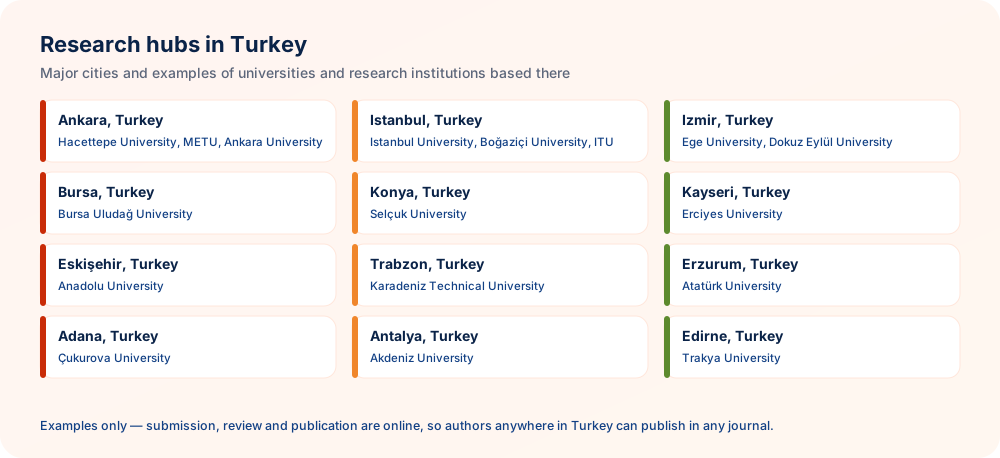
Ankara, Istanbul and Izmir lead research in Turkey, and every region has large universities.
Picking the Right Journal
Pick a journal before the writing ends. Three recent articles show if the scope suits; the author guidelines give length and referencing style; and your institution can say what it accepts, such as a national list, Scopus, Web of Science or just peer review. Have a trustworthy second option in case the first journal declines the paper. Writing to one journal's format from the start prevents rework.
Fees and Affordable Options
Many Turkish journals on DergiPark charge authors nothing, and several leading titles, including the Balkan Medical Journal, call themselves diamond open access. Others ask for processing fees in lira or APCs. Look at the journal’s official page for its fee policy. Keep a record of what the journal told you about fees before you submit.
Hand over payment solely after genuine acceptance, and solely through the journal's official channel. For reference, JMVRA's fee for foreign authors is $41 USD, due only after acceptance and covering up to five authors.
Our guide to low-cost journal publication holds the whole comparison method and works wherever you are in Turkey or beyond; read also how a low-fee journal manages its expenses.
Submitting Through DergiPark
Since most Turkish journals rely on DergiPark, the submission steps are much the same across hundreds of titles:
- Set up a single DergiPark account and fill in your profile with your ORCID iD and affiliation.
- Visit the journal’s page on DergiPark and go through its aims and scope, author guidelines, ethics policy and any statement on fees.
- Apply the journal’s template, adding a Turkish and English abstract where it is required.
- Upload the required files and declarations — a similarity report, ethics approval, and a copyright or licence form — as requested by the journal.
- Follow the review on your DergiPark dashboard and answer each reviewer comment point by point.
Hosting on DergiPark does not put a journal in TR Dizin, Scopus or Web of Science; if your requirement names one of them, check each separately before submitting.
Checking a Journal Step by Step
- Make sure the ISSN Portal lists the same ISSN and title.
- Establish the publisher, the editors and the contact address by yourself.
- Go through the peer review policy; decisions should come with reviewer comments.
- Verify any indexing claim by checking the database directly.
- Fees should be stated beforehand and asked for only after acceptance.
Checklist Before You Submit a Manuscript
- Journal verifiedScope, requirement and indexing reviewed
- Template usedLayout, reference style and length
- Similarity verifiedEvery source credited, with your own earlier work too
- Ethics addressedApproval, consent and conflicts disclosed
- Author details accurateNames and affiliations in the form meant for publication
- Cover letter readyWhy this paper is suited to this journal
How JMVRA suits authors in Turkey
Based in India, JMVRA (ISSN 2984-8911) is an international open access journal covering many disciplines. It is not a Turkish journal, but it accepts papers from authors in Turkey.
- Fee: Authors from abroad, Turkey included, pay $41 USD after acceptance alone, and up to 5 authors are included.
- Review: subject experts carry out open double-blind peer review, and similarity is kept under 15%.
- Access: open access with a CC BY 4.0 licence; a Crossref DOI can be had when requested.
- Indexing, in plain terms: we appear in Google Scholar; not in Scopus, Web of Science or DOAJ.
A 12-Month Publication Roadmap for Researchers in Turkey
| Months | Focus |
|---|---|
| 1–3 | Settle on a focused question and a shortlist of two or three journals; study national systems like TR Dizin, DergiPark and YÖK criteria, along with international databases |
| 4–6 | Collect the data and analyse it, then draft directly in the template of your target journal |
| 7–9 | Ask a supervisor or colleague for feedback, and submit to just one journal at a time |
| 10–12 | Reply to reviewers' comments with a revised manuscript; after publication, share the paper and update your ORCID and Google Scholar profiles |
Language Options for Authors in Turkey
Researchers in Turkey work in Turkish and English. Choose the language according to who needs to read the paper.
Write in Turkish
Gets to readers, practitioners and policy makers in Turkey.
Publishing in English
Gets in front of readers, reviewers and indexes worldwide.
Abstract in two languages
Adding an English title and abstract to a Turkish-language paper makes it easier to find internationally.
Language editing support
Have a colleague or editor read the final version before you submit.
Practical Tips for Turkish Scholars Submitting Journal Manuscripts
Turkish researchers often juggle submission systems, language choices and institutional requirements. These tips emphasise preparation habits that reduce errors and help your manuscript move smoothly through the first editorial checks.
- Prepare files before opening the form. Gather the manuscript, title page, cover letter, figures and declarations in one folder first. Submission forms may time out, and having everything ready prevents mistakes under pressure.
- Remove identifying details when asked. If the journal uses blind review, strip names, affiliations and revealing acknowledgements from the main file. Accidentally identifying yourself can lead to the paper being returned for correction.
- Check Turkish characters in the final file. Special letters can break when documents are converted. Open the exported file and read through names, references and figure labels to confirm every character appears correctly.
- Write a clear English abstract. Even for papers in Turkish, an abstract in clear English helps international readers decide whether to cite you. Keep it factual and free from untranslated idioms.
- Document each revision round. Keep every version with a date in its filename and a short note of changes. This avoids uploading the wrong file when several revisions are in circulation.
Prepare every file in advance, check blinding and special characters, and keep careful version records throughout the review process.
Questions Researchers Often Ask
Summary and What to Do Next
DergiPark and TR Dizin make it simple to locate and assess journals in Turkey. Add Scopus and Web of Science checks and pick the journal that suits your paper.
- Get your institution's publication requirement confirmed in writing.
- Pick journals from the table to form a shortlist, then go through the articles they have published lately.
- To verify indexing, consult our Turkey guide to Scopus and Web of Science journals.
- Prepare the manuscript in the journal's template and submit it through the journal's own website.
Ready to send in your paper?
Submission to JMVRA is online and free. Review always comes first; the $41 USD publication fee applies only after your paper is accepted.
Related searches
Related searches by researchers in Turkey include affordable open access journals, high impact factor journals, Scopus and Web of Science indexed journals, paper publication fees and journal publication in Turkey. These guides cover them:
- Low-cost journal publication in Turkey
- High impact factor journals in Turkey
- Scopus and Web of Science journals in Turkey
- How a low-fee journal is funded
- Locating high impact factor journals
- How to choose a journal
- Checking an indexing claim yourself
- Recognising a predatory journal
- Publishing with JMVRA from outside India
- JMVRA publication charges
References and Sources
Checked on 4 October 2026. Indexing, fees and policies can change, so check them again before submitting.
Publishing with JMVRA From Turkey
- Submit onlineAuthors from all countries can apply; no payment at submission
- ScreeningChecks on scope and similarity (below 15%)
- Double-blind reviewSubject experts assess it; the decision reaches you by email
- Accepted — $41 USDA single fee, covering up to 5 authors
- PublishedOpen access under CC BY 4.0
Details: Publication charges · Peer review · Advice for authors outside India.
Ready to Publish? Submit to JMVRA
JMVRA is aligned with UGC's Suggested Parameters for Choosing Peer-Reviewed Journals.
JMVRA is a Transparent, Peer-Reviewed, Open Access Journal (Refereed Journal). Following the discontinuation of the UGC and UGC-CARE journal listing, and in alignment with the latest UGC-CARE recommendations and guidelines, JMVRA is aligned with UGC’s Suggested Parameters for Choosing Peer-Reviewed Journals.
Helpful pages on jmvra.org
Key Terms
Subjects and search phrases this article addresses.
Related Reading
Further guides for researchers in Turkey and for selecting a journal.
Affordable Journal Publication in Turkey
Read the guide RelatedHigh-Impact Journals for Researchers in Turkey
Read the guide RelatedScopus & Web of Science Journals: Turkey
Read the guide RelatedResearch Journals in Indonesia: SINTA & Scopus
Read the guide RelatedResearch Journals in Malaysia: MyCite & Scopus
Read the guide RelatedWhat International Authors Should Know About JMVRA
Read the guide RelatedChoosing a Journal: A 7-Step Scoring Framework
Read the guideKeep Reading on the JMVRA Blog
This guide belongs to the JMVRA journal blog, which offers practical advice on publishing, indexing, metrics and research integrity, written to be checkable instead of promotional.