
Searching for Turkish journals in SCI, SSCI or Scopus? TÜBİTAK’s own journals, along with titles from universities and societies, lead Turkey’s indexed output. The guide lists examples together with the index each reports, explains where TR Dizin fits, and shows how to verify indexing by ISSN.
Scopus and Web of Science: The Essentials
Scopus, owned by Elsevier, selects the abstracts and citations it indexes, produces CiteScore, and supplies the data behind the SCImago Journal Rank (SJR). The Core Collection of Clarivate’s Web of Science is made up of AHCI (arts and humanities), ESCI (emerging sources), SCIE (sciences) and SSCI (social sciences), while Journal Citation Reports carries the Journal Impact Factor. Each service reviews its titles from time to time and can drop some. For a closer look, see Scopus explained and Web of Science explained.
| Term | What it is | Where to check |
|---|---|---|
| Scopus | An Elsevier database with selective coverage of abstracts and citations | Scopus Sources |
| SCIE | Science Citation Index Expanded, which is the sciences section of Web of Science | Master Journal List |
| SSCI | Social Sciences Citation Index, the part of Web of Science for the social sciences | Master Journal List |
| AHCI | Arts & Humanities Citation Index, the part of Web of Science for the humanities | Master Journal List |
| ESCI | Emerging Sources Citation Index, a Web of Science listing for journals that have been vetted | Master Journal List |
| Journal Impact Factor | A two-year average of citations, assigned to every journal in the Web of Science Core Collection starting with the 2023 release | Journal Citation Reports |
| CiteScore | Scopus journals’ citation average across a four-year window | Scopus Sources |
| SJR | SCImago Journal Rank, built on Scopus data, which weights citations by the prestige of the citing source | SCImago |
| Quartile (Q1–Q4) | Where a journal stands in its own subject category during one year | JCR or SCImago |
Among Turkish journals, TÜBİTAK’s academic journals (SCIE), the Balkan Medical Journal, Diagnostic and Interventional Radiology (SCIE) and Education and Science (SSCI) report Web of Science coverage. Scopus and TR Dizin include many more. To get the full Scopus-based list, filter SCImago’s rankings to Turkey, and use the Master Journal List to search Web of Science. Matching the exact index named in your own rules matters more than a journal’s general reputation.
Turkish Journals in Scopus and Web of Science
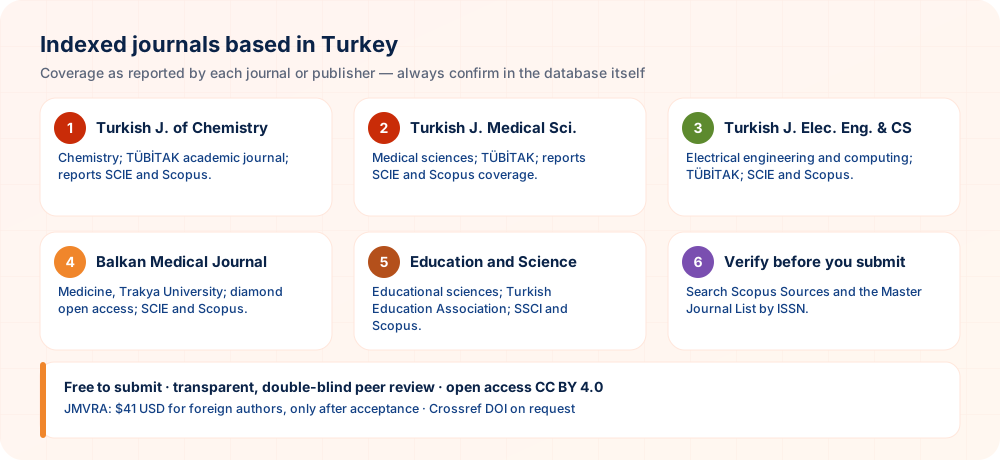
Each of the journals below is published in Turkey and states that Scopus and/or Web of Science covers it, on its own site or via its publisher. Cross-check each ISSN in Scopus Sources and the Master Journal List when you make your choice.
| Journal | Publisher | Subject | Reported coverage |
|---|---|---|---|
| Turkish Journal of Chemistry | TÜBİTAK, Ankara | Chemistry | Reported coverage: SCIE and Scopus |
| Turkish Journal of Medical Sciences | TÜBİTAK, Ankara | Medical sciences | Reported coverage: SCIE and Scopus |
| Turkish Journal of Electrical Engineering & Computer Sciences | TÜBİTAK, Ankara | Electrical engineering, computer science | Reported coverage: SCIE and Scopus |
| Balkan Medical Journal | Trakya University, Edirne | Medicine | Reported: SCIE and Scopus; diamond open access |
| Education and Science (Eğitim ve Bilim) | Turkish Education Association (TED), Ankara | Educational sciences | Reported: SSCI and Scopus; TR Dizin |
Other well-regarded journals, whose Scopus or Web of Science indexing has not been confirmed
| Journal | Publisher | Reported coverage |
|---|---|---|
| Diagnostic and Interventional Radiology | Turkish Society of Radiology | Reported coverage: SCIE and Scopus |
Checked 4 October 2026. “Reported” means the journal or publisher says so; we have not independently confirmed it.
Indexing Verification Checklist
- Record the ISSNBoth the print and online ISSN as shown on the journal’s own site
- Scopus SourcesSearch with the ISSN and verify the status and the years covered
- Master Journal ListSearch with the ISSN, then see whether it is SCIE, SSCI, AHCI or ESCI
- Discontinued titlesLook through the list of titles that Scopus has discontinued
- Keep evidenceSave dated screenshots for your grant or promotion file
Publishing Abroad From Turkey
Turkey has more indexed national journals than many countries, but for most fields the widest selection is international. As you look abroad, examine the article processing charge (APC), whether a publisher agreement at your university covers it, and whether a diamond open access journal (free of fees for authors and readers) exists in your field — DOAJ lets you filter by “without fees”.
TÜBİTAK operates support programmes for international publications; read the present programme rules on its website before relying on them.
Quartiles, Impact Factor and Top-Tier Journals
Three measures dominate: the Journal Impact Factor (from Clarivate, over two years, for Web of Science journals alone), CiteScore (from Scopus, over four years) and SJR (from SCImago, using Scopus data plus weighting). Q1–Q4 quartiles show where a journal ranks within one subject category in a given year. None of them measures the quality of an individual article, so read them as background and never as a ruling on your own paper.
Researchers in Turkey will usually find that international journals, not local ones, offer the highest-impact options in a field. Use subject categories in Journal Citation Reports, Scopus Sources or SCImago to find them, then read recent articles to test the fit. Our guide on how to find high impact factor journals describes the method in steps. Choose a few candidates rather than just one, so you have a fallback if a decision goes against you.
Picking an Indexed Journal for Your Subject
| Field | Turkish-published journals | Then search |
|---|---|---|
| Chemistry & sciences | Turkish Journal of Chemistry and other TÜBİTAK journals | SCIE and Scopus physical and life sciences |
| Medicine | Turkish Journal of Medical Sciences; Balkan Medical Journal; Diagnostic and Interventional Radiology | Medicine subject areas in JCR and Scopus |
| Engineering & computing | Journal title: Turkish Journal of Electrical Engineering and Computer Sciences | SCIE and Scopus engineering |
| Education | Education and Science (Eğitim ve Bilim) | SSCI and Scopus education |
| Social sciences & humanities | Many TR Dizin journals on DergiPark (check indexing) | SSCI, AHCI, ESCI and Scopus |
Comparing TR Dizin, Scopus and Web of Science
Academic criteria in Turkey mention several indexes, so a side-by-side view is useful.
| TR Dizin | Scopus | Web of Science | |
|---|---|---|---|
| Run by | TÜBİTAK ULAKBİM | Elsevier | Clarivate |
| Coverage | Turkey-based journals | International | International (SCIE, SSCI, AHCI, ESCI) |
| Metrics | National citation data | CiteScore; SJR via SCImago | Journal Impact Factor; JCR quartiles |
| Check at | trdizin.gov.tr | Scopus Sources | Master Journal List |
A journal from Turkey may be listed in one of them, two, or all three. Where your criteria score each index differently, record the precise index and year for every article in your records.
Getting Your Paper Ready for an Indexed Journal
Indexed journals receive a large number of submissions and editors turn away a high proportion at once, usually because of poor fit or weak presentation instead of unsound science. You can improve your odds as follows:
- State your contribution first. In the abstract and the close of the introduction, say plainly what is new and why it matters outside your own local context.
- Engage with the journal’s conversation. Cite recent literature and, when relevant, articles the target journal has published earlier.
- Report the methods in full. Follow the reporting guideline suited to your study type, such as CONSORT, PRISMA or STROBE, so that reviewers can judge the rigour.
- Tailor the cover letter. Explain in a few lines why the paper suits this journal’s readership.
Frequent Mistakes With Indexed Journals
- Relying on a badge displayed on a journal’s site instead of checking the database entry.
- Leaving out the index name — “Web of Science” might mean SCIE, SSCI, AHCI or ESCI.
- Overlooking discontinuation — indexing that held last year may no longer apply.
- Choosing on metrics only — a paper that lies outside the journal’s scope is turned down fast.
How JMVRA suits authors in Turkey
Based in India, JMVRA (ISSN 2984-8911) is an international open access journal covering many disciplines. It is not a Turkish journal, but it accepts papers from authors in Turkey. JMVRA is not in Scopus or Web of Science; it serves authors who want an affordable, peer-reviewed open access journal rather than an indexed one.
- Fee: Authors based abroad, including those in Turkey, pay $41 USD, collected only after acceptance, and up to 5 authors are covered.
- Review: subject experts carry out a transparent double-blind peer review, and the similarity level must stay under 15%.
- Access: articles are published open access with CC BY 4.0, and a Crossref DOI can be supplied on request.
- Indexing status: we are covered by Google Scholar, but not by Scopus, Web of Science or DOAJ.
A Preparation Kit for Submitting to Indexed Journals From Turkey
| Item | Tip |
|---|---|
| Manuscript | Use the journal template, with the title, abstract and keywords written in English |
| Cover letter | Sets out the journal fit and the reasons readers beyond Turkey will find the work valuable |
| ORCID iDs | To keep the records accurate, give it for every author |
| Approvals | Ethics clearance and any research permits that Turkey requires |
| Data availability statement | A pointer to the data, or the grounds for not sharing it |
International Collaboration Starting in Turkey
Regional collaborators
Collaborative projects across Europe and the Middle East pool data, methods and reviewers.
Researchers in the diaspora
Turkish researchers based overseas make natural co-authors and mentors.
Co-supervision
Joint supervision of a thesis leads to papers with more than one author.
Agreeing authorship
Settle roles, author order and data ownership in writing before you begin.
Practical Tips for Turkish Academics Choosing Between Indexes
Turkish academics often weigh a national index against international citation databases when planning submissions. These tips help you compare options fairly and prepare a manuscript that suits the venue you choose.
- Know your promotion criteria. Read your university's current rules on which indexes count for each purpose. Planning from the written criteria prevents surprises after a paper has already been accepted.
- Write the title for discovery. Use specific nouns that international readers would search, and avoid translating local idioms literally. A discoverable title improves how your article is found and cited.
- Keep your English structured. Short, direct sentences are easier to review than long translated constructions. Consider a professional language check for the final draft, especially for the abstract and discussion.
- Report statistics fully. State the tests used, the software, assumptions checked and effect sizes where relevant. Complete reporting answers common reviewer queries before they are raised.
- Compare journals on turnaround and fit. Look at published information about review stages and recent topics. A journal that regularly covers your subject and communicates clearly can be a better choice than a famous one.
Plan from your institution's written criteria, craft a discoverable title, and report methods and statistics completely so reviewers have fewer questions.
Questions Researchers Often Ask
Summary and What to Do Next
Strong indexed journals exist in Turkey for science, medicine and education. Identify which index your criteria specify, check it by ISSN and choose the best match.
- Check whether your regulation requires a quartile, an index, Web of Science or Scopus.
- Shortlist journals for your field using the tables above together with international databases.
- Check each title by its ISSN and keep a record of what you find.
- Look at the directory of research journals in Turkey for titles that are not indexed.
Ready to send in your paper?
Submission to JMVRA is online and free. Review always comes first; the $41 USD publication fee applies only after your paper is accepted.
Related searches
Researchers from Turkey reading this guide often also search for affordable open access journals, high impact factor journals, Scopus and Web of Science indexed journals, paper publication fees and journal publication in Turkey. These guides address those subjects:
- Low-cost journal publication in Turkey
- High impact factor journals in Turkey
- Research journals in Turkey
- How a low-fee journal is funded
- Locating high impact factor journals
- How to choose a journal
- Checking an indexing claim yourself
- Recognising a predatory journal
- Publishing with JMVRA from outside India
- JMVRA publication charges
References and Sources
Checked on 4 October 2026. Indexing status can change, so confirm it before submitting.
- SCImago journal rankings — Turkey
- TÜBİTAK Academic Journals
- TR Dizin
- Education and Science
- Balkan Medical Journal
- Scopus Sources
- Clarivate Master Journal List
- ISSN Portal
- SCImago Journal & Country Rank
- Journal Citation Reports
Submitting to JMVRA From Turkey
- Submit onlineUpload from any location; nothing is payable when you submit
- ScreeningScope and overlap check (similarity below 15%)
- Double-blind reviewExperts in the subject assess it; you get the decision by email
- Accepted — $41 USDOne fee that covers up to 5 authors
- PublishedOpenly available with a CC BY 4.0 licence
Details: Publication charges · Peer review · Advice for authors outside India.
Ready to Publish? Submit to JMVRA
JMVRA is aligned with UGC's Suggested Parameters for Choosing Peer-Reviewed Journals.
JMVRA is a Transparent, Peer-Reviewed, Open Access Journal (Refereed Journal). Following the discontinuation of the UGC and UGC-CARE journal listing, and in alignment with the latest UGC-CARE recommendations and guidelines, JMVRA is aligned with UGC’s Suggested Parameters for Choosing Peer-Reviewed Journals.
Related pages on jmvra.org
Key Terms
Subjects and search phrases this article addresses.
Related Reading
Additional reading for researchers in Turkey on picking a journal.
Affordable Journal Publication in Turkey
Read the guide RelatedHigh-Impact Journals for Researchers in Turkey
Read the guide RelatedResearch Journals in Turkey: TR Dizin & DergiPark
Read the guide RelatedResearch Journals in Indonesia: SINTA & Scopus
Read the guide RelatedResearch Journals in Malaysia: MyCite & Scopus
Read the guide RelatedWhat International Authors Should Know About JMVRA
Read the guide RelatedChecking a Journal’s Indexing Claims
Read the guideKeep Reading on the JMVRA Blog
Published on the JMVRA journal blog, this guide gives practical direction on publishing, indexing, metrics and research integrity, with a focus on what can be verified instead of on promotion.