
Trying to locate high impact factor journals in Turkey? Plenty of career steps and funding awards rest on impact factors, quartiles and rankings, and such figures are easy to misread or falsify. Inside you will see what the principal metrics mean, how to avoid fake impact factors, which Turkey-published journals report international indexing, and a staged method for identifying the highest-impact journals in your discipline. It is aimed at researchers in Ankara, Turkey; Istanbul, Turkey; Izmir, Turkey; Bursa, Turkey. Reading each section in order gives you a framework you can reuse for any future paper.
What a High Impact Factor Actually Tells You
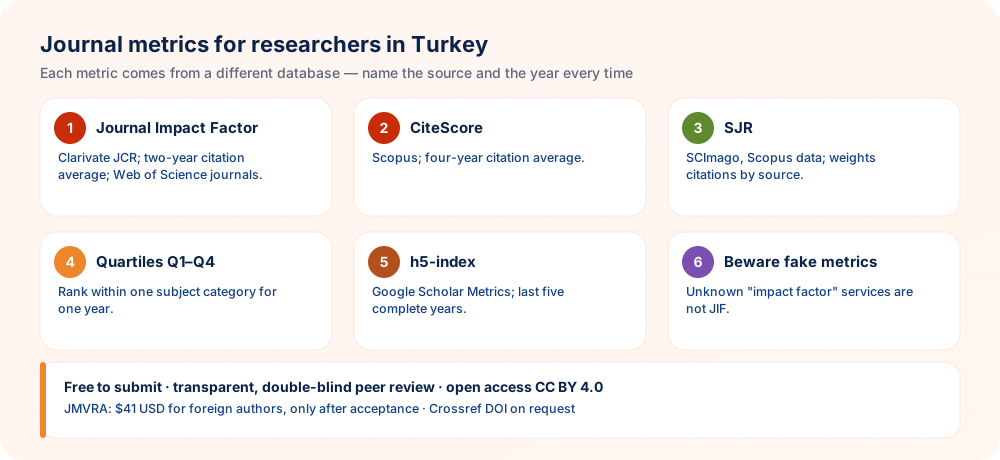
Dividing the citations a journal gets in one year to items it published in the previous two years by its number of citable items gives the impact factor. Clarivate works it out only for journals inside the Web of Science Core Collection. CiteScore (Scopus, four-year window) and SJR (SCImago, prestige-weighted) tackle similar questions using different data.
| Metric | Data source | Window | Where to check |
|---|---|---|---|
| Journal Impact Factor | Web of Science (Clarivate) | 2 years | Journal Citation Reports |
| CiteScore | Scopus (Elsevier) | 4 years | Scopus Sources |
| SJR | Scopus data, SCImago | 3-year period, adjusted for journal prestige | SCImago Journal & Country Rank |
| Quartile (Q1–Q4) | JCR or SCImago | Limited to one category in one year | JCR or SCImago |
| h5-index | Google Scholar Metrics | 5 years | Google Scholar Metrics |
Invented Impact Factors and Misleading Metrics
Many websites sell or hand out “impact factors” that have nothing to do with Clarivate’s Journal Impact Factor. If a journal boasts a large number from an obscure service, or claims a JIF while missing from the Master Journal List, it is misleading you. Ask three things: which database produced the figure, for what year, and whether it can be seen on that database’s own site.
Journals Published in Turkey That Are Indexed
TÜBİTAK’s own academic journals, many of which report SCIE, lead Turkey’s indexed titles, alongside society journals like Education and Science (SSCI); the criteria for associate professorship set by ÜAK award points for publications in Web of Science and TR Dizin.
| Journal | Publisher | Subject | Reported coverage |
|---|---|---|---|
| Turkish Journal of Chemistry | TÜBİTAK, Ankara | Chemistry | Reported status: SCIE and Scopus |
| Turkish Journal of Medical Sciences | TÜBİTAK, Ankara | Medical sciences | Reported status: SCIE and Scopus |
| Turkish Journal of Electrical Engineering and Computer Sciences | TÜBİTAK, Ankara | Electrical engineering, computer science | Reported status: SCIE and Scopus |
| Balkan Medical Journal | Trakya University, Edirne | Medicine | Reported: SCIE and Scopus; diamond open access |
| Education and Science (Eğitim ve Bilim) | Turkish Education Association (TED), Ankara | Educational sciences | Reported: SSCI and Scopus; TR Dizin |
Coverage details below reflect what each journal or publisher stated on 4 October 2026. For up-to-date numbers, consult Journal Citation Reports (Journal Impact Factor and quartile) and Scopus Sources or SCImago (CiteScore or SJR). Note the date alongside any metric you quote.
Online Journals and Platforms Available in Turkey
E-journals are now the usual format for journals in Turkey. The services below can help you locate them, compare them and confirm their standing:
- DergiPark — The hosting and editorial-management platform of TÜBİTAK ULAKBİM for academic journals published in Turkey; submissions to most Turkish journals are made through it.
- TR Dizin — The national citation index of TÜBİTAK ULAKBİM, which reviews journals based in Turkey and includes those that satisfy its criteria.
- Council of Higher Education (YÖK) — Responsible for planning and overseeing higher education in Turkey; the Interuniversity Board (ÜAK) defines the criteria for associate professorship.
- Directory of Open Access Journals — Look up open access journals satisfying DOAJ’s criteria, narrowing the results by publisher country (Turkey) or by “without fees”.
- SCImago country rankings — Journal rankings built on Scopus, limited to titles published in Turkey and showing quartiles and SJR.
- ISSN Portal — Check that a journal’s ISSN, exact title and country of publication are registered before you put your trust in it.
Appearing in a directory or platform proves nothing definite about high impact or international indexing, so look up every journal in the citation databases themselves.
Locating Top-Tier Journals in Your Field
- Identify your own subject category according to the classification JCR and SCImago use.
- Open that category in JCR or SCImago and sort its journals by whichever metric your requirement names.
- Test the fit for each shortlisted journal by reading its three most recent articles.
- Check the current year's metric and quartile at the original source.
- Before submitting, check the fees, open access options and any waivers.
| Field | Titles published in Turkey | Then search |
|---|---|---|
| Chemistry & sciences | Turkish Journal of Chemistry and other TÜBİTAK journals | SCIE and Scopus physical and life sciences |
| Medicine | Turkish Journal of Medical Sciences; Balkan Medical Journal; Diagnostic and Interventional Radiology | Medical categories listed in JCR and Scopus |
| Engineering & computing | Turkish Journal of Electrical Engineering and Computer Sciences | SCIE and Scopus engineering |
| Education | Education and Science (Eğitim ve Bilim) | SSCI and Scopus education |
| Social sciences & humanities | Many TR Dizin journals on DergiPark (check indexing) | SSCI, AHCI, ESCI and Scopus |
Open Access, Costs and Impact
Plenty of high-impact journals provide open access in return for an article processing charge, a few are diamond open access, and many subscription journals charge authors nothing. Open access widens readership, particularly where libraries cannot afford subscriptions; any citation gain depends on the field, so avoid paying a big APC just for impact.
- Look at the fee before trimming the list, together with the metric and the fit.
- Ask about waivers: writers from lower- and middle-income countries are often offered them by publishers.
- Use self-archiving: where the journal’s policy allows, you may deposit your accepted manuscript in a repository at no cost.
- Consult your library to learn if an agreement with the publisher pays or reduces the APC for authors in Turkey.
A Practical Path to High-Impact Publication
Be ambitious, but plan a step-by-step path. Match each paper to a journal where it can realistically succeed: early-stage or local findings suit reputable national journals, stronger studies suit indexed regional or international titles, and the leading journals in your category deserve your best work, carefully designed, clearly framed and of international relevance.
- Strengthen the study: begin with a clear question, then provide a sound design, a sufficient sample and complete reporting.
- Give it an international angle: show what readers beyond Turkey can take from it.
- Bring in co-authors where helpful, above all when they contribute expertise or data.
- Answer every reviewer thoroughly — revision is the norm for most high-impact papers.
Preparing to Submit to a Top-Tier Journal
- Right categoryThe subject area of the journal fits your paper
- Metric confirmedThis year’s JIF or quartile has been checked in JCR or SCImago
- Match testedHaving read three recent articles, you find yours is of similar standard
- Costs checkedThe APC, any waivers and the open access options are known to you
- Backup selectedA reliable second-choice journal has been found beforehand
How JMVRA suits authors in Turkey
Based in India, JMVRA (ISSN 2984-8911) is an international open access journal covering many disciplines. It is not a Turkish journal, but it accepts papers from authors in Turkey. JMVRA does not have a Clarivate impact factor; it is a good fit for papers that need an affordable, peer-reviewed open access home rather than a Scopus or WoS-indexed one.
- Charge: Due only after acceptance, the $41 USD fee for foreign authors covers up to 5 authors.
- Evaluation: manuscripts receive transparent, double-blind peer review from subject experts, and the similarity score must be below 15%.
- Licence: open access under CC BY 4.0; a Crossref DOI can be requested whenever you need it.
- Plain facts on indexing: the journal is in Google Scholar and is not in Scopus, Web of Science or DOAJ.
A Step-by-Step Path to High-Impact Journals for Authors in Turkey
| Stage | Goal |
|---|---|
| First papers | Well-founded, fully reported studies appearing in genuine peer-reviewed journals |
| Building | Partnerships across Europe and the Middle East, bigger samples and more robust methods |
| Targeting | Q1 or Q2 journals in your subject’s category, their rank verified in JCR or Scopus |
| Sustaining | Acting as a manuscript reviewer, sharing your data and sticking to a coherent research theme |
The Role of Journal Metrics in Turkey
- State which metric you mean — JIF, CiteScore, SJR, or a figure based on Google Scholar
- Go to the source — and confirm the journal’s entry yourself
- Judge against the same field — and not against other fields
- Log your verification — add the date for evaluators
Turkish Authors and the Journal Shortlisting Process
Researchers in Turkey often publish in both national and international outlets. These suggestions help you assemble a shortlist that balances audience, rigour and your own career needs without relying on appearances.
- Rank journals with a simple scorecard. List criteria such as subject fit, editorial transparency and peer review description, then score each candidate. Writing the scores down reduces the influence of impressions and persuasive emails.
- Read the peer review description closely. A trustworthy journal explains how reviewers are chosen and how decisions are made. Vague or missing descriptions deserve extra questions before you send a manuscript.
- Consider a regional audience when appropriate. Some topics matter most to regional readers, and a well-regarded regional journal may serve them better than a distant one. Choose based on who needs your findings.
- Avoid submitting to many journals at once. Simultaneous submissions violate normal publishing ethics. Submit to a single journal, wait for the decision, and move to the next candidate only after a rejection.
- Keep a version history. Save each draft with a date and a short note about what changed. A clear history helps you revisit decisions and recover earlier text if a revision goes wrong.
Use a transparent scorecard, scrutinise peer review descriptions and submit to one journal at a time to protect both quality and ethics.
Questions Researchers Often Ask
Summary and What to Do Next
Publishing high-impact work from Turkey is realistic when you have the right paper, the right journal and an honest reading of the metrics. Check each number at its source, select by fit within your category, and grow your record gradually.
- Pin down your subject category and requirement.
- Pick candidate journals through JCR or SCImago and read their latest articles.
- Confirm metrics and fees before submitting.
- You can also read about journals in Turkey covered by Scopus and Web of Science and about affordable journal publishing in Turkey.
Ready to send in your paper?
Submission to JMVRA is online and free. Review always comes first; the $41 USD publication fee applies only after your paper is accepted.
Related searches
Many readers in Turkey of this guide additionally search for high impact factor journals, Q1 and Q2 journals, Scopus and Web of Science indexing, and ways of checking journal metrics. The guides that follow answer those queries:
References and Sources
Checked on 4 October 2026. Metrics are updated every year, so confirm them at the original source.
Turkish Authors Publishing in JMVRA
- Online submissionPapers come from all countries, and nothing is charged at the time of submission
- ScreeningSubject fit and similarity review (below 15%)
- Double-blind reviewExperts in the subject assess it and email you the outcome
- Accepted — $41 USDJust one fee, with up to 5 authors included
- PublishedReleased as open access (CC BY 4.0)
Details: Publication charges · Peer review · Advice for authors outside India.
Ready to Publish? Submit to JMVRA
JMVRA is aligned with UGC's Suggested Parameters for Choosing Peer-Reviewed Journals.
JMVRA is a Transparent, Peer-Reviewed, Open Access Journal (Refereed Journal). Following the discontinuation of the UGC and UGC-CARE journal listing, and in alignment with the latest UGC-CARE recommendations and guidelines, JMVRA is aligned with UGC’s Suggested Parameters for Choosing Peer-Reviewed Journals.
Handy links within jmvra.org
Key Terms
Subjects and search phrases this article addresses.
Related Reading
Additional guides for researchers based in Turkey.
Keep Reading on the JMVRA Blog
The JMVRA journal blog includes this guide, one of many practical pieces on publishing, indexing, metrics and research integrity, prepared so readers can verify them without any sales pitch.