
Searching for a list of journals in Thailand? Thai publishing revolves around a national citation index, TCI, and a common platform, ThaiJO. Here you will find prominent Thai journals with their publisher, subject area and reported indexing, an explanation of the TCI tiers, and steps for verifying any journal. It is aimed at researchers in Bangkok, Thailand; Chiang Mai, Thailand; Khon Kaen, Thailand; Hat Yai, Thailand and elsewhere in the country.
Scholarly Publishing in Thailand
Thailand runs a well-organised national journal system. The Thai-Journal Citation Index (TCI) Centre keeps a national citation database for articles in Thai journals, spanning about 1,000 journal titles, and assesses them in periodic rounds, placing each in Tier 1, Tier 2 or Tier 3. ThaiJO, the common online journal platform, hosts many Thai journals, and the centre additionally runs the regional ASEAN Citation Index. Knowing which system a journal belongs to helps you judge how its reputation will be read locally.
Most journals come from universities — Chulalongkorn, Mahidol, Kasetsart, Chiang Mai, Khon Kaen, Prince of Songkla and more — and from learned societies like the Science Society of Thailand. Graduation and promotion requirements at many Thai universities are framed around TCI tiers or international databases such as Scopus, so confirm the precise rule for your programme prior to picking a journal.
Listing of Research Journals in Thailand
Each journal below is published in Thailand by a university, society or research body that can be identified. The “reported coverage” column gives what the journal or its publisher says about itself; check any indexing in Scopus Sources or the Master Journal List prior to submitting.
| Journal | Publisher | Subject area | Reported coverage |
|---|---|---|---|
| ScienceAsia | Science Society of Thailand | Multidisciplinary sciences | As reported: SCIE and Scopus |
| Chiang Mai Journal of Science | Faculty of Science, Chiang Mai University | Sciences | As reported: SCIE and Scopus |
| Engineering Journal | Faculty of Engineering, Chulalongkorn University | Engineering | Reported: Scopus and ESCI; TCI |
| Songklanakarin Journal of Science and Technology | Prince of Songkla University, Hat Yai | Science and technology | Reported: Scopus |
| Kasetsart Journal of Social Sciences | Kasetsart University, Bangkok | Social sciences | Reported: Scopus; TCI |
| Journal of Population and Social Studies | Institute for Population and Social Research, Mahidol University | Population and social studies | Reported: Scopus; TCI |
We compared every entry with the journal's own site or publisher on 4 October 2026. For researchers in Thailand it is somewhere to start, not a ranking and not a complete list.
Online Journal Platforms and Directories to Use
Consult TCI for a Thai journal’s tier, use ThaiJO for reading and submitting, and compare against international directories.
Thai-Journal Citation Index (TCI)
The national citation database of Thailand; in periodic rounds it evaluates Thai journals and places them in Tier 1, Tier 2 or Tier 3. Visit.
ThaiJO (Thai Journals Online)
Thai journals in large numbers are hosted on this web platform, which supports article search and online submission.
ASEAN Citation Index
Regional citation index for journals from ASEAN countries, operated by the TCI centre. Visit.
Directory of Open Access Journals
Find open access journals that satisfy DOAJ’s criteria; narrow the results by publisher country (Thailand) or by “without fees”. Visit.
SCImago country rankings
Journal rankings based on Scopus, limited to journals published in Thailand, showing quartiles and SJR. Visit.
ISSN Portal
Before you depend on a journal, check its ISSN, exact title and country of publication. Visit.
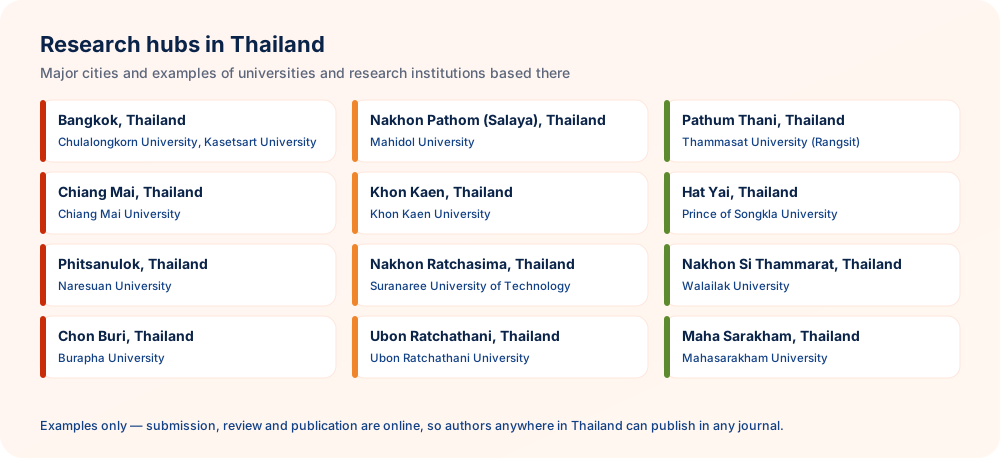
Thailand’s Research Hubs
Research in Thailand is centred on Bangkok and nearby provinces, and large regional universities serve the north, northeast, south and east.
Picking the Right Journal
Work from what the manuscript needs: its intended readers, the recognition your institution requires and the journal's favoured format. Shortlist two or three journals, browse their latest articles, and keep a solid fallback ready before submitting. Setting the author instructions of each candidate next to one another often shows mismatches early.
Fees and Affordable Options
Fees are set by each Thai journal. Some ask for nothing, many levy a processing fee in baht, and a few charge more for international authors or expedited handling. Look for the official fee statement on the journal’s ThaiJO page or website, and see what it includes. Read the wording closely so that no extra charge surprises you later.
Money should change hands only once acceptance is real, and only via the journal's official channel. To compare, JMVRA's fee for foreign authors is $41 USD, due only after acceptance and covering up to five authors.
Our low-cost journal publication guide, usable in Thailand and every other country, gives a complete method for comparing journals; there is also a note on how a low-fee journal funds itself.
Checking a Journal Step by Step
- Look the ISSN up on the ISSN Portal and see which title comes back.
- You ought to be able to name the publisher and reach the editorial office.
- A journal should describe how it reviews papers and genuinely do so.
- The journal needs a record in the database itself; a logo on its site does not count.
- Costs are explained clearly and are payable once the paper has been accepted.
Checklist Before You Submit a Manuscript
- Journal checkedFit, requirement and indexing confirmed
- Template appliedFormatting, referencing style and length
- Similarity testedEach source cited, own work included
- Ethics settledApprovals, consent and declared conflicts
- Author information checkedNames and affiliations just as they will be printed
- Cover letter writtenHow the paper suits this journal
How JMVRA suits authors in Thailand
Based in India, JMVRA (ISSN 2984-8911) is an international open access journal covering many disciplines. It is not a Thai journal, but it accepts papers from authors in Thailand.
- Fee: Foreign authors, those in Thailand included, pay $41 USD, collected only after a paper is accepted, for up to 5 authors.
- Review: experts in the subject perform a transparent double-blind peer review, with similarity below 15% required.
- Access: open access publishing (CC BY 4.0); a Crossref DOI is available on request.
- Straight about indexing: Google Scholar indexes our articles; Scopus, Web of Science and DOAJ do not.
A 12-Month Publication Roadmap for Researchers in Thailand
| Months | Focus |
|---|---|
| 1–3 | Settle on a focused question and a shortlist of two or three journals; study national systems like the Thai-Journal Citation Index (TCI) tiers and the ThaiJO platform, along with international databases |
| 4–6 | Carry out data collection and analysis while writing directly in the template of the journal you intend to use |
| 7–9 | Ask a supervisor or colleague for feedback, and submit to just one journal at a time |
| 10–12 | Address the reviewers' comments in a revision, share the final paper, and update your ORCID and Google Scholar profiles |
Language Options for Authors in Thailand
Researchers in Thailand work in Thai and English. Choose the language according to who needs to read the paper.
Write in Thai
Gets to readers, practitioners and policy makers in Thailand.
Publishing in English
Brings in international readers, reviewers and indexes.
Abstract in two languages
Adding an English title and abstract to a Thai-language paper makes it easier to find internationally.
Language editing support
Have a colleague or editor read the final version before you submit.
Practical Tips for Thai Academics Aiming for Wider Readership
Thai researchers often write for both national and international audiences, and each has different expectations. These suggestions help you make deliberate choices about who you are writing for and how to reach them.
- Choose your audience before writing. Decide whether the main readers are Thai practitioners or an international scholarly community. That choice affects language, level of background detail and the journals you approach.
- Translate titles and abstracts with care. If you provide both Thai and English versions, check that they say exactly the same thing. Mismatches confuse readers and complicate how your paper is found and cited.
- Explain cultural and institutional context. Describe the educational, health or business setting briefly, since practices differ between countries. Context helps outsiders interpret your results without assuming familiar systems.
- Spell your name consistently. Romanised Thai names can be written several ways. Pick one form, use it in every paper and in your profile so that your publications are grouped together reliably.
- Present statistics clearly. Report effect sizes and uncertainty along with significance tests, and explain your choice of method. Careful statistical reporting is a frequent concern in reviewers' comments.
Know your readers, keep bilingual versions and your name consistent, and report your statistics with enough detail to be checked.
Questions Researchers Often Ask
Summary and What to Do Next
Thailand’s TCI system makes judging a national journal simpler than in many countries. Combine TCI, Scopus and Web of Science, verify every journal, and select by fit. A short comparison table of your shortlisted journals can make the final decision easier.
- Have your institution set out its publication requirement in writing.
- Pick some journals from the table and see what they have published recently.
- To verify indexing, consult our Thailand guide to Scopus and Web of Science journals.
- Prepare the manuscript using the journal's template and submit on the journal's own site.
Ready to send in your paper?
Submission to JMVRA is online and free. Review always comes first; the $41 USD publication fee applies only after your paper is accepted.
Related searches
Related searches by researchers in Thailand include affordable open access journals, high impact factor journals, Scopus and Web of Science indexed journals, paper publication fees and journal publication in Thailand. These guides cover them:
- Low-cost journal publication in Thailand
- High impact factor journals in Thailand
- Scopus and Web of Science journals in Thailand
- How a low-fee journal is funded
- Locating high impact factor journals
- How to choose a journal
- Checking an indexing claim yourself
- Recognising a predatory journal
- Publishing with JMVRA from outside India
- JMVRA publication charges
References and Sources
Checked on 4 October 2026. Indexing, fees and policies can change, so check them again before submitting.
- Thai-Journal Citation Index Centre
- ThaiJO
- ASEAN Citation Index
- CASRAI — TCI tiers explained
- ScienceAsia
- Engineering Journal
- Scopus Sources
- Clarivate Master Journal List
- ISSN Portal
Publishing with JMVRA From Thailand
- Submit onlineOpen to authors everywhere; no charge at submission
- Initial checkScope fit and similarity (below 15%)
- Double-blind reviewReviewed by subject specialists; you are told the result by email
- Accepted — $41 USDOne payment for up to 5 authors
- PublishedFree-to-read, CC BY 4.0 licence
Details: Publication charges · Peer review · Advice for authors outside India.
Ready to Publish? Submit to JMVRA
JMVRA is aligned with UGC's Suggested Parameters for Choosing Peer-Reviewed Journals.
JMVRA is a Transparent, Peer-Reviewed, Open Access Journal (Refereed Journal). Following the discontinuation of the UGC and UGC-CARE journal listing, and in alignment with the latest UGC-CARE recommendations and guidelines, JMVRA is aligned with UGC’s Suggested Parameters for Choosing Peer-Reviewed Journals.
More useful pages at jmvra.org
Key Terms
Subjects and search phrases this article addresses.
Related Reading
Further guides for researchers in Thailand and for selecting a journal.
Affordable Journal Publication for Thai Researchers
Read the guide RelatedChoosing High-Impact Journals as a Thai Researcher
Read the guide RelatedScopus & Web of Science Journals: Thailand
Read the guide RelatedResearch Journals in Malaysia: MyCite & Scopus
Read the guide RelatedResearch Journals in Indonesia: SINTA & Scopus
Read the guide RelatedWhat International Authors Should Know About JMVRA
Read the guide RelatedChoosing a Journal: A 7-Step Scoring Framework
Read the guideKeep Reading on the JMVRA Blog
You are reading part of the JMVRA journal blog, a source of hands-on guidance about publishing, indexing, metrics and research integrity that aims to be verifiable, not promotional.