
Want to find high impact factor journals in Thailand? Career moves and funding awards often turn on impact factors, quartiles and rankings, and such numbers are easy to misunderstand or fabricate. Inside you will learn what the main metrics mean, how to steer clear of fake impact factors, which Thailand-published journals report international indexing, and a staged method for finding the highest-impact journals in your area. It is aimed at researchers in Bangkok, Thailand; Nakhon Pathom (Salaya), Thailand; Pathum Thani, Thailand; Chiang Mai, Thailand.
What a High Impact Factor Actually Tells You
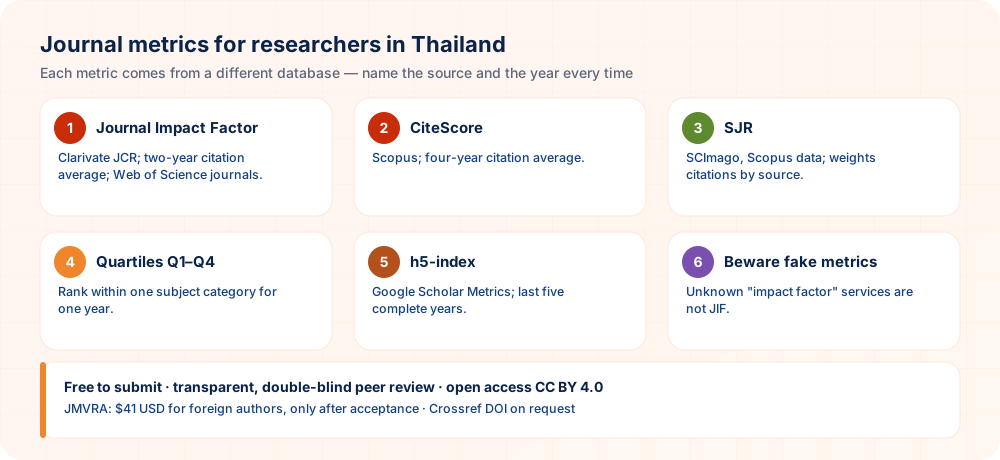
Describing a journal as “high impact” means its recent articles earn frequent citations on average, compared with other journals in the same field. Clarivate's Journal Impact Factor (JIF), released in Journal Citation Reports, is the most widely known measure, with CiteScore and the SCImago Journal Rank (SJR) from Scopus as alternatives. All of them rate the journal as a whole, not one article of yours, as researchers in Thailand should keep in mind.
| Metric | Data source | Window | Where to check |
|---|---|---|---|
| Journal Impact Factor | Web of Science (Clarivate) | 2 years | Journal Citation Reports |
| CiteScore | Scopus (Elsevier) | 4 years | Scopus Sources |
| SJR | Scopus data, SCImago | Over 3 years, weighted by prestige | SCImago Journal & Country Rank |
| Quartile (Q1–Q4) | JCR or SCImago | A single year within a single category | JCR or SCImago |
| h5-index | Google Scholar Metrics | 5 years | Google Scholar Metrics |
Invented Impact Factors and Misleading Metrics
Many websites sell or give out “impact factors” that are not related to Clarivate's Journal Impact Factor. A journal that parades a big number from an unfamiliar service, or says it has a JIF but is not in the Master Journal List, is misleading you. Ask three things: which database, which year, and can the figure be seen on the database's own website?
Journals Published in Thailand That Are Indexed
ScienceAsia and the Chiang Mai Journal of Science (SCIE), together with Chulalongkorn’s Engineering Journal (ESCI), are Thai journals reporting Web of Science coverage; Thai journals are also graded by TCI, from Tier 1 to Tier 3.
| Journal | Publisher | Subject | Reported coverage |
|---|---|---|---|
| ScienceAsia | Science Society of Thailand | Multidisciplinary sciences | Reported listing: SCIE and Scopus |
| Chiang Mai Journal of Science | Faculty of Science, Chiang Mai University | Sciences | Reported listing: SCIE and Scopus |
| Engineering Journal | Faculty of Engineering, Chulalongkorn University | Engineering | Reported: Scopus and ESCI; TCI |
| Songklanakarin Journal of Science and Technology | Prince of Songkla University, Hat Yai | Science and technology | Reported: Scopus |
| Kasetsart Journal of Social Sciences | Kasetsart University, Bangkok | Social sciences | Reported: Scopus; TCI |
What follows is the coverage each journal or publisher reported on 4 October 2026. Up-to-date values are in Journal Citation Reports for the Journal Impact Factor and quartile, and in Scopus Sources or SCImago for CiteScore or SJR. Always put a date on any metric you quote.
Online Journals and Platforms Available in Thailand
E-journals are now the usual format for journals in Thailand. The services below can help you locate them, compare them and confirm their standing:
- Thai-Journal Citation Index (TCI) — The national citation database of Thailand, which assesses Thai journals and places them into Tier 1, Tier 2 and Tier 3 during periodic rounds.
- ThaiJO (Thai Journals Online) — An online platform that hosts a large proportion of Thai journals and offers article search plus online submission.
- ASEAN Citation Index — A regional citation index for journals published in ASEAN countries, run by the TCI centre.
- Directory of Open Access Journals — Look up open access journals satisfying DOAJ’s criteria, narrowing the results by publisher country (Thailand) or by “without fees”.
- SCImago country rankings — Journal rankings built on Scopus, limited to titles published in Thailand and showing quartiles and SJR.
- ISSN Portal — Check a journal's ISSN, exact title and country of publication before you put your trust in it.
Being listed on a platform or in a directory does not automatically imply high impact or international indexing; verify each journal in the citation databases.
Locating Top-Tier Journals in Your Field
- Find out which subject category your paper falls into, according to JCR and SCImago.
- List that category's journals in JCR or SCImago and sort them by the metric your requirement specifies.
- See whether your paper fits by reading three recent articles from every journal on your shortlist.
- Check the current year's metric and quartile at the original source.
- Before submitting, check the fees, open access options and any waivers.
| Field | Titles published in Thailand | Then search |
|---|---|---|
| Multidisciplinary sciences | ScienceAsia; Chiang Mai Journal of Science | SCIE and Scopus multidisciplinary |
| Engineering | Engineering Journal (Chulalongkorn) | Scopus engineering; SCIE |
| Science & technology | Songklanakarin Journal of Science and Technology | Scopus physical and life sciences |
| Social sciences | Kasetsart Journal of Social Sciences; Journal of Population and Social Studies | SSCI, ESCI and Scopus social sciences |
| Medicine & health | Use international journals and Thai medical society journals (check indexing) | JCR and Scopus categories for medicine |
Open Access, Costs and Impact
Many high-impact journals give open access in exchange for an article processing charge, a few are diamond open access, and numerous subscription journals levy no author fee. Open access widens readership, above all where libraries cannot afford subscriptions, but its impact on citations varies by field, so a large APC should not be paid for impact alone.
- Review the fee before shortlisting, with the metric and the fit.
- Find out about waivers: many publishers award them to authors from lower- and middle-income countries.
- Use self-archiving: if journal policy permits, deposit the accepted manuscript in a repository without charge.
- Consult your library to learn if an agreement with the publisher pays or reduces the APC for authors in Thailand.
A Practical Path to High-Impact Publication
Few researchers manage a first paper in a Q1 journal. The sensible route is staged: a well-prepared paper in a reputable national or regional outlet first, then indexed journals in your field, and top-tier journals at the end, once you have a record, collaborators and a study of clear international relevance.
- Build a stronger study: raise a clear question, select a sound design, collect an adequate sample and report completely.
- Give it an international angle: show what readers beyond Thailand can take from it.
- Partner with others who contribute expertise or data you do not have.
- Reply to reviewers in full — revision is part of the process for most high-impact papers.
Preparing to Submit to a Top-Tier Journal
- Category correctThe journal's subject category is a good fit for your paper
- Metric checkedJIF or quartile found in JCR or SCImago for this year
- Suitability reviewedThree recent articles read; your paper would fit alongside them
- Costs confirmedAPC, waivers and open access options clear
- Fallback readyA trustworthy second-choice journal chosen ahead of time
How JMVRA suits authors in Thailand
Based in India, JMVRA (ISSN 2984-8911) is an international open access journal covering many disciplines. It is not a Thai journal, but it accepts papers from authors in Thailand. JMVRA does not have a Clarivate impact factor; it is a good fit for papers that need an affordable, peer-reviewed open access home rather than a Scopus or WoS-indexed one.
- Fee: Foreign authors pay $41 USD, payable only after acceptance, and the amount covers up to 5 authors.
- Review: subject experts carry out an open, double-blind peer review, and similarity must remain below 15%.
- Access: the journal is open access under CC BY 4.0; ask if you want a Crossref DOI.
- Our indexing, in short: present in Google Scholar; absent from Scopus, Web of Science and DOAJ.
A Step-by-Step Path to High-Impact Journals for Authors in Thailand
| Stage | Goal |
|---|---|
| First papers | Strong research, clearly reported and published in credible peer-reviewed journals |
| Building | Partnerships across ASEAN, larger samples and sturdier methods |
| Targeting | Journals in Q1 or Q2 of your subject category, as confirmed in JCR or Scopus |
| Sustaining | Data sharing, refereeing for journals and a steady line of research |
The Role of Journal Metrics in Thailand
- Say which metric you mean — JIF, CiteScore or SJR, or a number based on Google Scholar
- Follow the figure to its source — and look the journal up there for yourself
- Benchmark within one discipline — not across different ones
- Record your checks — dated, so that evaluators can see them
Thai Researchers: Strengthening a Manuscript Before Submission
Thai authors often have strong data but spend less time on presentation. These reminders concentrate on the writing and review stage, where careful preparation can noticeably improve a paper's reception.
- Read the manuscript aloud. Reading aloud exposes awkward sentences and missing links in the argument. Fix each place where you stumble, because reviewers will stumble there too.
- Use plain, direct sentences. Short sentences with one idea each translate well and avoid misunderstanding. Reserve complex phrasing for points that genuinely need it.
- Check that conclusions match the evidence. Compare every claim in your discussion with a specific result. Remove statements that go beyond your data, as overreach is a frequent reason for criticism.
- Run a similarity check. Use a similarity checking tool on your draft and review every flagged passage. Paraphrase or quote and cite properly so that overlap reflects only legitimate sources.
- Prepare a response template early. Create a simple document for answering reviewer comments before they arrive. Having a format ready makes revision faster and your replies more organised.
Polish the text, align conclusions with evidence and check similarity before sending, so reviewers can concentrate on your science.
Questions Researchers Often Ask
Summary and What to Do Next
Publishing high-impact work from Thailand is realistic when you have the right paper, the right journal and an honest reading of the metrics. Check each number at its source, select by fit within your category, and grow your record gradually. Bookmark the sources you trust so rechecking before each submission takes only a few minutes.
- Work out your subject category and requirement.
- Compile a candidate list of journals through JCR or SCImago, then go through some of their recent articles.
- Confirm metrics and fees before submitting.
- You can also read about journals in Thailand covered by Scopus and Web of Science and about affordable journal publishing in Thailand.
Ready to send in your paper?
Submission to JMVRA is online and free. Review always comes first; the $41 USD publication fee applies only after your paper is accepted.
Related searches
Many readers in Thailand of this guide additionally search for high impact factor journals, Q1 and Q2 journals, Scopus and Web of Science indexing, and ways of checking journal metrics. The guides that follow answer those queries:
References and Sources
Checked on 4 October 2026. Metrics are updated every year, so confirm them at the original source.
Thai Authors Publishing in JMVRA
- Online submissionAuthors from any country may apply; no charge is levied when you submit
- ScreeningChecks on scope and similarity (below 15%)
- Double-blind reviewSubject specialists evaluate the paper; the decision reaches you by email
- Accepted — $41 USDA single fee, covering up to 5 authors
- PublishedOpen access under CC BY 4.0
Details: Publication charges · Peer review · Advice for authors outside India.
Ready to Publish? Submit to JMVRA
JMVRA is aligned with UGC's Suggested Parameters for Choosing Peer-Reviewed Journals.
JMVRA is a Transparent, Peer-Reviewed, Open Access Journal (Refereed Journal). Following the discontinuation of the UGC and UGC-CARE journal listing, and in alignment with the latest UGC-CARE recommendations and guidelines, JMVRA is aligned with UGC’s Suggested Parameters for Choosing Peer-Reviewed Journals.
Helpful pages on jmvra.org
Key Terms
Subjects and search phrases this article addresses.
Related Reading
Additional guides for researchers based in Thailand.
Keep Reading on the JMVRA Blog
This guide belongs to the JMVRA journal blog, which offers practical advice on publishing, indexing, metrics and research integrity, written to be checkable instead of promotional.