
Looking for journals in Thailand indexed by Scopus or Web of Science titles? Thailand has a solid group of indexed university and society journals, strongest in science and engineering. The guide gives examples together with the index each one reports, shows where TCI tiers fit, and explains how to verify indexing.
Scopus and Web of Science: The Essentials
Scopus is an Elsevier abstract-and-citation database with selective inclusion; CiteScore is drawn from it and so is the data for the SCImago Journal Rank (SJR). In Clarivate’s Web of Science, the Core Collection covers SCIE (sciences), SSCI (social sciences), AHCI (arts and humanities) and ESCI (emerging sources), and the Journal Impact Factor is published by Journal Citation Reports. Journals are re-evaluated in both, and any of them can be discontinued. For more, see Scopus explained and Web of Science explained.
| Term | What it is | Where to check |
|---|---|---|
| Scopus | Abstracts and citations collected selectively by Elsevier | Scopus Sources |
| SCIE | Science Citation Index Expanded — Web of Science’s coverage of the sciences | Master Journal List |
| SSCI | Social Sciences Citation Index — Web of Science’s coverage of the social sciences | Master Journal List |
| AHCI | Arts & Humanities Citation Index — Web of Science’s coverage of the humanities | Master Journal List |
| ESCI | Emerging Sources Citation Index — journals admitted to Web of Science after a quality review | Master Journal List |
| Journal Impact Factor | A two-year citation average, given to every Web of Science Core Collection journal from the 2023 release onward | Journal Citation Reports |
| CiteScore | Citations averaged across four years, for the journals included in Scopus | Scopus Sources |
| SJR | SCImago Journal Rank — a prestige-weighted score based on Scopus data | SCImago |
| Quartile (Q1–Q4) | The order in which a journal sits within its subject category in one year | JCR or SCImago |
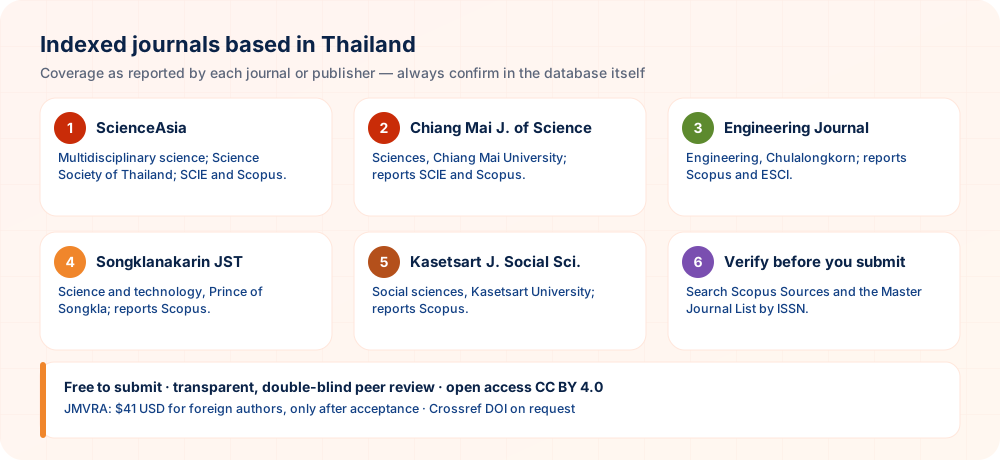
Among Thai journals, ScienceAsia, the Chiang Mai Journal of Science (SCIE) and the Engineering Journal (ESCI) report coverage in Web of Science. Others report Scopus coverage, for example the Songklanakarin Journal of Science and Technology as well as journals of Kasetsart and Mahidol universities. For the full up-to-date list, narrow SCImago’s rankings to Thailand. Remember that a journal’s reported coverage can lag behind the databases, so confirm at the source.
Thai Journals Covered by Scopus and Web of Science
The journals below are published in Thailand and report Scopus and/or Web of Science coverage, either on their own sites or via their publisher. On the day you decide, verify each by ISSN in Scopus Sources and the Master Journal List.
| Journal | Publisher | Subject | Reported coverage |
|---|---|---|---|
| ScienceAsia | Science Society of Thailand | Multidisciplinary sciences | Reported source: SCIE and Scopus |
| Chiang Mai Journal of Science | Faculty of Science, Chiang Mai University | Sciences | Reported source: SCIE and Scopus |
| Engineering Journal | Faculty of Engineering, Chulalongkorn University | Engineering | Reported: Scopus and ESCI; TCI |
| Songklanakarin Journal of Science and Technology | Prince of Songkla University, Hat Yai | Science and technology | Reported: Scopus |
| Kasetsart Journal of Social Sciences | Kasetsart University, Bangkok | Social sciences | Reported: Scopus; TCI |
Further respected titles; whether Scopus or Web of Science indexes them is not confirmed
| Journal | Publisher | Reported coverage |
|---|---|---|
| Journal of Population and Social Studies | Institute for Population and Social Research, Mahidol University | Reported: Scopus; TCI |
Checked 4 October 2026. “Reported” means the journal or publisher says so; we have not independently confirmed it.
Indexing Verification Checklist
- Pick up the ISSNThe print and online ISSN stated on the official website
- Scopus SourcesEnter the ISSN and take note of status and years of coverage
- Master Journal ListEnter the ISSN and write down whether SCIE, SSCI, AHCI or ESCI appears
- Coverage ended?Look through Scopus’s record of discontinued titles
- Hold on to proofScreenshots with dates for inclusion in your promotion or grant file
Publishing Abroad From Thailand
Thailand has more indexed national journals than many countries do, but in most fields the broadest choice is international. When looking abroad, consider the article processing charge (APC), whether a publisher agreement at your university covers it, and whether your field has a diamond open access journal, one that charges neither authors nor readers; DOAJ has a “without fees” filter for this. Writing down these answers for each shortlisted journal makes the comparison far easier.
Talk to the research office at your university about publication rewards and help with APC costs, and check which databases your programme recognises.
Quartiles, Impact Factor and Top-Tier Journals
Because Impact Factor, CiteScore and SJR are journal-wide averages produced from different databases and over different periods, they shift annually. Set like against like (identical metric, category and year) and check the value where it is published instead of trusting a homepage.
For the majority of researchers in Thailand, international journals rather than local ones offer the highest-impact options in a field. Search by subject category in Journal Citation Reports, Scopus Sources or SCImago, and read recent articles to judge the fit. Our step-by-step guide to journals with a high impact factor explains how.
Picking an Indexed Journal for Your Subject
| Field | Thai-published journals | Then search |
|---|---|---|
| Multidisciplinary sciences | ScienceAsia; Chiang Mai Journal of Science | SCIE and Scopus multidisciplinary |
| Engineering | Engineering Journal (Chulalongkorn) | Scopus engineering; SCIE |
| Science & technology | Songklanakarin Journal of Science and Technology | Scopus physical and life sciences |
| Social sciences | Kasetsart Journal of Social Sciences; Journal of Population and Social Studies | SSCI, ESCI and Scopus social sciences |
| Medicine & health | Turn to Thai medical society journals or international ones, checking indexing first | Medical categories listed in JCR and Scopus |
Using TCI Tiers Alongside International Indexing
Researchers in Thailand frequently deal with two scales at once: the national TCI tiers and international indexing. They address separate questions. A TCI tier shows how a Thai journal fared in the national evaluation round; Scopus or Web of Science shows whether an international database chose it. Some Thai journals appear in both systems, many appear in TCI alone, and the international databases also include thousands of non-Thai journals across every field.
| Question | TCI tier | Scopus / Web of Science |
|---|---|---|
| Who decides? | Assessed by the TCI Centre in scheduled evaluation rounds | Selection panels at Elsevier or Clarivate |
| Which journals? | Thai-published journals | Journals worldwide |
| Where to check? | tci-thailand.org | Scopus Sources; Master Journal List |
| Typical use | Requirements for graduation and promotion in Thailand | Global grants, rankings and career promotion |
Where your programme accepts “TCI Tier 1 or Scopus”, a Thai journal listed in both systems gives you the greatest flexibility; where it demands Scopus or Web of Science alone, consult the database first. Confirm the exact wording with your programme office to avoid surprises at graduation time.
Getting Your Paper Ready for an Indexed Journal
What matters most for entry into an indexed journal is suitability, clear writing and rigour, not the metric. Practical steps to take:
- Begin with scope when shortlisting, with the metric second.
- Improve the framing: pose one well-defined research question, state what you contribute and admit limitations openly.
- Stick to the template of the journal and its citation style exactly; this reflects care.
- Partner with colleagues at other institutions or abroad if they add skills — cross-border teamwork is also tied to wider visibility.
Frequent Mistakes With Indexed Journals
- Putting trust in a logo on the journal’s main page rather than the database record.
- Skipping the index name — “Web of Science” does not say whether SCIE, SSCI, AHCI or ESCI is meant.
- Not allowing for discontinuation — indexing held in the previous year may be invalid today.
- Picking on the metric alone — a paper that falls outside the journal’s scope will be rejected swiftly.
How JMVRA suits authors in Thailand
Based in India, JMVRA (ISSN 2984-8911) is an international open access journal covering many disciplines. It is not a Thai journal, but it accepts papers from authors in Thailand. JMVRA is not in Scopus or Web of Science; it serves authors who want an affordable, peer-reviewed open access journal rather than an indexed one.
- Fee: the $41 USD for foreign authors falls due only when the paper is accepted, and covers up to 5 authors.
- Review: each paper receives transparent double-blind peer review from experts in its subject, with similarity kept under 15%.
- Access: open access with a CC BY 4.0 licence; a Crossref DOI is available whenever you ask.
- The facts on indexing: included in Google Scholar, but not included in Scopus, Web of Science or DOAJ.
A Preparation Kit for Submitting to Indexed Journals From Thailand
| Item | Tip |
|---|---|
| Manuscript | In the journal’s own template, giving an English title, abstract and keywords |
| Cover letter | Sets out the journal fit and the reasons readers beyond Thailand will find the work valuable |
| ORCID iDs | Every author needs one, which keeps the records correct |
| Approvals | Ethics clearance and any research permits that Thailand requires |
| Data availability statement | Say where the data is available, or why it is not shareable |
International Collaboration Starting in Thailand
Regional collaborators
Collaborative projects around ASEAN pool data, methods and reviewers.
Researchers in the diaspora
Thai researchers based overseas make natural co-authors and mentors.
Co-supervision
If a thesis has co-supervisors, the papers from it have co-authors.
Agreeing authorship
Settle roles, author order and data ownership in writing before you begin.
Practical Tips for Thai Researchers Combining National and International Indexing
Thai researchers often balance national citation tiers with international database coverage. These tips help you plan a publication path that satisfies local needs while still reaching a worldwide readership.
- Plan a staged publication path. Consider whether a national journal suits a preliminary report while a fuller analysis goes to an international outlet. Make sure the papers are genuinely different and cite each other honestly.
- Avoid duplicate publication. Do not submit essentially the same results to a Thai-language and an English-language journal without disclosure. Editors treat undeclared overlap as serious, whatever the language.
- Check tier rules from official sources. National tier definitions are revised from time to time. Read the current notice from the responsible body instead of relying on summaries from colleagues or social media.
- Write a bilingual abstract carefully. If a journal needs abstracts in Thai and English, prepare both from the same outline so that claims match. Mismatched abstracts create confusion for readers and indexers.
- Use clear figures and tables. Label axes, units and abbreviations in English even if the surrounding text is bilingual. Self-explanatory figures let international readers follow your results quickly.
Treat national and international venues as complementary, disclose any overlap honestly, and read current tier rules directly from official sources.
Questions Researchers Often Ask
Summary and What to Do Next
Thailand has dependable indexed journals in science, engineering and the social sciences. Use TCI together with Scopus and Web of Science checks, and pick by suitability.
- Question what your rule really asks for: Web of Science, Scopus, some index or a quartile.
- Narrow your field’s journals down using the preceding tables together with international databases.
- Check each title by its ISSN and keep a record of what you find.
- Browse the directory of research journals in Thailand for titles that are not indexed.
Ready to send in your paper?
Submission to JMVRA is online and free. Review always comes first; the $41 USD publication fee applies only after your paper is accepted.
Related searches
Thai researchers using this guide frequently go on to look up affordable open access journals, high impact factor journals, Scopus and Web of Science indexed journals, paper publication fees and journal publication in Thailand. These guides cover those subjects:
- Low-cost journal publication in Thailand
- High impact factor journals in Thailand
- Research journals in Thailand
- How a low-fee journal is funded
- Locating high impact factor journals
- How to choose a journal
- Checking an indexing claim yourself
- Recognising a predatory journal
- Publishing with JMVRA from outside India
- JMVRA publication charges
References and Sources
Checked on 4 October 2026. Indexing status can change, so confirm it before submitting.
- SCImago journal rankings — Thailand
- TCI Centre
- ScienceAsia
- Chiang Mai Journal of Science
- Engineering Journal
- Scopus Sources
- Clarivate Master Journal List
- ISSN Portal
- SCImago Journal & Country Rank
- Journal Citation Reports
Submitting to JMVRA From Thailand
- Submit onlineThai and other international authors may submit, with no fee at submission
- ScreeningSubject fit and similarity review (below 15%)
- Double-blind reviewExperts in the subject judge it, and the decision is emailed to you
- Accepted — $41 USDJust one fee, with up to 5 authors included
- PublishedReleased as open access (CC BY 4.0)
Details: Publication charges · Peer review · Advice for authors outside India.
Ready to Publish? Submit to JMVRA
JMVRA is aligned with UGC's Suggested Parameters for Choosing Peer-Reviewed Journals.
JMVRA is a Transparent, Peer-Reviewed, Open Access Journal (Refereed Journal). Following the discontinuation of the UGC and UGC-CARE journal listing, and in alignment with the latest UGC-CARE recommendations and guidelines, JMVRA is aligned with UGC’s Suggested Parameters for Choosing Peer-Reviewed Journals.
Handy links within jmvra.org
Key Terms
Subjects and search phrases this article addresses.
Related Reading
Additional reading for researchers in Thailand on picking a journal.
Affordable Journal Publication for Thai Researchers
Read the guide RelatedChoosing High-Impact Journals as a Thai Researcher
Read the guide RelatedResearch Journals in Thailand: TCI & ThaiJO
Read the guide RelatedResearch Journals in Malaysia: MyCite & Scopus
Read the guide RelatedResearch Journals in Indonesia: SINTA & Scopus
Read the guide RelatedWhat International Authors Should Know About JMVRA
Read the guide RelatedChecking a Journal’s Indexing Claims
Read the guideKeep Reading on the JMVRA Blog
The JMVRA journal blog includes this guide, one of many practical pieces on publishing, indexing, metrics and research integrity, prepared so readers can verify them without any sales pitch.