
Searching for a list of journals in Kenya? This guide gathers Kenyan research journals along with their publisher, subject and reported indexing, and points to the university journal platforms where many more can be found. It is intended for students, postgraduates and lecturers in Nairobi, Kenya; Eldoret, Kenya; Kisumu, Kenya; Mombasa, Kenya and throughout the country.
Kenya’s Academic Publishing Landscape
The Commission for University Education (CUE) regulates Kenya’s universities. It accredits institutions and sets standards for higher education, among them the hiring and promotion of academic staff, for which refereed publications carry weight. Research licensing and coordination fall to the National Commission for Science, Technology and Innovation (NACOSTI), which has additionally developed national guidelines for accrediting academic journals, showing that journal quality is a policy priority.
Kenyan journals come mainly from three kinds of publisher: universities — Kabarak, Maseno, Egerton, Moi, JKUAT, Kenyatta University and the University of Nairobi, among others, run their own online journal systems — research institutes such as KEMRI, and professional bodies such as the Kenya Medical Association, which publishes the East African Medical Journal. AJFAND, a long-established journal on food, agriculture and nutrition in Africa, is also based in Nairobi.
African Journals Online lists many of these titles. Which journals count for theses, promotions and grant reports is determined by your university’s present guidelines, so verify the requirement before drawing up a shortlist. Keeping a written copy of that rule can save disputes later.
Directory of Research Journals in Kenya
The journals below are issued in Kenya by recognisable universities, societies or research bodies. The “reported coverage” column records what each journal or its publisher claims; check any indexing in Scopus Sources or the Master Journal List prior to submitting.
| Journal | Publisher | Subject area | Reported coverage |
|---|---|---|---|
| East African Medical Journal | Kenya Medical Association | Medicine and health | Reported: Scopus; hosted on AJOL |
| African Journal of Food, Agriculture, Nutrition and Development (AJFAND) | Africa Scholarly Science Communications Trust, Nairobi | Food, agriculture and nutrition | Reported: Scopus |
| African Journal of Health Sciences | Kenya Medical Research Institute (KEMRI), Nairobi | Health sciences | Open access; hosted on AJOL |
| Journal of Agriculture, Science and Technology (JAGST) | Jomo Kenyatta University of Agriculture and Technology, Juja | Agriculture, science and engineering | AJOL hosts it; verify Scopus status via ISSN |
| Journal of the Kenya National Commission for UNESCO | Kenya National Commission for UNESCO, Nairobi | Education, science, culture and communication | Open access; check indexing |
Checked on 4 October 2026 against every journal's website or publisher. Treat this as a place to start, not a ranking or a complete directory of journals for Kenya.
Online Journal Platforms and Directories to Use
Kenyan journals are scattered across university systems, AJOL and international directories. Begin with the resources below, then submit via the website of the journal you choose. Bookmarking each platform keeps your search organised.
African Journals Online (AJOL)
A non-profit service that lists peer-reviewed African journals, offering free abstracts and many titles that are fully open access.
University of Nairobi Journals
Online journal platform of the University of Nairobi, home to journals from its faculties and departments.
JKUAT journals
The journal platform at Jomo Kenyatta University of Agriculture and Technology, where JAGST is published.
Kabarak University journals
Journals from Kabarak University covering science, education, business and law.
Commission for University Education (CUE)
Oversees and accredits Kenya’s universities and sets standards for higher education. Visit.
NACOSTI
The National Commission for Science, Technology and Innovation grants research licences in Kenya and has contributed to guidelines on accrediting academic journals. Visit.
Directory of Open Access Journals
Look up open access journals that satisfy DOAJ’s criteria; narrow by publisher country (Kenya) or choose “without fees”. Visit.
SCImago country rankings
Journal rankings drawn from Scopus, limited to journals published in Kenya, with quartiles and SJR. Visit.
ISSN Portal
Before relying on a journal, confirm its ISSN, complete title and country of publication are right. Visit.
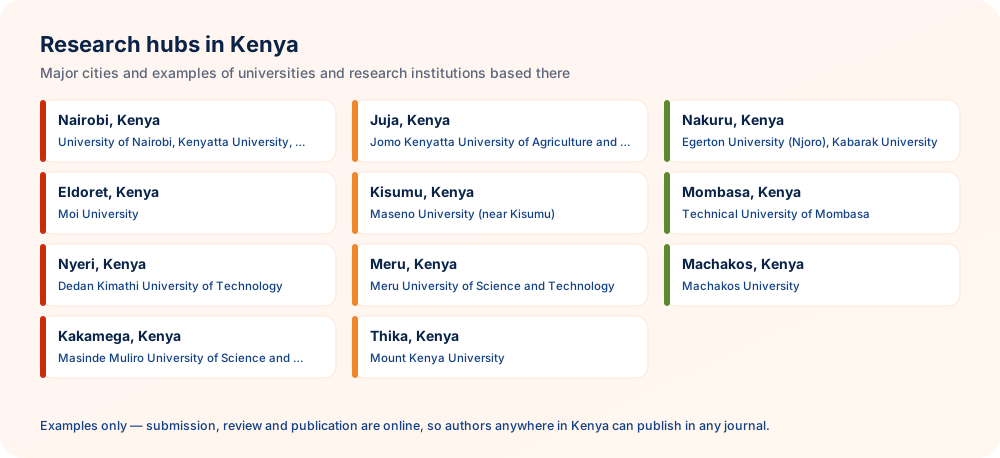
Kenya’s Main Research Hubs
Most research in Kenya clusters in Nairobi, though it also reaches university towns throughout the country. The cities below are home to leading universities and research institutes.
Picking the Right Journal
Let your own requirement, not a ready-made list, guide the choice of journal. Get written confirmation of what your university or funder accepts, shortlist journals whose recent papers resemble yours, and read their instructions for authors before touching the formatting. A backup journal saves weeks if the first one says no. Keep a note of each journal's aims and scope as you shortlist.
Fees and Affordable Options
Kenyan journals each set their own fees. University journals frequently levy modest processing or publication charges in Kenyan shillings, some levy none, and international journals may bill APCs in US dollars. Read the fee statement on the journal’s official website before you submit, and check what the fee includes. Saved copies of that statement are handy if questions arise afterwards.
Keep to three rules: pay only after a genuine acceptance with reviewer comments, pay only through the journal’s official channel, and ask about waivers. By way of comparison, JMVRA's fee for foreign authors is $41 USD, due only after acceptance and covering up to five authors.
For the full comparison method, read our guide to low-cost journal publication, whose checks work in any country, and how low-fee journals meet their costs.
Checking a Journal Step by Step
- Open the ISSN register record and check that the full title is identical.
- Confirm that every editorial board member can be traced and really works at the affiliation listed.
- Expect a named peer-review type, supported by real reviewer reports.
- Do not take an indexing claim on trust; search Scopus Sources or the Master Journal List yourself.
- Do not make any payment ahead of a genuine acceptance.
Checklist Before You Submit a Manuscript
- Venue confirmedScope, requirement and indexing looked at
- Template in useLayout, reference style and length
- Similarity clearedEvery source cited, your own publications too
- Ethics coveredApprovals and consent recorded; conflicts declared
- Author details exactNames and affiliations in the form they will appear
- Cover letter readyThe argument for placing this paper in this journal
How JMVRA suits authors based in Kenya
Based in India, JMVRA (ISSN 2984-8911) is an international open access journal covering many disciplines. It is not a Kenyan journal, but it accepts papers from authors in Kenya.
- Fee: Foreign authors, including those in Kenya, pay $41 USD; it is charged after acceptance only and includes up to 5 authors.
- Review: field experts handle a transparent double-blind peer review, and similarity must not exceed 15%.
- Access: articles are open access under CC BY 4.0, and a Crossref DOI is supplied on request.
- Indexing, honestly: Google Scholar covers us; Scopus, Web of Science and DOAJ do not.
A 12-Month Publishing Roadmap for Researchers in Kenya
| Months | Focus |
|---|---|
| 1–3 | Settle on one focused question and shortlist two or three target journals; consult national systems such as NACOSTI research licensing and university research offices, along with the international databases |
| 4–6 | Collect and analyse the data, and write straight into the template set by the journal you are targeting |
| 7–9 | Ask a supervisor or colleague for feedback, and submit to just one journal at a time |
| 10–12 | Revise in answer to the reviewers; after printing, promote your paper and update ORCID and Google Scholar |
Choosing a Language as an Author in Kenya
Researchers in Kenya work in English and Swahili. Choose the language according to who needs to read the paper.
Write in Swahili
Connects with readers, practitioners and policymakers across Kenya.
Publishing in English
Extends to readers, reviewers and indexes abroad.
Abstract in two languages
Adding an English title and abstract to a paper written in Swahili helps international readers find it.
Language editing support
Have a colleague or editor read the final version before you submit.
Practical Tips for Kenyan Authors Building a Publication Record
Kenyan researchers are often asked to show a steady record of publication for appointments and grants. These tips help you grow that record carefully, with attention to credibility and long-term visibility.
- Create and maintain a researcher profile. Register for a persistent author identifier and keep your profile up to date. It helps readers separate you from authors with similar names and gathers your outputs in one place.
- Build a pipeline of papers. Keep several manuscripts at different stages, such as drafting, under review and revising. This reduces the pressure on any single paper and keeps your output steady.
- Include policy implications honestly. For applied studies in agriculture, health or education, state practical implications without overstating them. Clear, modest recommendations are more persuasive to reviewers and to decision makers.
- Write with early-career colleagues. Pair junior staff with experienced authors and agree on tasks from the outset. Shared writing builds skills across the department and improves the quality of drafts.
- Keep copies of accepted versions. Store your accepted manuscript and follow the journal's permitted sharing rules for repositories. This protects access to your own work if a journal website later changes.
Maintain a clear author profile, keep several papers moving at once and share work only in the ways each journal permits.
Questions Researchers Often Ask
Summary and What to Do Next
Kenya’s journal scene is driven by its universities and research institutes, with a few internationally indexed titles in medicine and food science. Treat the list as a starting point, check your own requirement, confirm details at the source and submit via the journal’s own website. A short comparison table of your shortlisted journals can make the final choice easier.
- Get your institution to confirm in writing what it requires for publication.
- Build a shortlist from the table and read some recent papers from each journal.
- To verify indexing, see our Kenya-focused guide to Scopus and Web of Science journals.
- Prepare the manuscript in the journal's template and submit it through that journal's own site.
Ready to send in your paper?
Submission to JMVRA is online and free. Review always comes first; the $41 USD publication fee applies only after your paper is accepted.
Related searches
Readers in Kenya who use this guide often search as well for journal publication in Kenya, paper publication fees, Scopus and Web of Science indexed journals, high impact factor journals and affordable open access journals. The guides below cover these topics:
- Low-cost journal publication in Kenya
- High impact factor journals in Kenya
- Scopus and Web of Science journals in Kenya
- How a low-fee journal is funded
- Locating high impact factor journals
- How to choose a journal
- Checking an indexing claim yourself
- Recognising a predatory journal
- Publishing with JMVRA from outside India
- JMVRA publication charges
References and Sources
Checked on 4 October 2026. Indexing, fees and policies can change, so check them again before submitting.
- Commission for University Education
- NACOSTI
- African Journals Online
- AJFAND
- KEMRI — African Journal of Health Sciences
- University of Nairobi Journals
- JKUAT journals
- Scopus Sources
- Clarivate Master Journal List
- ISSN Portal
Getting Published From Kenya Through JMVRA
- Submit onlineSend your paper from anywhere in Kenya or elsewhere; no payment at submission
- ScreeningScope and overlap check (similarity below 15%)
- Double-blind reviewField experts review it; the decision is emailed to you
- Accepted — $41 USDOne fee that covers up to 5 authors
- PublishedOpenly available with a CC BY 4.0 licence
Details: Publication charges · Peer review · Advice for authors outside India.
Ready to Publish? Submit to JMVRA
JMVRA is aligned with UGC's Suggested Parameters for Choosing Peer-Reviewed Journals.
JMVRA is a Transparent, Peer-Reviewed, Open Access Journal (Refereed Journal). Following the discontinuation of the UGC and UGC-CARE journal listing, and in alignment with the latest UGC-CARE recommendations and guidelines, JMVRA is aligned with UGC’s Suggested Parameters for Choosing Peer-Reviewed Journals.
Related pages on jmvra.org
Key Terms
Subjects and search phrases this article addresses.
Related Reading
Further guides for Kenya-based researchers on selecting a journal.
Affordable Journal Publication in Kenya
Read the guide RelatedChoosing High-Impact Journals in Kenya
Read the guide RelatedScopus & Web of Science Journals: Kenya
Read the guide RelatedResearch Journals in Tanzania: A Verified List
Read the guide RelatedA Researcher’s Verified Guide to Journals in Nigeria
Read the guide RelatedWhat International Authors Should Know About JMVRA
Read the guide RelatedChoosing a Journal: A 7-Step Scoring Framework
Read the guideKeep Reading on the JMVRA Blog
Published on the JMVRA journal blog, this guide gives practical direction on publishing, indexing, metrics and research integrity, with a focus on what can be verified instead of on promotion.